Importing a used Volkswagen Taos from the USA
USCar Trader works as an independent intermediary.
 0049 (0)89 2000 791 00
 Mo - Fr 8:00am - 8:00pm
USCar Trader import service
Choose a specific vehicle. Where data is available, its detail page shows the import cost calculation. We assess any possible duty benefit with you before purchase.
Important: A 0% EU import-duty rate may be available for a vehicle covered by Regulation (EU) 2026/1455 that has US origin and is imported directly into the EU. CETA may apply to a vehicle with preferential Canadian origin. Whether the requirements are met is assessed for the individual case. Please contact us before purchase; we review the possible duty benefit and provide non-binding support through the process. Import VAT and other costs are assessed separately.
CarHub · Volkswagen
The Volkswagen Taos never officially reached German showrooms, which is exactly why it turns up on our desk. It is Volkswagen's smallest US crossover, slotted below the American Tiguan, and it was engineered specifically for North and South America.

Price:19,779.00 USD

Price:19,099.00 USD

Price:19,799.00 USD

Price:19,799.00 USD

Price:20,349.00 USD
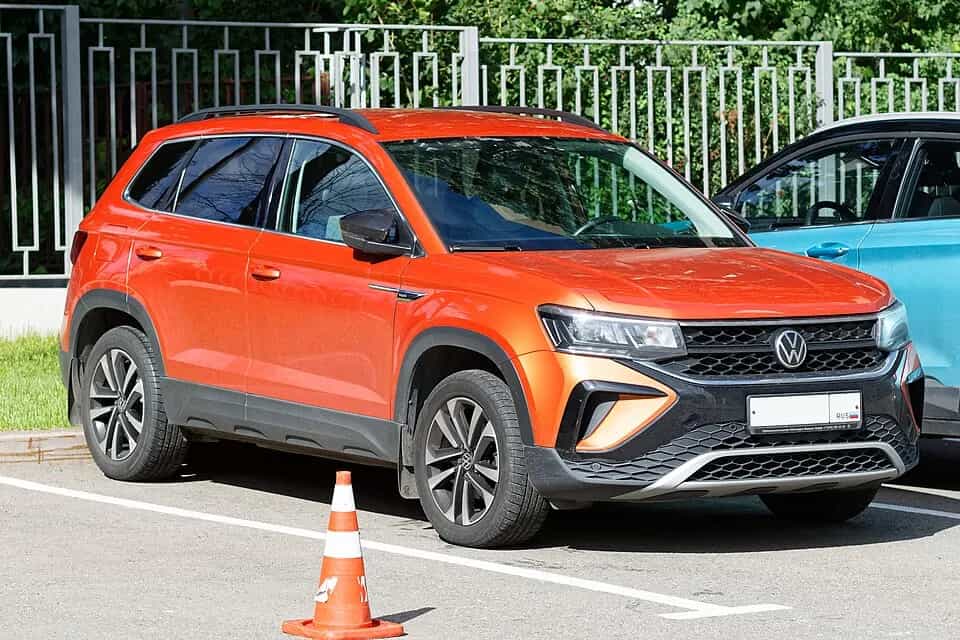
Model profile
USCar Trader works as an independent intermediary.
The Taos launched for the 2022 model year and has run as a single generation since, with a mid-cycle refresh for 2025.
Powertrain and equipment
Every US Taos uses the 1.5-litre EA211 evo turbocharged four-cylinder (TSI). In 2022–2024 form it produces 158 hp and 184 lb-ft of torque. The 2025 refresh reworked the engine to 174 hp with stronger low-end response.
The Taos is offered only as a five-door compact SUV. US trims run S, SE and SEL. The base S is deliberately simple; SE adds heated seats, blind-spot monitoring and better infotainment; SEL brings leather, a panoramic sunroof, ventilated seats and the full driver-assistance suite.
Vehicle selection
Supply is healthy.
The Taos suits a buyer who wants a compact, fuel-efficient VW SUV that Europe simply does not sell, and who values the reassurance of shared VW-group engineering.
Vehicle data
| Length | 175.8 in / 4,467 mm |
|---|---|
| Width | 72.5 in / 1,841 mm |
| Height | 64.4 in / 1,636 mm |
| Wheelbase | 105.9 in / 2,690 mm |
| Curb weight | 3,197–3,548 lb / 1,450–1,610 kg |
| Cargo (rear seats up) | 27.9–28.7 cu ft / 790–812 L |
| Engine | 1.5 L EA211 evo TSI turbo inline-4 |
|---|---|
| Power output | 158 hp (2022–24) / 174 hp (2025) |
| Torque | 184 lb-ft (approx. 250 Nm) |
| Transmission | 8-speed automatic (FWD) / 7-speed DSG (AWD, pre-2025) |
| Drivetrain | Front-wheel drive or 4Motion AWD |
| Fuel tank | approx. 47.5 L |
| Fuel type | Regular unleaded (petrol) |
| 0–60 mph | approx. 7.7–8.2 s |
|---|---|
| EPA economy | approx. 28–31 mpg combined |
Values are reproduced verbatim from the existing article table. The documents for the specific vehicle govern.
Pre-purchase review
The Taos is broadly dependable, but it has known weak points.If expressly commissioned, feasible at the vehicle location and approved by the seller, USCar Trader can arrange a driving assessment to document observable shift quality, shudder, hesitation or driveline noise; service and repair records are reviewed separately.
Germany and Europe
US-market Taos cars run amber rear turn signals in many cases but lack a rear fog lamp, use MPH-primary instruments, and carry US-spec lighting and side-marker reflectors.
Typical work includes fitting or coding a rear fog lamp, adapting the lighting to ECE standards, confirming the speedometer reads in km/h, and documenting the emissions and noise data for the file.
USCar Trader services
As a buyer based in Germany, you do not have to inspect the vehicle yourself in the United States or Canada. Within the agreed scope, USCar Trader can coordinate document review, a separately commissioned on-site inspection and purchase processing.
Covered inspection points are agreed in advance. An on-site inspection records condition at the appointment and is not a guarantee.
Next step: Before commissioning, USCar Trader and the customer agree which document, history, inspection and transaction checks suit the vehicle and are included in the service. This records what was actually checked.
Import process
The assessment depends on the specific vehicle and the circumstances of the transaction. Please contact USCar Trader before purchase; we review any possible duty benefit and provide non-binding support. Import VAT and other costs are considered separately.
Questions and answers
No. The Taos is an Americas-only model, which is precisely why buyers import a used Taos from the USA.
No, not automatically. A 0% EU import-duty rate may be available for a vehicle covered by Regulation (EU) 2026/1455 that has US origin and is imported directly into the EU. CETA may apply to a vehicle with preferential Canadian origin. Whether the requirements are met is assessed for the individual case. Please contact USCar Trader before purchase; we review the possible duty benefit and provide non-binding support. Import VAT and other costs are assessed separately.
Import VAT and other taxes or costs are assessed separately under the applicable rules and the circumstances of the individual case. A blanket answer for every vehicle would not be reliable.
Generally yes, with attention to carbon build-up and normal TSI servicing over time.
FWD cars use the smoother 8-speed automatic; 4Motion pre-refresh cars use the DSG. Choose based on your traction needs and inspect the transmission accordingly.
Clean 2022–2023 lease returns with 30,000–70,000 miles offer the best balance of price and condition.
Most mechanical parts are shared with VW-group cars and are readily available; some US-specific trim may need ordering.
From purchase to registration, typically several weeks, driven mainly by ocean freight and customs scheduling.
More vehicles