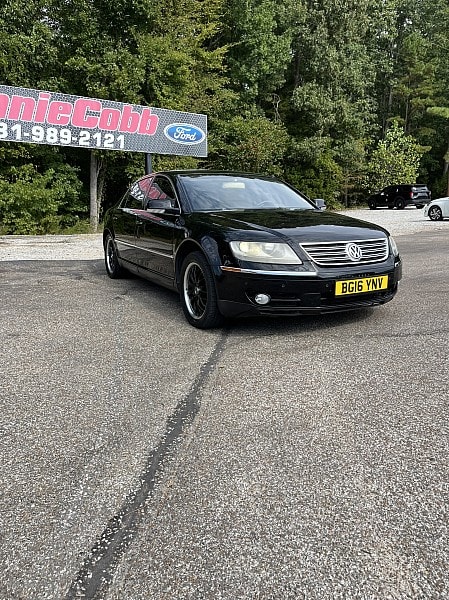
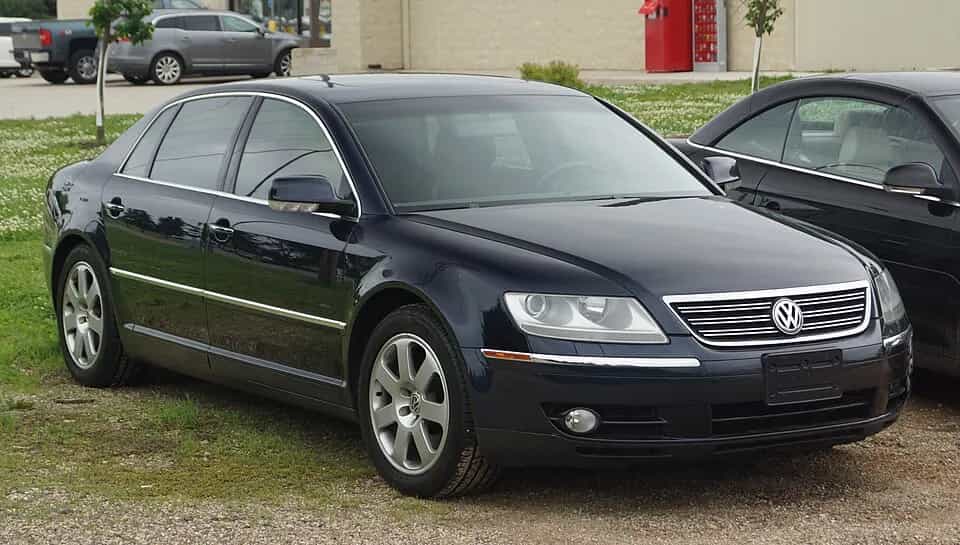
Volkswagen Phaeton
Importing a used Volkswagen Phaeton from the USA
The Phaeton is one of the most quietly ambitious cars Volkswagen ever built: a full-size luxury sedan hand-finished at the Transparent Factory in Dresden, engineered to sit alongside the Audi A8 and, in W12 form, to chase the Mercedes S-Class. It sold in tiny numbers in North America, which is precisely why the US used market is worth watching. A well-kept American Phaeton is a rare, heavily specified car, and importing one from the USA can be the most sensible way to find a clean example. Because this is a European-built model, the customs picture depends entirely on the plant of manufacture, so the VIN check comes first.

Model history and generations
The Phaeton launched globally in 2002 and reached the United States for the 2004 model year. VW offered it in America only briefly, through the 2005 and into the 2006 model year, before withdrawing it from the market due to slow sales. Every US car therefore comes from a narrow window. A mild facelift arrived internationally in 2007 and again in 2010, but those later cars were never sold new in the States, so American-market Phaetons are the early D1 generation. The car shares its platform, the VW Group D1, with the Bentley Continental Flying Spur and the first Audi A8 (D3) architecture philosophy.
Engines and drivetrain
US buyers had two engines. The headline unit is the 6.0-litre W12, a compact twelve-cylinder producing roughly 331 kW (about 444 hp) and paired with a six-speed automatic and standard 4Motion all-wheel drive. The alternative was the 4.2-litre naturally aspirated V8, around 246 kW (335 hp), also with 4Motion and a six-speed auto. Both engines are longitudinally mounted and drive through a Torsen-based permanent all-wheel-drive system. There was no diesel and no rear-drive Phaeton in the US, which simplifies the used search.
Which trim makes sense
The Phaeton came only as a four-door sedan, offered in standard and long-wheelbase forms, though the US market saw mostly the standard wheelbase. Trim was defined by equipment rather than badge: four-zone or optional five-zone climate control, ventilated and massaging front seats, a solar sunroof, and a draught-free climate system with hidden vents were signature features. Many US cars were near-fully loaded, since only well-heeled buyers ordered them in the first place.
Supply on the US market
Availability is genuinely limited. Only a few thousand Phaetons were sold in the United States, so listings appear sporadically rather than constantly. Typical survivors are 2004-2006 cars with moderate to high mileage, often cherished by enthusiasts who understood what they bought. Condition varies widely: some are pampered garage queens with full history, others have deferred maintenance on the air suspension and cooling system. A dry-state car with documented service is the target. When you import a used Phaeton from the USA, patience and a thorough history check matter more than chasing the lowest number.
Who benefits from importing
This is a car for the driver who wants understated luxury and V12 or V8 refinement without the badge premium, and who accepts that maintenance will be demanding. It suits collectors, long-distance cruisers, and enthusiasts who value engineering over image. It is not the choice for someone who wants low running costs or easy parts availability. If you know the Phaeton's quirks and still want one, a clean US car is a rewarding import.
Technical data
| Specification | Detail (US-market Phaeton) |
|---|---|
| Body style | Full-size luxury sedan, 4-door |
| Generation | D1 (US model years 2004-2006) |
| Engines | 6.0 W12 / 4.2 V8 (naturally aspirated) |
| W12 output | approx. 331 kW / 444 hp |
| V8 output | approx. 246 kW / 335 hp |
| Transmission | 6-speed automatic |
| Drivetrain | 4Motion permanent all-wheel drive |
| Suspension | 4-corner air suspension (CDC adaptive) |
| Length | approx. 5.06 m (standard wheelbase) |
| Kerb weight | approx. 2,300-2,450 kg |
| Fuel | Premium petrol |
| Seating | 4 or 5 |
| Assembly | Dresden, Germany (Transparent Factory) |
| Fuel tank | approx. 90 litres |
Known weak points and maintenance
The Phaeton is robust in its bones but expensive when it ages. The four-corner air suspension is the classic weak point: compressors, air struts and valve blocks wear, and a sagging corner or a running compressor points to a leak. The W12's cooling system, coolant pipes and secondary components are labour-intensive to reach. Both engines can develop oil leaks at the valve covers and, on higher-mileage cars, timing-chain wear on the W12 is a known concern. Electrical gremlins in the many comfort modules, and door and climate actuators, appear on neglected cars. None of this is unusual for a car of this class, but budget for specialist service; Phaeton common problems are almost always cost problems, not design flaws.
US and EU spec compared
US Phaetons run amber side markers, US-specification headlights and mph-primary instruments. Bumper mounting and lighting differ from EU homologation, and the trip computer and radio bands are US-configured. Mechanically the cars are the same, which makes conversion straightforward compared with more exotic imports.
The import process in detail
Selection comes first: identify a documented, dry-climate car. Then verify the VIN and plant of build, run a Carfax or AutoCheck report, and confirm a clean title. Payment is best handled through escrow. The car is then booked for ocean freight (container is advisable for a low, air-sprung luxury sedan), cleared through EU customs on arrival, and prepared for a TUEV individual approval (Einzelabnahme). Registration follows once the paperwork and any required modifications are complete.
What customs clearance really costs
Remember: no origin proof, no 0% duty – and 19% German import VAT is due on every import.
The Phaeton was assembled in Dresden, Germany, so it is a European-built car. That means the 0% EU import duty tied to provable US origin under Regulations (EU) 2026/1455 and 2026/1461 generally will not apply, and a car duty rate applies unless the VIN and plant documentation prove otherwise, which for a Dresden car it will not. We never promise duty-free status; the correct rate is determined from the VIN. Separately, the 19% German import VAT (Einfuhrumsatzsteuer) always applies to any US import and is calculated on the customs value plus duty and freight. USCar Trader acts only as a broker and adds no margin to these state charges.
TUEV, modifications and registration
Typical work includes converting headlights to EU beam pattern, adding a rear fog lamp, confirming the odometer reads correctly (kilometres or a documented mph unit), and verifying tyres and lighting. The Phaeton's complexity means the individual approval benefits from a workshop familiar with VW Group luxury cars.
Check before you buy
- Decode the VIN and confirm the plant and exact model year.
- Order a Carfax or AutoCheck history and read every entry.
- Confirm a clean, non-salvage title in the seller's name.
- Inspect all four air-suspension corners for sag or a constantly running compressor.
- Check the W12 or V8 cooling system, coolant pipes and for oil leaks.
- Look for rust on suspension components and underbody, favour dry-state cars.
- Test every comfort module: climate, seats, sunroof and infotainment.
Common questions
Can I import a used Volkswagen Phaeton from the USA to Germany?
Yes. As a used vehicle it is fully importable. The customs rate is set from the VIN and plant, and the 19% import VAT always applies.
Does the 0% EU import duty apply to a US Phaeton?
Usually not, because the Phaeton was built in Dresden, Germany. The 0% rate is tied to provable US origin, so the VIN check decides the correct duty.
Which engine should I look for?
The W12 is the flagship for outright refinement; the 4.2 V8 is slightly simpler to maintain. Both use 4Motion all-wheel drive.
Are parts hard to get in Europe?
Many components are shared with other VW Group cars, but Phaeton-specific parts can be pricey and occasionally slow to source.
Is the air suspension a dealbreaker?
No, but it is the main cost item. A car with recent suspension work is worth a premium over one with unknown history.
How rare are US-market cars?
Very. VW sold only a few thousand in America over two model years, so listings are infrequent.
What does TUEV approval involve?
Mainly lighting conversion, a rear fog lamp, odometer verification and a full individual technical inspection.
Is a container or roll-on shipment better?
A container is generally preferred for a low, air-sprung luxury sedan to protect the paint and ride height.
Explore more options via Volkswagen in the Carhub, compare the Volkswagen CC and the Volkswagen Jetta, or browse current Phaeton listings.