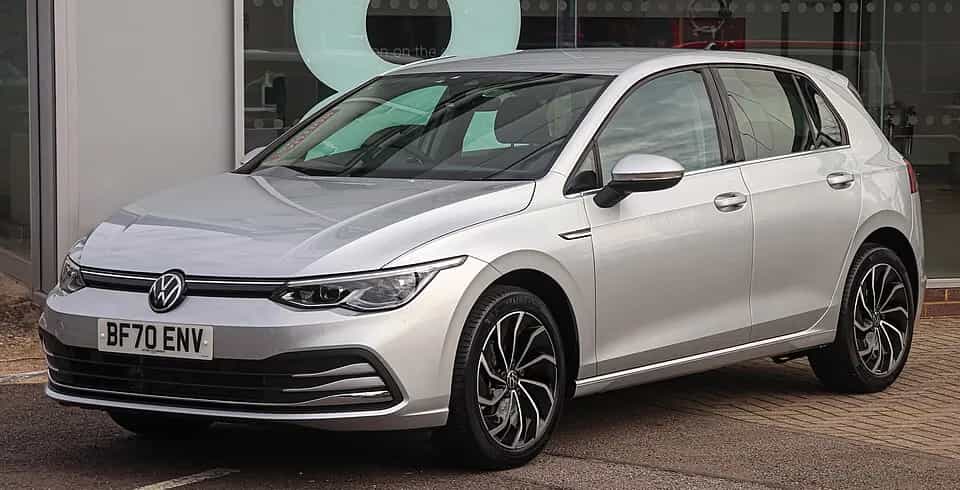
Volkswagen Golf

Importing a used Volkswagen Golf from the USA

The Golf is a German icon, yet the US-market versions carry their own distinct flavour — different engine choices, US-specific equipment, and often generous options at the price point where American buyers shopped. Importing a used Volkswagen Golf from the USA can make sense for enthusiasts chasing a particular US specification, a clean rust-free southern-state car, or simply a well-kept example at the right value. USCar Trader works purely as an independent broker for used cars: you choose the Golf, we verify and import it, without acting as a dealer and without adding a margin.

Volkswagen golf – used car imported from the USA
Photo: Vauxford · CC BY-SA 4.0 · Wikimedia Commons

Production years and key changes

The Golf has run for eight generations since 1974, but only some reached the USA in Golf form. The Mk4 (1999-2006) and Mk5 — sold there as the Rabbit (2006-2009) — were followed by the Mk6 (2010-2014) and the Mk7 (2015-2019), after which the standard Golf left the US line-up while the GTI and Golf R continued into the Mk8 era from 2022. The Mk7 is the sweet spot for importers: it introduced VW's modular MQB platform, sharper styling and a big step up in cabin quality, refinement and safety over the Mk6.

What is under the hood

US Golf engines differ from the European range. The mainstream Mk7 Golf used the 1.8-litre TSI turbo four (EA888) making around 170 hp, driving the front wheels through a 6-speed manual or a torque-converter automatic. The GTI ran the 2.0-litre TSI turbo (roughly 210-241 hp depending on year and package) with a manual or the DSG dual-clutch, while the Golf R added the higher-output 2.0 TSI (around 288-315 hp) with permanent 4Motion all-wheel drive. A 2.0 TDI diesel was sold before the 2015 emissions recall halted US diesel sales. Knowing exactly which engine and gearbox a given VIN carries is essential when you evaluate a car for import.

Trims and body styles

US Golfs were offered mainly as five-door hatchbacks, with the SportWagen estate and the raised Alltrack broadening the Mk7 range. Trim walk-ups such as S, SE and SEL added wheels, infotainment, leatherette and driver assistance. The GTI carried its own S, SE and Autobahn ladder, and the Golf R sat at the top. For an import, body style and drivetrain — hatch versus wagon, front-wheel drive versus 4Motion — shape the decision more than trim badges.

What the US market offers

Golfs are common on the US used market, and cars from dry southern and western states are especially attractive for their rust-free undersides. Typical examples span low to moderate mileage; the Mk7 in particular is plentiful and well supported. The best imports are single-owner cars with documented service, factory-standard or lightly modified, and free of the neglect that can afflict cheaper turbocharged hatchbacks.

Who this import is for

A used Golf suits the buyer who wants a refined, practical, fun-to-drive compact with a strong parts and specialist network, and who has a specific reason — spec, condition or value — to source it from the USA rather than locally. GTI and Golf R hunters after a particular US-market configuration are natural candidates. Buyers who simply want any Golf may find local European cars simpler; the import route pays off when the exact car you want is Stateside.

Technical data and figures

AttributeDetail (US-spec, Mk7 focus)
Body styles5-door hatchback; SportWagen estate; Alltrack
PlatformMQB (Mk7)
Base engine1.8 L TSI turbo (EA888), ~170 hp
GTI engine2.0 L TSI turbo, ~210-241 hp
Golf R engine2.0 L TSI turbo, ~288-315 hp
Diesel (pre-2015)2.0 L TDI
Transmissions6-speed manual, torque-converter auto, DSG
DrivetrainFront-wheel drive; 4Motion AWD (Golf R, Alltrack)
FuelPetrol (mostly); diesel pre-2015
Seating5
Length (Mk7 hatch)approx. 168 in (~4,255 mm)
US model years (Golf)Mk4-Mk7; GTI/R continue
TimingChain (EA888)
AssemblyMexico or Germany (verify by VIN)
OriginNon-US build (verify by VIN/plant)

Reliability: trouble spots to check

The Mk7 Golf is generally reliable, but the EA888 turbo engines have known watch-points. Early units could suffer timing-chain tensioner wear, so confirm this was addressed; the plastic water pump and thermostat housing are common failure items; and direct injection leads to intake-valve carbon build-up over high mileage, sometimes needing a walnut-blast clean. DSG gearboxes are durable when the mechatronic and clutch-pack fluid services are done on schedule — check the records. Also inspect for oil consumption on harder-driven GTI and R cars, PCV/breather issues, and the usual electrical niggles. A Golf with full service history and evidence of the tensioner and water-pump work is a much safer buy than a cheap example with gaps.

US vs. Europe differences

US Golfs read in mph, lack a rear fog lamp, and use US lighting and DRL setups that must be adapted for German approval. Engine and equipment specifications differ from European cars — the US 1.8 TSI base engine, for instance, was not the mainstream European unit. Infotainment mapping and radio bands may need European reconfiguration. Because the Golf was sold in Europe, parts and specialist knowledge are excellent, which eases both the TUEV process and later ownership.

How the import works

Selection: you pick the Golf; we appraise it. VIN and origin check: the plant code establishes assembly location (Mexico or Germany) and exact build. Escrow: funds held until the car is verified. Ocean freight: container or RoRo to a German port. Customs clearance: duty and import VAT declared. TUEV / individual approval: inspection and modifications. Registration: German plates issued.

Import duty, VAT and fees

Remember: no origin proof, no 0% duty – and 19% German import VAT is due on every import.

Duty and VAT are charged separately. The 0% EU import duty under Regulations (EU) 2026/1455 and 2026/1461 applies only where the VIN proves US origin and the car ships directly within the window to 31 December 2029. US-market Golfs are typically assembled in Mexico or Germany, so they will not usually meet the US-origin test — in that case the standard EU passenger-car customs rate, currently 10%, applies. On top of duty, the 19% German import VAT (Einfuhrumsatzsteuer) is always due on the customs value plus duty. We never add a margin; the figures are the genuine charges.

From modifications to registration

Expect to fit a rear fog lamp, adapt or replace the headlights and side markers to European standards, convert or document the speedometer, and record the odometer in kilometres. Any aftermarket suspension, wheels or lighting must be individually approved. Emissions verification is straightforward on a car derived from a European model, but a US diesel needs its post-recall status confirmed.

Pre-buy inspection points

Match the VIN to the title and car; obtain a Carfax or AutoCheck report for accidents and title brands; confirm the exact engine and gearbox; verify service history including timing-chain tensioner, water pump and DSG fluid work; inspect for oil consumption and carbon build-up on higher-mileage cars; check for rust on non-southern cars; and ensure a clean, lien-free title.

What buyers ask most

Can I import a used VW Golf from the USA to Germany?

Yes. As an independent broker we source the US Golf you select and handle shipping, customs and German registration.

Does a US Golf get 0% import duty?

Usually not, because US Golfs are built in Mexico or Germany rather than the USA. Without provable US origin, the standard EU car duty (currently 10%) applies.

Is import VAT always payable?

Yes. The 19% German import VAT applies to every used-car import, separately from any customs duty.

Which US Golf is the best import?

The Mk7 is the sweet spot for refinement and support; enthusiasts often target a specific US-market GTI or Golf R configuration.

Are US Golfs reliable?

Broadly yes, especially the Mk7, provided the EA888 tensioner and water-pump items and DSG services have been kept up.

What are the common problems?

Timing-chain tensioner wear on early engines, water-pump failure, intake carbon build-up and oil use on hard-driven cars.

What about US diesel Golfs?

TDI diesels were sold before the 2015 emissions recall; confirm the post-recall status before importing one.

How long does importing take?

Typically a couple of months from purchase to registration, including shipping, clearance and approval.

Browse more from Volkswagen in the Carhub, compare the hotter Volkswagen Golf GTI and the practical Volkswagen Golf SportWagen, or browse current Golf listings.