Importing a used Volkswagen Eos from the USA
For buyers researching how to import a used Volkswagen Eos from the USA, the appeal is a well-preserved, often low-mileage cabriolet at a time when Europe's own Eos supply is thinning out.
 0049 (0)89 2000 791 00
 Mo - Fr 8:00am - 8:00pm
USCar Trader import service
Choose a specific vehicle. Where data is available, its detail page shows the import cost calculation. We assess any possible duty benefit with you before purchase.
Important: A 0% EU import-duty rate may be available for a vehicle covered by Regulation (EU) 2026/1455 that has US origin and is imported directly into the EU. CETA may apply to a vehicle with preferential Canadian origin. Whether the requirements are met is assessed for the individual case. Please contact us before purchase; we review the possible duty benefit and provide non-binding support through the process. Import VAT and other costs are assessed separately.
CarHub · Volkswagen
The Volkswagen Eos occupies a niche almost nobody else tried to fill: a compact four-seat coupé-cabriolet with a folding steel roof that also hides a full sliding glass sunroof.

Price:6,376.00 USD
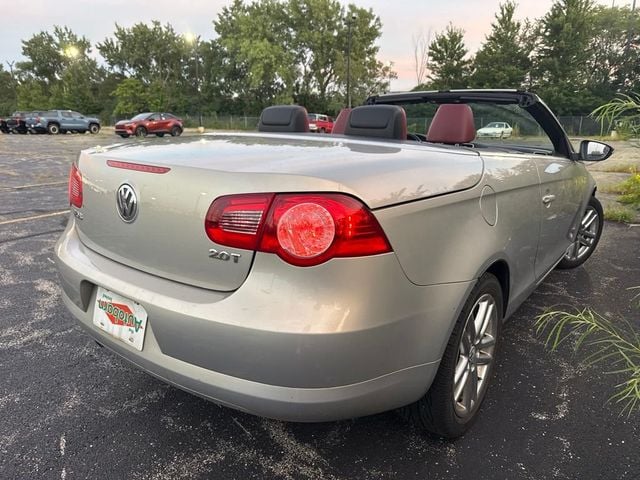
Price:7,162.00 USD

Price:8,950.00 USD

Price:5,811.00 USD

Price:12,993.00 USD
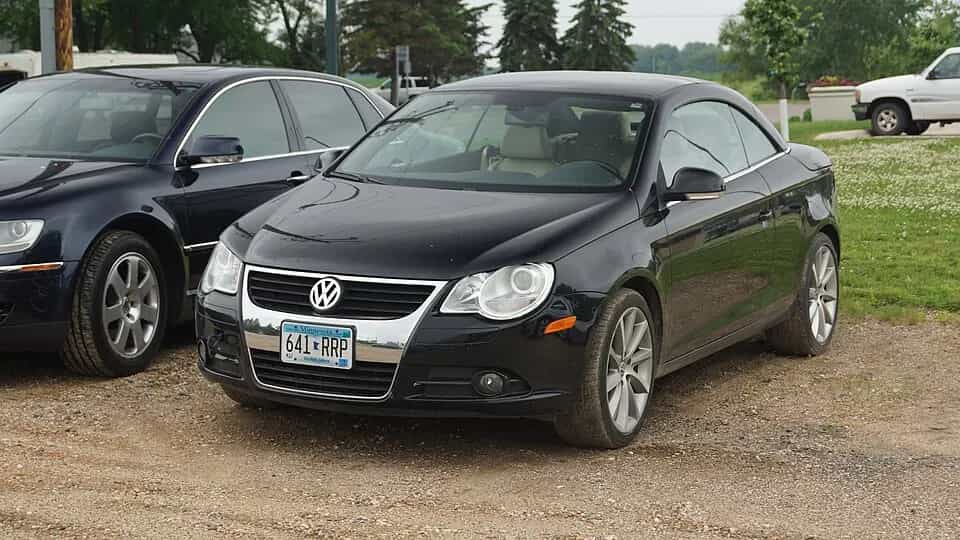
Model profile
For buyers researching how to import a used Volkswagen Eos from the USA, the appeal is a well-preserved, often low-mileage cabriolet at a time when Europe's own Eos supply is thinning out.
The Eos was a single generation with a long run, reaching US showrooms as a 2007 model and remaining on sale through 2016.
Powertrain and equipment
Early US cars were offered with VW's 3.2-liter VR6 producing around 250 horsepower, but the volume engine quickly became the 2.0-liter turbocharged four. Initial 2.0T (EA113) cars made about 200 hp; the later 2.0 TSI (EA888) versions produced roughly 200–211 hp with strong mid-range torque.
The Eos existed only as a two-door retractable-hardtop convertible. US trim names shifted over the years but broadly ran from a base car up through Komfort, Lux, Sport and the well-equipped Executive and Final Edition.
Vehicle selection
Eos supply in the States is concentrated in warm-weather regions, which is good news for corrosion.
The Eos suits a buyer who wants open-air motoring with the security and refinement of a solid roof, in a compact package that still seats four at a pinch.
Vehicle data
| Body style | Detail (US-market Eos): 2-door retractable hardtop convertible |
|---|---|
| Seating | Detail (US-market Eos): 4 |
| Length | Detail (US-market Eos): approx. 4,415 mm |
| Curb weight | Detail (US-market Eos): approx. 1,540–1,650 kg |
| Base engine | Detail (US-market Eos): 2.0L turbo inline-4 (TSI) |
|---|---|
| Power (2.0T) | Detail (US-market Eos): approx. 200–211 hp |
| Optional engine (early) | Detail (US-market Eos): 3.2L VR6, approx. 250 hp |
| Transmission | Detail (US-market Eos): 6-speed manual or 6-speed DSG |
| Drivetrain | Detail (US-market Eos): Front-wheel drive |
| Fuel | Detail (US-market Eos): Premium unleaded |
| Fuel tank | Detail (US-market Eos): approx. 55 L |
| Production years (US) | Detail (US-market Eos): 2007–2016 |
|---|---|
| Platform | Detail (US-market Eos): VW PQ35 (Golf/Jetta) |
| Roof | Detail (US-market Eos): CSC 5-piece folding hardtop with sunroof |
| Typical US mileage | Detail (US-market Eos): often low for age |
Values are reproduced verbatim from the existing article table. The documents for the specific vehicle govern.
Pre-purchase review
Eos reliability is defined by two areas: the roof and the engine. The CSC roof is intricate, and the most common Eos problems are water leaks caused by clogged or misaligned drain channels, worn seals, or a failing hydraulic pump and microswitches. Regular cleaning of the drains and periodic lubrication of the seals prevent most of it.
Germany and Europe
American Eos cars carry US lighting (amber side markers, differing rear signal colours), miles-per-hour instruments and US-spec infotainment.
US-market headlights use the FMVSS/SAE beam pattern, which differs from the ECE pattern required in the EU, so they may need adjustment or replacement with ECE-compliant units for registration.
USCar Trader services
As a buyer based in Germany, you do not have to inspect the vehicle yourself in the United States or Canada. Within the agreed scope, USCar Trader can coordinate document review, a separately commissioned on-site inspection and purchase processing.
Covered inspection points are agreed in advance. An on-site inspection records condition at the appointment and is not a guarantee.
Next step: Before commissioning, USCar Trader and the customer agree which document, history, inspection and transaction checks suit the vehicle and are included in the service. This records what was actually checked.
Import process
The assessment depends on the specific vehicle and the circumstances of the transaction. Please contact USCar Trader before purchase; we review any possible duty benefit and provide non-binding support. Import VAT and other costs are considered separately.
Questions and answers
It is a five-piece folding steel hardtop that also incorporates a sliding glass sunroof, so the car works as a coupé, a sunroof coupé or a full convertible.
The 2.0 TSI turbo four with the DSG is the most common and practical combination; the early 3.2 VR6 is rarer and thirstier.
No, not automatically. A 0% EU import-duty rate may be available for a vehicle covered by Regulation (EU) 2026/1455 that has US origin and is imported directly into the EU. CETA may apply to a vehicle with preferential Canadian origin. Whether the requirements are met is assessed for the individual case. Please contact USCar Trader before purchase; we review the possible duty benefit and provide non-binding support. Import VAT and other costs are assessed separately.
Roof-related water leaks from blocked drains or worn seals; regular maintenance prevents the majority of them.
Yes. The Eos shares extensive mechanical parts with the contemporary Golf and Jetta, so servicing is straightforward.
Import VAT and other taxes or costs are assessed separately under the applicable rules and the circumstances of the individual case. A blanket answer for every vehicle would not be reliable.
It is durable when the mechatronic fluid service is done on schedule; skipped services are the usual cause of trouble.
Yes, as an independent broker we handle selection, escrow, shipping, customs and TÜV, without being the selling dealer.
More vehicles