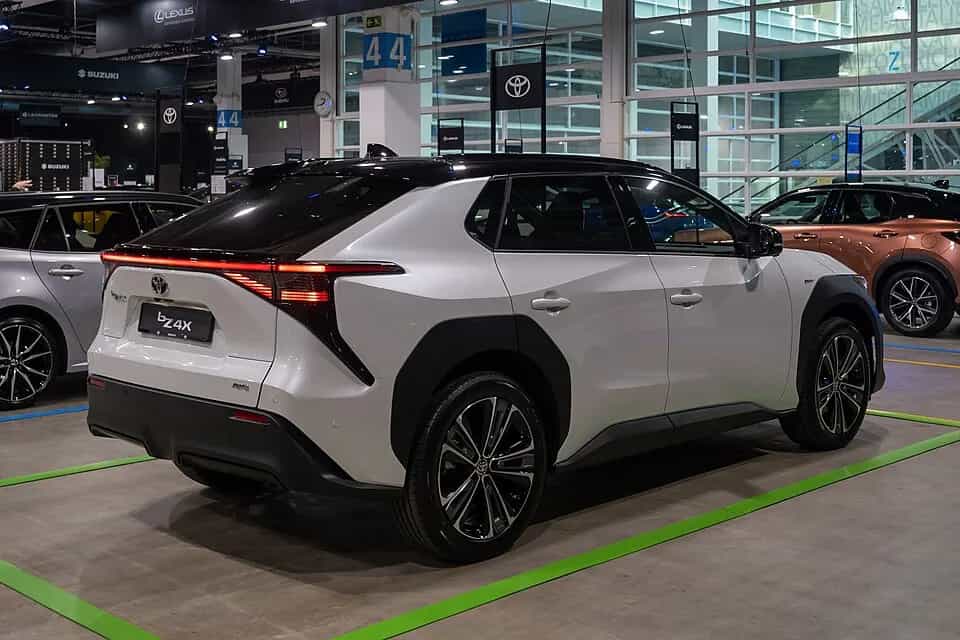
Toyota bZ
Importing a used Toyota bZ from the USA
The Toyota bZ is the core of Toyota's dedicated battery-electric line — the model that carried the awkward bZ4X badge for its first years before Toyota simplified the name to plain bZ for the 2026 refresh. In the American market it competes directly with the Volkswagen ID.4, the Hyundai IONIQ 5 and the Ford Mustang Mach-E, and because US fleet and lease returns move quickly, a two- to three-year-old bZ is one of the more attainable ways to put a modern electric crossover on German plates. USCar Trader handles that route as an independent broker: we source, verify and clear the car, but we never carry inventory or a manufacturer franchise. Below is what actually matters when you import a used Toyota bZ from the USA.

Model history: years and generations
The nameplate arrived for the 2023 model year as the bZ4X, Toyota's first vehicle on the e-TNGA electric platform co-developed with Subaru (which sells the near-identical Solterra). Early cars are remembered less for their driving and more for the 2022 wheel-hub recall that briefly halted deliveries. Toyota worked through that, and the 2024 and 2025 cars settled into a steady, if unspectacular, groove. For 2026 the car was heavily updated: the name became simply bZ, the front fascia was reworked, a native NACS charging port replaced the CCS1 socket, battery pre-conditioning was added, and the usable capacity grew. On the US used market you will therefore find two clearly different animals — the 2023–2025 bZ4X and the reworked 2026 bZ — so read the model year and the window sticker carefully before you commit.
Engines, transmissions and drive
Every bZ is electric, so "engine" means motor and battery. Front-wheel-drive cars use a single permanent-magnet motor rated around 150 kW (about 201 hp on early FWD versions, closer to 168 hp on the base 2026 pack). The all-wheel-drive layout adds a second motor on the rear axle; early XLE/Limited AWD cars produced roughly 214 hp, while the 2026 dual-motor tune climbs to about 338 hp. Battery capacity on 2023–2025 cars is 71.4 kWh gross (around 63.4 kWh usable on FWD), and 2026 cars adopt a larger pack for meaningfully better range. All versions drive through a single-speed reduction gear. The AWD system, marketed as X-MODE on higher trims, is genuinely useful on snow and light gravel, though this is a crossover and not an off-roader.
Equipment lines and body styles
The bZ is sold only as a five-door, five-seat crossover — there is no coupe, no long-wheelbase and no pickup variant. US trims run from the base XLE up through the better-equipped Limited, with the AWD option available on most. Standard kit includes a large central touchscreen, Toyota Safety Sense, adaptive cruise and, on higher grades, a heat pump, radiant leg heaters, a panoramic roof and synthetic-leather seating. A quirk worth knowing: some early bZ4X cars shipped without a 120V/240V AC home-charging cable in the box and relied heavily on the touchscreen for climate control.
The US used market
Supply is healthy. The bZ4X sold in reasonable numbers to US lease and fleet buyers, and those cars are now flowing back into the used channel with typical odometer readings between 15,000 and 50,000 miles for 2023–2024 examples. Condition is generally good — these are suburban commuter cars, not abused trucks — but battery state-of-health and charging history matter far more than paint. Look for cars from dry-climate states to avoid road-salt corrosion, and always confirm the car has the correct charge port for the infrastructure you plan to use.
Is an import right for you?
A used bZ suits a buyer who wants a quiet, well-built electric family crossover with Toyota's reputation for durable electronics, and who values proven reliability over headline range figures. It is a sensible import for someone comparing it against a used IONIQ 5 or Mach-E and who prefers Toyota's conservative engineering. Because the bZ's real-world range is competitive rather than class-leading, it fits daily commuting and regional trips better than constant long-haul autobahn use.
Specs at a glance
| Attribute | Typical figure (2023–2025 bZ4X / 2026 bZ) |
|---|---|
| Body style | 5-door electric crossover SUV |
| Seats | 5 |
| Drivetrain | FWD single-motor or AWD dual-motor |
| Power (FWD) | approx. 168–201 hp |
| Power (AWD) | approx. 214–338 hp |
| Battery (gross) | 71.4 kWh (2023–2025); larger pack for 2026 |
| Usable capacity (FWD) | approx. 63.4 kWh (early cars) |
| Transmission | Single-speed reduction gear |
| DC fast charging | CCS1 (2023–2025) / NACS (2026) |
| 0–100 km/h | approx. 6.5–7.5 s (AWD) / ~7.5 s (FWD) |
| Length | approx. 4,690 mm |
| Wheelbase | approx. 2,850 mm |
| Kerb weight | approx. 1,930–2,020 kg |
| Fuel type | Electric (BEV) |
| Origin | Assembled in Japan (Motomachi) — confirm plant by VIN |
Common issues buyers should know
Toyota bZ reliability is, on balance, strong for a first-generation EV, but there are known weak points. The headline issue was the 2022 recall covering hub bolts that could loosen and allow a wheel to detach — any car you import must show that campaign completed. Owners of 2023 cars also report DC fast-charging that is slower than the spec sheet suggests, especially in cold weather on pre-2026 cars that lacked battery pre-conditioning. Software glitches with the infotainment and the 12V auxiliary battery draining on cars left parked for long periods are the other recurring bZ common problems. Mechanically the drivetrain has been dependable. Have the battery state-of-health read out via the diagnostic port before purchase; a healthy pack is the single most valuable thing you can verify.
Differences from the European version
US-market bZ4X cars use the CCS1 (Combo 1) inlet, not the CCS2 (Combo 2) plug used across Europe, and 2026 cars use NACS. Neither matches European public chargers without an adapter, so plan your charging solution before the car lands. US cars also run amber-only rear turn signals in some cases, headlamps aimed for right-hand traffic, and miles-based instrumentation. The infotainment is configured for US navigation and radio bands. None of these are showstoppers, but each is a line item at TÜV time.
Import step by step
The process is methodical. First, selection — we identify a suitable bZ or bZ4X at a US auction or dealer. Second, a VIN and origin check to establish the assembly plant, options and clean history. Third, secure payment through escrow so funds are only released against the title. Fourth, ocean freight in a container or RoRo vessel to Bremerhaven or a comparable port. Fifth, EU customs clearance on arrival. Sixth, technical inspection and individual approval (Einzelabnahme) at TÜV or DEKRA. Finally, registration at your local Zulassungsstelle.
Customs and taxes: what applies
In short: the 0% duty rate applies only with documented US origin (VIN/plant) – German import VAT of 19% is always due.
Two separate charges apply and we always state them separately. The import duty depends on the car's actual origin: the bZ4X is assembled in Japan, so it does not automatically qualify for the 0% rate reserved for provably US-built vehicles under Regulations (EU) 2026/1455 and 2026/1461. The applicable third-country passenger-car rate then applies unless the VIN proves a US plant. On top of the customs value, the German import VAT (Einfuhrumsatzsteuer) of 19% is charged in every case, without exception. USCar Trader adds no hidden margin on either figure; you pay the authorities directly and our fee is transparent.
Modifications and single-vehicle approval
Typical work for TÜV approval on a bZ includes fitting or coding a compliant rear fog lamp, adjusting or replacing headlamps for left-hand traffic, converting the odometer reading to kilometres, and confirming the tyre and rim combination is homologated. Because the car is electric there is no exhaust or emissions retrofit, which simplifies the individual approval compared with a combustion import. A charging adapter or a coding change for the CCS2 network is a practical rather than a legal requirement.
What to verify before buying
Before you commit to any used bZ, confirm the following: the 17-digit VIN matches the title and the door label; the Carfax or AutoCheck report is clean with no salvage, flood or total-loss branding; the hub-bolt and any other open recalls are completed; the battery state-of-health has been read and is above roughly 90%; the underbody and suspension show no road-salt corrosion; the title is a clean US title, not a rebuilt or bonded title; and the charge port type matches your plan for Europe.
Common questions
Is the Toyota bZ the same car as the bZ4X?
Yes and no. The 2026 bZ is the renamed and updated successor to the 2023–2025 bZ4X on the same platform. Older cars wear the bZ4X badge; newer ones say bZ.
Will a used bZ qualify for 0% EU import duty?
Not automatically. The 0% rate applies only to vehicles with provable US origin. The bZ4X is built in Japan, so its VIN normally points away from a US plant and the standard duty applies.
Does the 19% import VAT always apply?
Yes. The German Einfuhrumsatzsteuer of 19% is charged on every import regardless of the car's origin or the customs duty rate.
Can I fast-charge a US bZ in Europe?
Only with an adapter. US cars use CCS1 or NACS, not the CCS2 standard on European public chargers, so plan your charging hardware in advance.
What mileage is normal on an imported bZ4X?
Two- to three-year-old cars commonly show between 15,000 and 50,000 miles, reflecting their life as US lease and commuter vehicles.
How long does the whole import take?
From purchase to German registration, expect roughly eight to twelve weeks, driven mainly by shipping schedules and TÜV appointment availability.
What is the biggest thing to check before buying?
Battery state-of-health. A verified healthy pack matters far more than cosmetics on an electric car.
Is USCar Trader a Toyota dealer?
No. We are an independent broker and intermediary for used US vehicles, with no manufacturer partnership and no dealer margin.
Ready to start? Browse Toyota in the Carhub, compare closely related electric Toyotas such as the Toyota bZ4X and the Toyota bZ Woodland, or view current bZ listings.