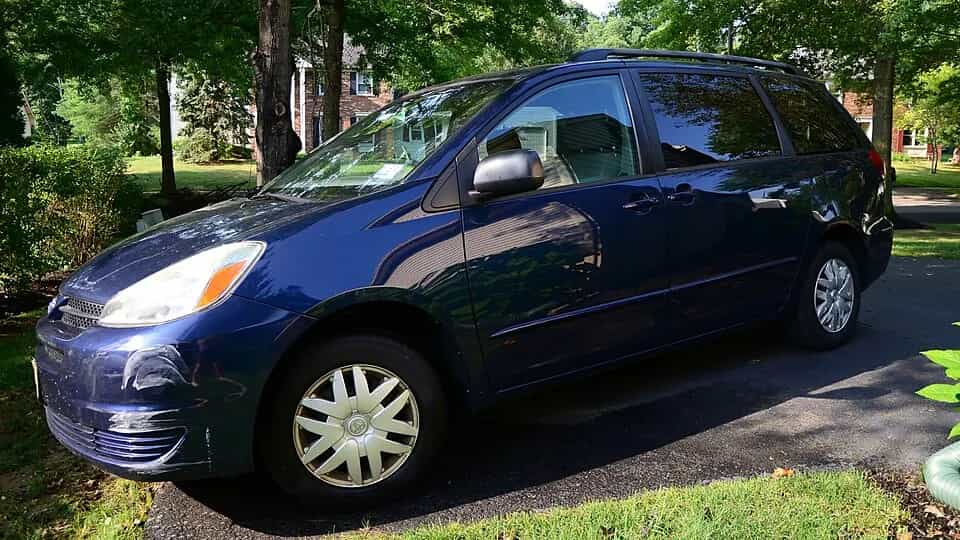
Toyota Sienna

Importing a used Toyota Sienna from the USA

The Toyota Sienna is one of the few genuine full-size minivans left on the road, and the US market has always been its home turf. For a German or EU buyer, importing a used Sienna means access to a body style that Toyota never sold in Europe in meaningful numbers — a spacious, seven- or eight-seat people-mover built around comfort, sliding doors and long-distance touring. USCar Trader acts purely as an independent broker in that process; we do not sell new cars and hold no manufacturer franchise. The point of this page is to give you the real technical and practical background before you commit to importing a used Sienna from the USA.

Toyota Sienna – used car imported from the USA
Photo: slgckgc · CC BY 2.0 · Wikimedia Commons

From launch to today

The Sienna nameplate has run since 1997, but the two generations that matter most for import today are the third generation (XL30, 2011–2020) and the fourth generation (XL40, from 2021). The third-gen car was a conventional minivan offered with V6 power and, unusually for its class, an available all-wheel-drive system. The fourth generation broke sharply with the past: from 2021 Toyota made the Sienna hybrid-only, dropping the V6 entirely. If you want a used Sienna with a normal petrol V6, you are shopping the 2011–2020 cars; if you want the modern hybrid drivetrain, you are looking at 2021 and newer.

Engines and drivetrain in detail

Third-generation Siennas use the 3.5-litre 2GR-FE (and later 2GR-FKS) V6 producing roughly 266–296 hp depending on year, paired with a conventional automatic — a six-speed on early cars, an eight-speed on the facelifted 2017-onward models. The fourth generation runs Toyota's 2.5-litre four-cylinder hybrid system (the A25A-FXS engine plus electric motors), with combined output around 245 hp and a planetary eCVT. Front-wheel drive is standard across the board; electronic all-wheel drive is optional and, in the hybrid, is provided by a separate rear electric motor rather than a driveshaft.

Trim levels and variants

The Sienna is sold only as a minivan, but the trim ladder is wide: LE, XLE, SE and Limited on older cars, expanding to LE, XLE, XSE, Limited and Platinum on the current generation. Higher trims add leather, a panoramic roof, a built-in vacuum, rear-seat entertainment and captain's chairs with ottoman-style leg support. Seating is typically seven (with second-row captain's chairs) or eight (with a second-row bench).

Used availability in the USA

Supply is deep. The Sienna sold in large numbers as a family and fleet vehicle, so used examples across every generation are widely available at auction and through US dealers. Expect the typical family-van profile: mid-to-high mileage on the V6 cars, cleaner low-mileage examples among the newer hybrids. Southern and western states tend to offer rust-free bodies, which matters for a van that will face German TÜV scrutiny. Condition varies enormously with how the van was used — a one-owner suburban family car is a very different animal from an ex-rideshare or airport-shuttle unit.

When importing makes sense

A used Sienna makes sense for large families, small businesses and anyone who wants comfortable seven-seat capacity without stepping into a commercial van. The hybrid is genuinely economical for its size, and the AWD option gives it all-season ability that European MPVs rarely matched. If you specifically want the sliding-door minivan format with Toyota running gear, importing one is often the only way to get it in the configuration you want.

Facts and figures

AttributeTypical figure (generation-dependent)
Body styleMinivan, 5-door
Seating7 or 8
Engine (3rd gen)3.5 L V6 (2GR-FE / 2GR-FKS)
Engine (4th gen)2.5 L four-cylinder hybrid (A25A-FXS)
Power (V6)approx. 266–296 hp
Power (hybrid)approx. 245 hp combined
Transmission6/8-speed automatic (V6) or eCVT (hybrid)
DriveFWD, optional AWD
Lengthapprox. 5.17 m
Wheelbaseapprox. 3.06 m
Kerb weightapprox. 1,950–2,150 kg
Fuel (hybrid)approx. 6.5–7 L/100 km real-world
Towingup to approx. 1,585 kg
Fuel typePetrol / petrol-hybrid
OriginAssembled in Princeton, Indiana (USA)

Reliability and common problems

The Sienna's reputation for durability is well earned, but there are known weak points. On the V6 cars, watch for oil consumption on higher-mileage 2GR engines, occasional VVT-i rattle on cold start, and power sliding-door mechanisms that fail — cable and motor issues are the classic Sienna complaint. Some third-gen cars had dashboard cracking in hot climates. On the hybrid fourth generation, the drivetrain has proven robust so far, though a few owners have reported infotainment glitches and the usual electric water-pump attention on ageing hybrids. Brakes and suspension bushings wear as you would expect on a heavy family van. A documented service history is the single best predictor of a trouble-free import.

How US versions differ

The Sienna was engineered for North America, so expect US-spec lighting (amber-free rear indicators on some years, no rear fog lamp), miles-per-hour instrumentation, and DOT rather than ECE glazing. Infotainment runs US navigation data and the radio tuner is set to the American band plan. None of this is a barrier to registration, but each item becomes a line on the TÜV list.

From US purchase to registration

The process runs in a clear order: select the vehicle and confirm the exact configuration; run a VIN and origin check to establish the plant of build; secure payment through escrow rather than a direct wire; arrange ocean freight (usually container or RoRo from a US port to Bremerhaven or Rotterdam); clear German customs on arrival; present the van for TÜV and individual approval (Einzelabnahme where needed); and finally register it with your local authority.

Costs, duty and taxes at a glance

Key point: duty depends on the plant of build; only a VIN check secures the 0% rate. Import VAT of 19% applies regardless.

Two separate charges apply. First, the import duty: the standard EU rate for passenger cars is 10%, but a 0% preferential rate can apply where US origin is provable via VIN and plant, under Regulations (EU) 2026/1455 and 2026/1461 (in force since 1 July 2026, for direct transport, until 31 December 2029). The Sienna is assembled in Indiana, which often supports a US-origin claim — but this must be verified per VIN, never assumed. Second, and always, the 19% German import VAT (Einfuhrumsatzsteuer) is levied on the customs value. We quote these transparently and add no margin.

TÜV, approval and license plates

Typical work includes converting or adding rear fog lamps, adapting headlights to ECE beam pattern, confirming the speedometer reads in km/h, and documenting the odometer reading in the vehicle papers. Once TÜV issues the approval, registration proceeds as with any imported car.

Pre-purchase checklist

  • Decode the VIN and confirm the build plant for origin.
  • Pull a full Carfax or AutoCheck history for accidents and title events.
  • Inspect underbody and door sills for rust, especially on northern-state cars.
  • Test both power sliding doors through a full cycle.
  • Check service records for hybrid battery and transmission care.
  • Confirm the title is clean, not salvage or rebuilt.
  • Verify all seats, tracks and folding mechanisms operate.

Import FAQ

Is the Toyota Sienna available with all-wheel drive?

Yes. AWD has been an option across several generations and is standard-available on the current hybrid via a separate rear electric motor.

Can I still import a V6 Sienna?

Yes, by buying a 2011–2020 model. From 2021 the Sienna became hybrid-only.

Does the 0% import duty apply to the Sienna?

It can, because the Sienna is US-assembled, but only with provable US origin per VIN. The 19% import VAT always applies regardless.

How many seats does it have?

Seven or eight, depending on whether it has second-row captain's chairs or a bench.

Is the Sienna reliable enough to import?

Generally yes; the main watch items are power sliding-door mechanisms and oil use on older V6 engines. Service history matters.

Will it pass German TÜV?

Yes, after the usual lighting and documentation adjustments handled during individual approval.

How is it shipped from the USA?

By container or RoRo from a US port to a northern European port, followed by customs clearance.

Explore the full Toyota in the Carhub, compare it with the Highlander or the larger Grand Highlander, and browse current Sienna listings.