Production years and key changes
The second generation (2008 to 2022, code XK60) is the one most people picture: a huge, softly sprung V8 hauler that stayed on sale almost unchanged for well over a decade, which makes parts and knowledge plentiful.
 0049 (0)89 2000 791 00
 Mo - Fr 8:00am - 8:00pm
USCar Trader import service
Choose a specific vehicle. Where data is available, its detail page shows the import cost calculation. We assess any possible duty benefit with you before purchase.
Important: A 0% EU import-duty rate may be available for a vehicle covered by Regulation (EU) 2026/1455 that has US origin and is imported directly into the EU. CETA may apply to a vehicle with preferential Canadian origin. Whether the requirements are met is assessed for the individual case. Please contact us before purchase; we review the possible duty benefit and provide non-binding support through the process. Import VAT and other costs are assessed separately.
CarHub · Toyota
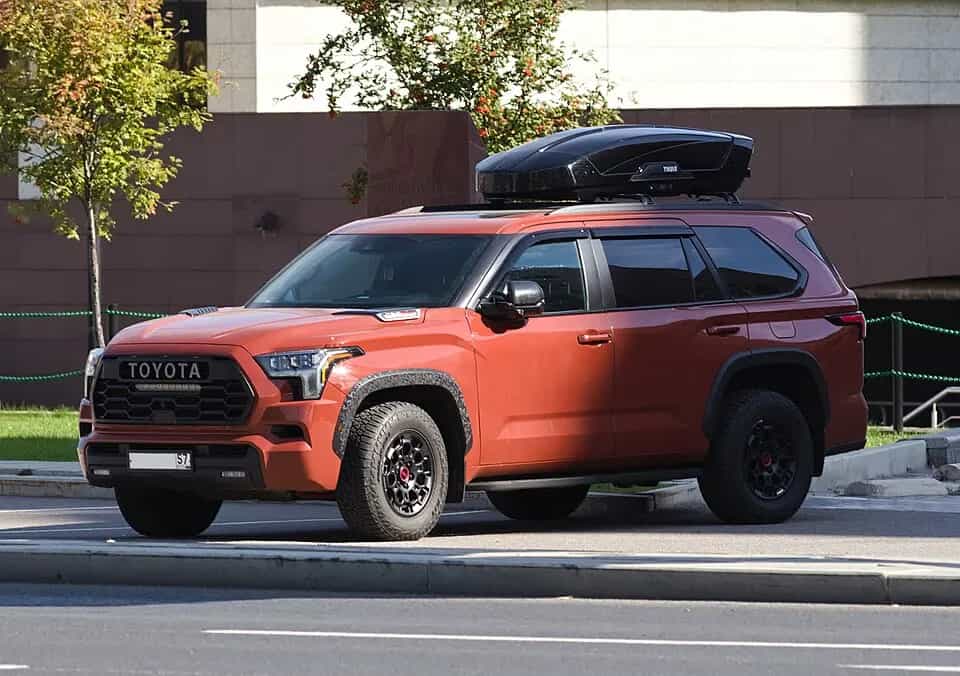
The Sequoia is Toyota's full-size, body-on-frame SUV — the three-row alternative to a Chevrolet Tahoe or Ford Expedition, built to haul a family and tow a trailer without complaint.

Price:75,725.00 USD

Price:90,018.00 USD

Price:89,595.00 USD

Price:90,216.00 USD

Price:85,938.00 USD
Model profile
The second generation (2008 to 2022, code XK60) is the one most people picture: a huge, softly sprung V8 hauler that stayed on sale almost unchanged for well over a decade, which makes parts and knowledge plentiful.
Powertrain and equipment
Second-gen Sequoias run the 5.7-litre 3UR-FE V8, roughly 381 hp, mated to a six-speed automatic — smooth, torquey and thirsty, but famously durable.
The Sequoia is a single large SUV body with two or three rows of seats. Trims across the generations include SR5, Limited, Platinum, the off-road-flavoured TRD Pro, and the newer Capstone luxury flagship.
Vehicle selection
Second-generation trucks are everywhere in the US used market, often with high but honest mileage — 80,000 to 150,000 miles is common and these V8s frequently sail past 300,000.
The Sequoia suits a buyer who needs genuine seven- or eight-seat space, serious towing capacity for a caravan or boat, and Toyota durability, and who doesn't mind the footprint or the fuel bill of a full-size SUV on German roads.
Vehicle data
| Body style | Typical figure: Full-size body-on-frame SUV, 7–8 seats |
|---|---|
| Length | Typical figure: ~5,285–5,340 mm |
| Wheelbase | Typical figure: ~3,100 mm |
| Seating | Typical figure: 7 or 8 |
| Engine (2nd gen) | Typical figure: 5.7 L 3UR-FE V8, ~381 hp |
|---|---|
| Engine (3rd gen) | Typical figure: 3.5 L V35A-FTS twin-turbo V6 hybrid (i-Force MAX) |
| Combined output (3rd gen) | Typical figure: ~437 hp |
| Transmission | Typical figure: 6-speed auto (2nd gen); 10-speed auto (3rd gen) |
| Drivetrain | Typical figure: RWD or 4WD with low range |
| Fuel economy (V8) | Typical figure: ~15–17 l/100 km real-world |
| Fuel economy (hybrid) | Typical figure: ~11–13 l/100 km real-world |
| Fuel tank | Typical figure: ~85–100 l |
| 0–100 km/h | Typical figure: ~6.5–7.0 s (i-Force MAX) |
|---|---|
| Towing capacity | Typical figure: up to ~4,000 kg (8,900 lb, 3rd gen) |
| Origin | The assessment depends on the specific vehicle and the circumstances of the transaction. Please contact USCar Trader before purchase; we review any possible duty benefit and provide non-binding support. Import VAT and other costs are considered separately. |
Values are reproduced verbatim from the existing article table. The documents for the specific vehicle govern.
Pre-purchase review
The second-gen 5.7 V8 is one of Toyota's most bulletproof engines; the usual gripes are cam tower oil leaks, an air-injection pump failure on higher-mileage trucks, and simple thirst. Its six-speed automatic rarely gives trouble.
Germany and Europe
US Sequoias use amber-integrated front lighting, generally lack a rear fog lamp, and display miles and °F. Infotainment maps are US-based.
Plan for a retrofitted rear fog lamp, European-compliant lighting/signalling, and verification of the km/h odometer reading. The inspector examines lights, glass markings, tyres and emissions paperwork.
USCar Trader services
As a buyer based in Germany, you do not have to inspect the vehicle yourself in the United States or Canada. Within the agreed scope, USCar Trader can coordinate document review, a separately commissioned on-site inspection and purchase processing.
Covered inspection points are agreed in advance. An on-site inspection records condition at the appointment and is not a guarantee.
Next step: Before commissioning, USCar Trader and the customer agree which document, history, inspection and transaction checks suit the vehicle and are included in the service. This records what was actually checked.
Import process
The assessment depends on the specific vehicle and the circumstances of the transaction. Please contact USCar Trader before purchase; we review any possible duty benefit and provide non-binding support. Import VAT and other costs are considered separately.
Questions and answers
Yes. It's a normal used import completed via individual approval, as the Sequoia was never sold new in Europe.
Whether a duty benefit may be available for the specific vehicle is assessed individually. Please contact USCar Trader before purchase; we review the case and provide non-binding support through the process.
No, not automatically. A 0% EU import-duty rate may be available for a vehicle covered by Regulation (EU) 2026/1455 that has US origin and is imported directly into the EU. CETA may apply to a vehicle with preferential Canadian origin. Whether the requirements are met is assessed for the individual case. Please contact USCar Trader before purchase; we review the possible duty benefit and provide non-binding support. Import VAT and other costs are assessed separately.
Import VAT and other taxes or costs are assessed separately under the applicable rules and the circumstances of the individual case. A blanket answer for every vehicle would not be reliable.
The 2008–2022 5.7 V8 is the proven, simple choice; the 2023-on i-Force MAX hybrid is faster and thriftier but newer and pricier.
The high load floor and non-folding third row reduce cargo flexibility, so inspect the boot against your needs.
Expect roughly 15 to 17 litres per 100 km in real-world driving.
Generally six to twelve weeks from purchase to German plates.
More vehicles