Toyota Prius v

Importing a used Toyota Prius v from the USA

The Toyota Prius v is the Prius family's practical estate — a taller, longer, more cargo-focused take on Toyota's famous hybrid. Sold in Europe as the Prius+ and in Japan as the Prius α, the North American Prius v was the five-seat wagon version, aimed at families and drivers who loved the Prius drivetrain but needed a proper boot. If you specifically want a US-market Prius v, importing a used one from the USA is the natural route. USCar Trader acts as an independent broker for used US vehicles, sourcing a suitable car, verifying its history and origin, and handling ocean freight, customs and approval on your behalf.

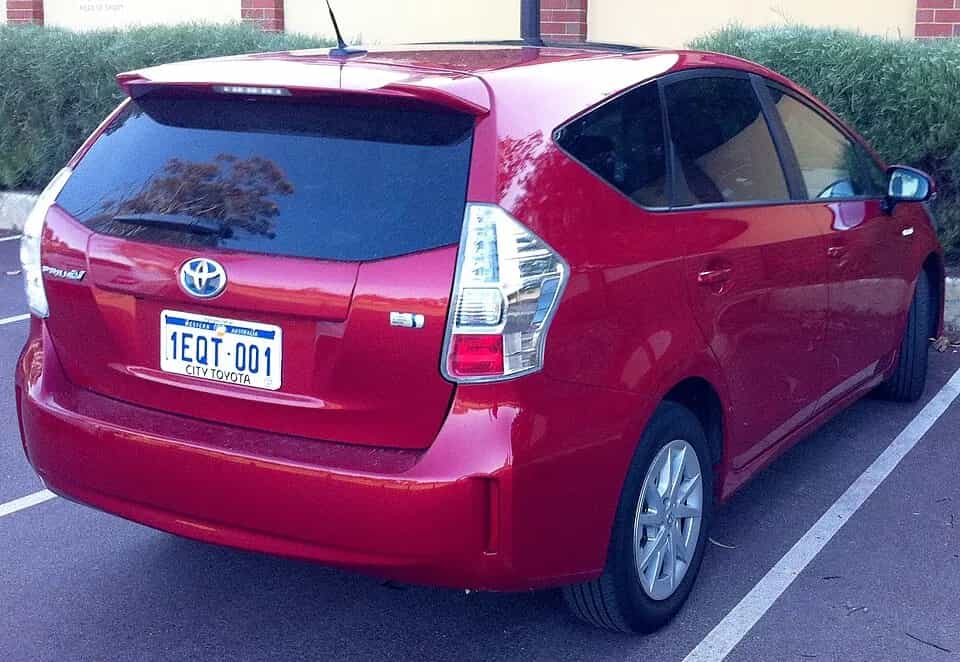
Toyota prius-v – used car imported from the USA
Photo: EurovisionNim · CC BY-SA 4.0 · Wikimedia Commons

Generations at a glance

The Prius v launched for the 2012 model year and ran in the US through 2017, built on the third-generation Prius platform but stretched for space. Unlike the seven-seat Japanese Prius α, the US Prius v was a five-seater using a nickel-metal-hydride battery pack, which sat under the rear seat to preserve cargo room. Toyota gave it a mild facelift for 2015 with revised styling and lighting. Throughout its run the mechanical package stayed consistent, so buyers do not have to weigh up major generational changes — only trim level and model year.

Powertrain lineup

The Prius v uses Toyota's proven Hybrid Synergy Drive: a 1.8-litre 2ZR-FXE Atkinson-cycle four-cylinder paired with electric motor-generators, for a combined system output of around 134 hp. Drive goes to the front wheels through an electronically controlled planetary "eCVT" that has no conventional gears to wear out. It is not built for speed — this is a car engineered for smoothness and economy, returning strong real-world fuel figures for its size. The drivetrain is essentially the same battle-tested hybrid system Toyota has sold in millions of Priuses, which is central to its appeal as a low-stress import.

Trims in the US market

One body style: the five-door hybrid wagon/MPV. US trims were badged Two, Three, Four and Five, climbing from basic to well-equipped. Higher grades added features such as a panoramic resin roof with sunshades, SofTex upholstery, a larger multimedia screen, and adjustable sliding and reclining rear seats. Compared with the standard Prius, the v offers markedly more headroom and a much larger, squarer boot — the reason so many chose it as a hybrid family hauler.

The used market stateside

Prius v supply in the States is healthy, since it sold steadily for six model years and many went to high-mileage private and fleet use where the hybrid economy paid off. That means mileage ranges widely, so history and battery condition matter more than the odometer number alone. Typical import candidates are 2012–2017 cars, and we always pull the full Carfax or AutoCheck report and check the hybrid system's state before you commit. No European prices are quoted here; you receive a transparent, itemised import calculation.

Who should import one

The Prius v suits buyers who want proven hybrid efficiency with genuine practicality: families, high-mileage commuters, and anyone who found the regular Prius too small. It is a sensible, low-drama choice rather than an emotional one — but for the right buyer, a well-kept US Prius v is a supremely useful and economical import.

Key specifications

SpecificationDetail (typical US-spec)
Body style5-door hybrid wagon/MPV (5 seats)
Production years (US)2012–2017
Engine1.8 L 2ZR-FXE Atkinson I4 + electric
System powerapprox. 134 hp combined
Hybrid systemHybrid Synergy Drive
BatteryNickel-metal-hydride (NiMH)
TransmissioneCVT (planetary)
DrivetrainFront-wheel drive
FuelPetrol-electric hybrid
Lengthapprox. 4,615 mm
Wheelbaseapprox. 2,780 mm
Cargo (rear up)approx. 970 L
Seating5
Assembly plantTsutsumi, Japan

How reliable is it?

The Prius v carries the Prius family's strong reliability reputation, and the hybrid drivetrain is famously durable. The most common real-world issue on cars of this age is the small 12-volt auxiliary battery, which triggers a cluster of warning lights and no-start faults when it weakens — an inexpensive fix but a frequent one. The main hybrid traction battery is robust, but any NiMH pack loses capacity with age and heat; a car from a hot US state with very high mileage deserves a battery health check. On the 1.8 engine, carbon build-up and EGR-related deposits can appear on neglected examples, and the electric inverter coolant pump is a known long-term wear item on this generation. Brakes often last unusually long thanks to regenerative braking. Overall, a serviced Prius v with a healthy battery is one of the lower-risk used imports on the market.

What US models do differently

As a US-market car, the Prius v runs FMVSS lighting (frequently red rear indicators and no rear fog lamp), a speedometer in mph, and US-band radio and connected-services hardware. The five-seat US version also differs from the European Prius+ in battery type and seating. Its headlights meet US rather than ECE norms. These are the standard items German type approval checks, and all are readily addressed during import.

Seven steps to your import

We agree your specification and source a suitable used Prius v; verify the VIN, title status and full Carfax/AutoCheck history; hold your funds in secure escrow until the car is confirmed; move the vehicle to a US port and ship it by ocean freight to a North Sea port such as Bremerhaven; clear customs on arrival; present it for TÜV inspection and individual approval (§21 StVZO); and finally register it on German plates.

Customs, taxes and costs explained

Remember: no origin proof, no 0% duty – and 19% German import VAT is due on every import.

Two separate charges apply on entry. The first is the import duty, which depends on the vehicle's provable origin. The Prius v was built in Japan, so its origin is not US — that means the standard passenger-car import rate normally applies, and the 0% EU preference under Regulations (EU) 2026/1455 and 2026/1461 (which requires provable US origin and direct transport, valid until 31 December 2029) does not apply to a Japanese-built car. Nothing here is ever "duty-free": the VIN and plant decide the rate. Separately, the 19% German import VAT (Einfuhrumsatzsteuer) always applies to every import regardless of origin. We list both as transparent, separate line items with no margin added.

German TÜV and registration

Typical work includes fitting a rear fog lamp, converting the rear indicators and headlights to ECE specification, and confirming the odometer is presented in a form German authorities accept. After a successful individual inspection, registration follows at your local Zulassungsstelle.

The buyer checklist

Before buying any US Prius v: 1) match the VIN to the car and paperwork; 2) obtain the full Carfax/AutoCheck and screen for accidents or salvage; 3) request a hybrid-battery health check, especially on high-mileage or hot-climate cars; 4) confirm the 12-volt battery and any warning lights have been addressed; 5) verify the title is clean rather than salvage; 6) check for underbody rust on salt-belt cars; 7) confirm regular hybrid-system and coolant servicing.

Questions and answers

Can I import a used Toyota Prius v to Germany?

Yes. The US five-seat Prius v can be imported as a used vehicle and registered after individual approval.

Is the Prius v reliable?

Very. The hybrid drivetrain is proven; the most common issue is simply the small 12-volt battery weakening with age.

Does the 0% EU import duty apply to the Prius v?

No. It is built in Japan, so US origin cannot be proven and the standard import rate normally applies.

Do I always pay German import VAT?

Yes. The 19% Einfuhrumsatzsteuer applies to every import regardless of origin.

How is the US Prius v different from the European Prius+?

The US version is a five-seater with a nickel-metal-hydride battery, while the European Prius+ was offered with seven seats and a lithium-ion pack.

Should I worry about the hybrid battery?

The traction battery is durable, but on very high-mileage or hot-state cars a health check before import is wise.

Is USCar Trader a dealer?

No. We are an independent broker for used US vehicles, working on your behalf with no manufacturer partnership.

What TÜV changes are typical?

Mainly lighting — a rear fog lamp and ECE headlights and indicators.

To get started, browse Toyota in the Carhub, compare related models such as the Toyota Prius, the Toyota Prius c and the Toyota Venza, or view current Prius v listings.