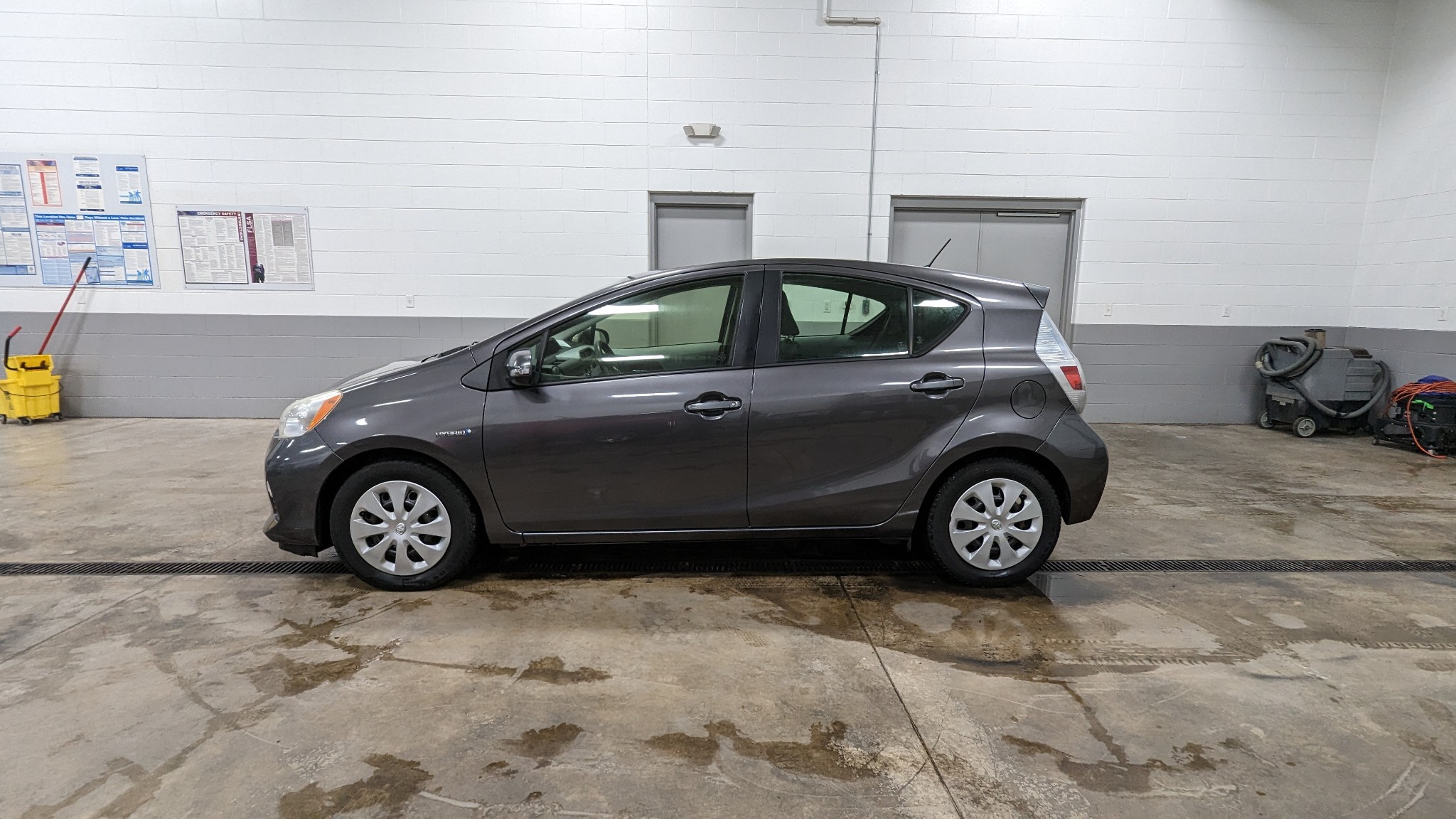
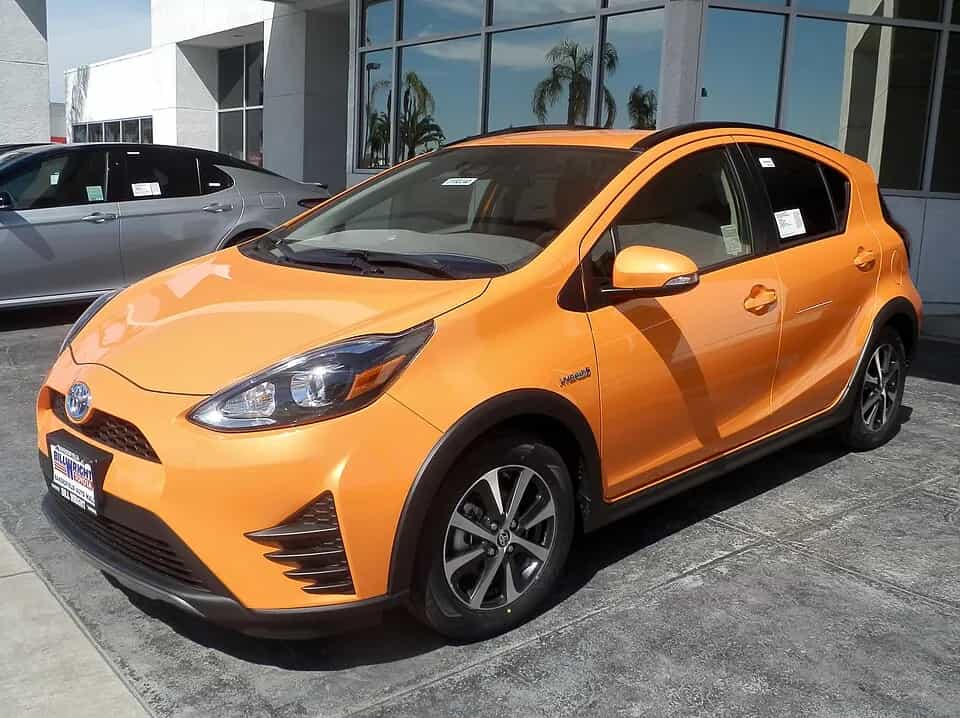
Toyota Prius c
Importing a used Toyota Prius c from the USA
The Toyota Prius c is the smallest and lightest member of the Prius family, a subcompact hybrid hatchback that packages Toyota's proven petrol-electric system into a city-friendly footprint. In much of the world it was sold as the Toyota Aqua, but in the United States it wore the Prius c badge and was marketed as the affordable, easy-to-park entry into hybrid motoring. USCar Trader is an independent broker for used US vehicles, and we can source a Prius c from the American market for import to Germany. If you are looking into how to import a used Toyota Prius c from the USA, the sections below explain the model's background, its hybrid drivetrain, the used market and the full path to German registration.

From launch to today
The US-market Prius c was sold from the 2012 through the 2019 model year as a single generation, sharing its underpinnings with the Toyota Yaris rather than the larger Prius liftback. It was built in Japan, which is an important point for the customs discussion later. Over its run the Prius c received styling and equipment updates, most notably a refresh for 2018 that added a bolder front end and made Toyota Safety Sense C, with pre-collision warning and automatic high beams, standard across the range. The Prius c was discontinued in the US after 2019 as Toyota consolidated its hybrid line-up, but the closely related Aqua continued elsewhere, so this generation is now firmly a used proposition.
Engines and drivetrain in detail
The Prius c uses a compact version of Toyota's Hybrid Synergy Drive. A 1.5-litre four-cylinder petrol engine running on the efficient Atkinson cycle works with an electric motor and a nickel-metal-hydride battery, for a combined system output of around 99 horsepower. Drive goes to the front wheels through an electronically controlled continuously variable transmission (e-CVT), which has no conventional gears and delivers smooth, seamless acceleration. The car can move on electric power alone at low speeds and recovers energy under braking. Fuel economy is the headline: the Prius c was among the most economical non-plug-in cars sold in the US, making it ideal for stop-start urban use. There is no all-wheel-drive or diesel option; the single hybrid drivetrain defines the model.
Trim levels and variants
The Prius c came only as a five-door hatchback, sold in the US under numbered trims from One through Four. Higher trims added features such as alloy wheels, a larger touchscreen, navigation, keyless entry with push-button start, heated seats and, later, additional safety equipment. Even the base cars included the full hybrid system, air conditioning and Bluetooth. Because the range was simple, choosing a Prius c is mostly about equipment level and, from 2018, the standard driver-assistance package.
Used availability in the USA
The Prius c sold in solid numbers as a budget hybrid, so the American used pool is plentiful and affordable, with a good spread of years and trims. Many were used as commuter and city cars, so mileage varies widely from lightly used examples to high-mileage workhorses; the hybrid system generally takes high mileage in its stride. Cars from California and other warm states offer the cleanest, rust-free bodies and often have well-documented service histories. Later 2018 and 2019 cars with standard safety systems are the most desirable.
When importing makes sense
The Prius c suits the buyer who wants a small, extremely economical and reliable hybrid for city and commuter use, with low running costs and easy parking. It appeals to someone who values Toyota's hybrid dependability over outright performance or size, and who likes the idea of a well-kept used import from a sunny US state. It is not a car for long high-speed motorway stretches or for those needing space, but as an urban runabout it is hard to fault.
Facts and figures
| Specification | Detail (Toyota Prius c) |
|---|---|
| Body style | 5-door hatchback, 5 seats |
| Powertrain | 1.5 L Atkinson-cycle petrol + electric motor (full hybrid) |
| System power | approx. 99 hp (74 kW) |
| Battery | Nickel-metal-hydride (NiMH) |
| Transmission | Electronic CVT (e-CVT) |
| Drive layout | Front-wheel drive |
| 0-100 km/h | approx. 11.5 s |
| Length | approx. 4,000 mm |
| Width | approx. 1,695 mm |
| Wheelbase | approx. 2,550 mm |
| Kerb weight | approx. 1,140 kg |
| Fuel | Petrol (full hybrid) |
| Fuel tank | approx. 36 L |
| Assembly | Japan |
| Production years (US) | 2012-2019 |
Reliability and common problems
The Prius c has an excellent reputation, and Toyota's hybrid system is one of the most durable powertrains on the road. When assessing Toyota Prius c reliability, the areas to watch are age-related rather than fundamental. The nickel-metal-hydride hybrid battery is robust, but on older, high-mileage cars its capacity gradually declines; a battery health check is worthwhile, and replacement or reconditioning is a known, budgetable job. The 12-volt auxiliary battery is a common cause of no-start faults and is cheap to replace. Some cars can develop excessive oil consumption on the 1.5-litre engine if servicing was neglected, so check oil level and history. Suspension bushings, brake actuator components and, on cars from salted regions, underbody corrosion deserve inspection. The regenerative braking system means the friction brakes wear slowly, but the actuator and calipers should still be checked. Overall these are low-maintenance cars, and a documented service record is the best assurance.
How US versions differ
The US Prius c uses mph instrumentation, US rear lighting logic and SAE headlight patterns, all corrected during approval. It is closely related to the Toyota Aqua sold in other markets, so mechanical familiarity among hybrid specialists is good. Infotainment, radio bands and connected features are configured for the US market. The Prius c was not sold in Europe under that name, so it lacks European type approval and imports go through an individual inspection.
From US purchase to registration
The sequence is clear: select the car and obtain a condition report; verify the VIN and confirm the build country for origin; pay through escrow so funds release only on confirmed ownership; ship by ocean freight from a US port to Bremerhaven or a comparable European port; clear customs on arrival; complete a TÜV individual inspection (Einzelabnahme) with any required modifications; and register the car in Germany. USCar Trader manages each stage as your intermediary and never acts as a dealer.
Costs, duty and taxes at a glance
Remember: no origin proof, no 0% duty – and 19% German import VAT is due on every import.
Origin is decisive here, and for the Prius c it is straightforward. The car was built in Japan, so it does not qualify for the 0% US-origin EU import duty granted under Regulations (EU) 2026/1455 and 2026/1461 (in force since 1 July 2026 for direct transport, valid to 31 December 2029), because that relief requires provable US origin from the VIN and plant. A Japanese-built Prius c is therefore subject to the standard 10% third-country car duty. Separately and in every case, the 19% German import VAT (Einfuhrumsatzsteuer) applies and is calculated on its own basis. We never describe an import as duty-free and never add a margin; the classification follows the individual VIN and its country of manufacture.
TÜV, approval and license plates
Typical work includes adapting or replacing the headlights to a European beam pattern, fitting a rear fog lamp, and confirming the speedometer displays km/h. The odometer reading is documented and checked for plausibility against the history. After the TÜV certificate is issued, the car is registered locally and receives German plates. The hybrid high-voltage system is inspected as part of the process.
Pre-purchase checklist
Confirm the VIN across the title, dash and door label. Obtain a Carfax or AutoCheck report to check for accidents, title branding and odometer accuracy. Have the hybrid battery health assessed, especially on older, high-mileage cars. Verify service history and check the 1.5-litre engine's oil consumption. Inspect for underbody rust on cars from northern states. Confirm the title is clean rather than salvage or rebuilt. Test that the hybrid system, air conditioning and any safety features function correctly.
Import FAQ
Where was the Toyota Prius c built?
The Prius c was built in Japan, which means it does not qualify for the US-origin 0% EU import duty.
Does the Prius c qualify for 0% EU import duty?
No. As a Japanese-built car it is subject to the standard 10% third-country car duty, with origin confirmed by the VIN.
Is the 19% import VAT always due?
Yes. The German import VAT of 19% applies to every import and is calculated separately from any customs duty.
Is the Prius c the same as the Toyota Aqua?
Essentially yes. The US-market Prius c is the close counterpart of the Toyota Aqua sold in other regions.
How reliable is the hybrid battery?
The nickel-metal-hydride battery is durable, though capacity slowly declines with age; a health check before purchase is sensible.
Is the Prius c economical to run?
Very. It was among the most fuel-efficient non-plug-in cars in the US and is ideal for city and commuter use.
How long does the import take?
Typically six to twelve weeks from purchase to German registration, depending on freight and inspection scheduling.
Can the Prius c be registered in Germany?
Yes, through a TÜV individual approval covering lighting, a rear fog lamp and speedometer units, plus a hybrid-system check.
Discover more Toyota hybrids through our Toyota in the Carhub, or compare related compact and hybrid models such as the Toyota Prius, the Toyota Yaris and the Toyota Corolla Hatchback. You can also browse the current Prius c listings we can source and import for you.