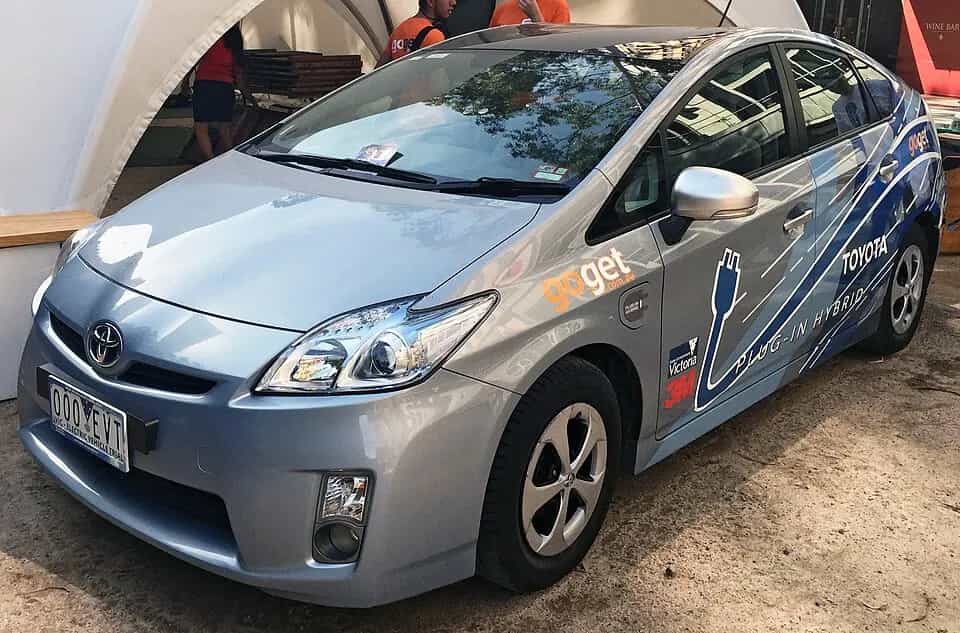
Toyota Prius Plug-in Hybrid
Importing a used Toyota Prius Plug-in Hybrid from the USA
In the United States, the plug-in version of the Toyota Prius is sold under the name Prius Prime, and it sits at the top of the Prius family as the model that can drive meaningful distances on electricity alone before its efficient hybrid system takes over. For buyers in Germany and the wider EU, importing a used Prius Plug-in Hybrid from the USA is a way to secure a proven, frugal Toyota hybrid, often in high trim, from the large American used pool. USCar Trader acts strictly as an independent broker: we find and vet the car and handle the shipping and paperwork, without holding inventory or adding a dealer margin.

From launch to today
The plug-in Prius has two clearly distinct generations on the US market. The fourth-generation Prius Prime (2017 to 2022, XW50 platform) paired a 1.8-litre engine with a plug-in system offering roughly 25 miles of EV range from an 8.8 kWh battery. The current fifth-generation Prius Prime (2023 onward, XW60 platform) is a substantial leap: sharper styling, far more power, and a larger 13.6 kWh battery pushing EPA electric range to about 44 miles (roughly 71 km). If EV-only running matters to you, the newer car is the one to target, but both generations are dependable choices.
Engines and drivetrain in detail
The current Prius Prime uses a 2.0-litre four-cylinder (Toyota's M20A-FXS) within a plug-in hybrid system producing a combined output around 220 hp, a dramatic increase over the previous 121 hp 1.8-litre setup. Drive goes through Toyota's electronically controlled continuously variable transmission (eCVT) to the front wheels; unlike the standard Prius, the US Prime is front-wheel drive only. The battery charges from a standard AC outlet, with no DC fast charging, reflecting its role as a commuter-friendly plug-in rather than a full EV. Once the battery is depleted, the car runs as a conventional, highly efficient Prius hybrid, which is where its legendary fuel economy comes from.
Trim levels and variants
The Prius Prime is a five-door liftback hatchback with seating for five. Current US trims are SE, XSE and XSE Premium, climbing through larger wheels, a bigger central touchscreen, a fixed glass roof, a premium audio system and available features such as a solar roof panel that trickle-charges the battery. The previous generation offered Plus, Premium and Advanced trims. Higher trims are well worth seeking out on the used market because they bundle the technology and comfort features that make the car feel a class above its price.
Used availability in the USA
Prius Primes are plentiful in the US because California and other states pushed plug-in adoption hard, so supply of clean, well-kept examples is healthy. Fourth-generation cars (2017 to 2022) are the affordable, high-mileage-tolerant option, while fifth-generation cars (2023 onward) command more but offer the real EV range and modern cabin. Typical used Primes have been treated gently by economy-minded owners, though it is worth confirming the battery has been charged and cycled regularly rather than left flat. As always with US cars, avoid rust-belt examples where road salt is used and favour dry-climate cars.
When importing makes sense
A used Prius Plug-in Hybrid is ideal for the buyer who wants Toyota reliability, very low running costs and the flexibility to complete most short daily trips on electricity while retaining full hybrid range for long journeys, with no charging anxiety. It suits commuters, high-mileage drivers and anyone who wants a plug-in without committing to a full EV. It is less relevant to buyers who need all-wheel drive or who want to fast charge, since the Prime is front-drive and AC-charge only.
Facts and figures
| Attribute | Detail (US Prius Prime) |
|---|---|
| Body style | 5-door liftback hatchback |
| Seating | 5 |
| Layout | Front-engine, front-wheel drive |
| Engine (5th gen) | 2.0 L I4 (M20A-FXS) plug-in hybrid |
| Combined power (5th gen) | approx. 220 hp |
| Engine (4th gen) | 1.8 L I4 plug-in hybrid, approx. 121 hp |
| Transmission | eCVT |
| Battery (5th gen) | approx. 13.6 kWh |
| EV range (5th gen) | approx. 44 mi (approx. 71 km) EPA |
| EV range (4th gen) | approx. 25 mi (approx. 40 km) EPA |
| Charging | AC only, no DC fast charge |
| Trims | SE, XSE, XSE Premium (current) |
| Model years | 2017–2022 (4th), 2023 on (5th) |
| Assembly | Tsutsumi, Japan |
Reliability and common problems
The Prius Plug-in Hybrid inherits Toyota's strong reliability record, and the hybrid system is among the most durable in the industry. Genuine mechanical failures are rare. Known watch points are more about age and use: the 12-volt auxiliary battery is a frequent cause of no-start faults and is cheap to replace; the traction battery should be verified as healthy and regularly cycled, since a plug-in left permanently uncharged can lose usable capacity; and the previous-generation cars had a modest EV range that shrinks noticeably in cold weather. Early fourth-gen infotainment (the Entune system) can feel dated and occasionally glitchy. Otherwise, routine servicing, tyres and brakes (which last a long time thanks to regen) are the main costs.
How US versions differ
US Primes run North American navigation and connected services, imperial instrumentation by default, and North American lighting. The charging inlet is a Type 1 (J1772) AC connector rather than the European Type 2, so a suitable adapter or cable is required for home and public AC charging in Europe. Some Toyota connected app features are region-locked. These are all manageable items but must be addressed during the import and approval process.
From US purchase to registration
The sequence is: select the specific car, run a VIN and origin check to establish the plant and specification, secure payment through escrow once verified, ship by ocean freight to a European port, clear customs on arrival, obtain a TÜV individual approval (Einzelabnahme) with any needed modifications, and register the car locally.
Costs, duty and taxes at a glance
Key point: duty depends on the plant of build; only a VIN check secures the 0% rate. Import VAT of 19% applies regardless.
The Prius Prime is built in Japan (Toyota's Tsutsumi plant), so its origin is not the United States. The applicable import duty therefore depends on the actual plant and origin as evidenced by the VIN and documents, and cannot be assumed to be zero. The preferential 0% EU import duty under Regulations (EU) 2026/1455 and 2026/1461 (in force since 1 July 2026, requiring direct transport and provable US origin, valid until 31 December 2029) applies only where genuine US origin is proven, which a Japanese-built Prius will generally not satisfy. Separately, the 19% German import VAT (Einfuhrumsatzsteuer) always applies on import. We list these two items distinctly and never promise a duty-free outcome.
TÜV, approval and license plates
Typical approval work covers adapting the headlights to EU specification, ensuring a rear fog lamp is present and functioning, and confirming the instruments can display metric units. The odometer is recorded in kilometres for registration. The charging inlet compatibility (Type 1 to Type 2) is also addressed so the car can be charged on European infrastructure.
Pre-purchase checklist
- Decode the VIN to confirm generation, year and trim.
- Obtain a full Carfax or AutoCheck history report.
- Confirm the traction battery health and that the car was regularly charged.
- Test the 12-volt battery and check for corrosion.
- Inspect underbody for rust, favouring dry-state cars.
- Verify a clean, non-salvage title.
- Check service records for scheduled hybrid maintenance.
Import FAQ
How far can a used Prius Prime go on electricity alone?
The current fifth-generation car is EPA-rated at about 44 miles (roughly 71 km); the earlier fourth-generation car managed about 25 miles. Cold weather reduces both figures.
Can I fast charge a Prius Plug-in Hybrid?
No. The Prime charges only on AC (Type 1 inlet in the US), so a Type 2 adapter or cable is needed in Europe, and there is no DC fast charging.
Is the Prius Prime reliable?
Yes. It shares Toyota's proven hybrid technology and has a strong reliability record; the main age-related items are the 12-volt battery and traction battery care.
Does importing a Prius Prime qualify for 0% duty?
Generally not, because it is built in Japan. The 0% preferential rate needs provable US origin; the duty rate depends on the VIN-verified plant, and the 19% import VAT always applies.
Is the Prius Prime available with all-wheel drive?
No. The US Prius Prime plug-in is front-wheel drive only; only the non-plug-in Prius offers optional AWD.
What is the difference between Prius Prime and regular Prius?
The Prime is the plug-in version with a larger battery and EV-only driving range, whereas the standard Prius is a conventional hybrid that cannot be plugged in for extended EV range.
Will it pass German TÜV?
Yes, after the standard individual approval and typical modifications such as EU lighting and a rear fog lamp.
How long does the import take?
Usually several weeks from purchase to registration, mostly determined by shipping and the approval appointment.
Explore your options via Toyota in the Carhub, compare the related Prius and RAV4 Plug-in Hybrid, or view current Prius Plug-in Hybrid listings.