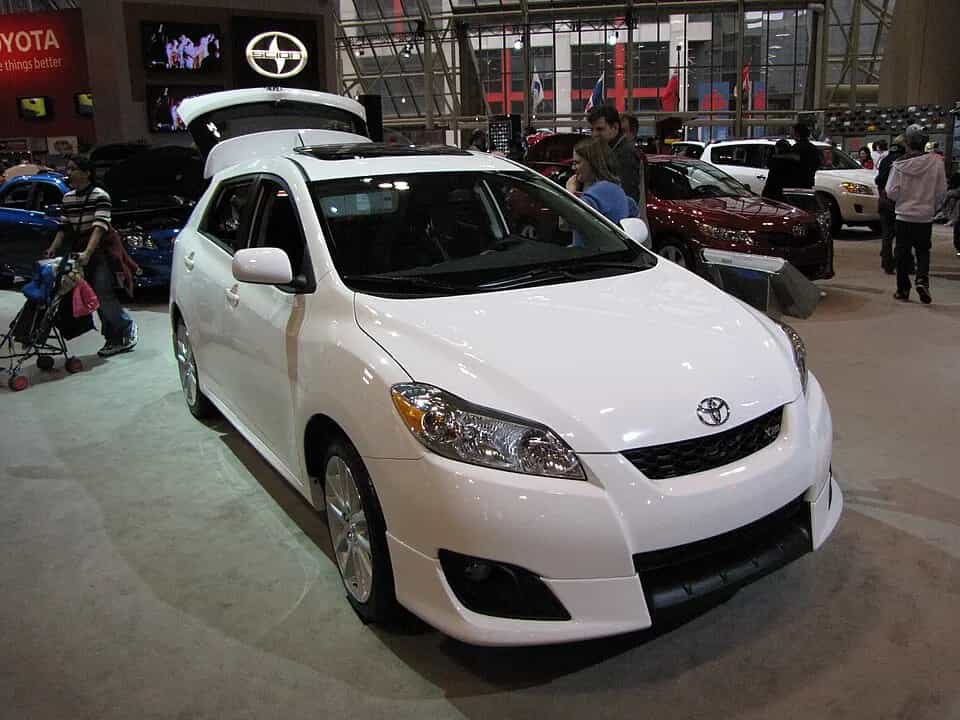
Toyota Matrix
Importing a used Toyota Matrix from the USA
The Toyota Matrix is the practical, slightly sporty hatchback version of the Corolla — a tall, versatile five-door that was aimed squarely at North American buyers and never sold widely in Europe. That rarity is exactly why some enthusiasts want to import one: it offers legendary Corolla mechanicals in a more useful, more distinctive body, and clean US examples are plentiful. USCar Trader is an independent broker for used US vehicles only; we do not sell new cars and take no vehicle margin.

From launch to today
The Matrix arrived for the 2003 model year and shared everything under the skin with the Corolla and its identical twin, the Pontiac Vibe. The first generation (E130) ran from 2003 to 2008 and was styled as a low, wagon-like hatch. The second generation (E140) launched for 2009 with a taller, more crossover-influenced shape and ran in the US through 2013 (a year longer in Canada). Both generations were assembled at Toyota's Cambridge, Ontario plant — a detail that shapes the customs treatment on import.
Engines and drivetrain in detail
First-generation cars used the 1.8-litre 1ZZ-FE four-cylinder with about 126 hp in base and XR trim. The enthusiast pick was the XRS, fitted with the high-revving 1.8-litre 2ZZ-GE (the same lift-cam engine family as the Celica GT-S), making around 170–173 hp and offering a six-speed manual. Second-generation cars offered a 1.8-litre 2ZR-FE (about 132 hp) and, in the S and XRS grades, a 2.4-litre 2AZ-FE with roughly 158 hp; the 2.4 could be paired with optional all-wheel drive. Transmissions included five- and six-speed manuals and four- or five-speed automatics.
Trim levels and variants
The Matrix was sold only as a five-door hatch. First-gen trims were the base, XR and sporty XRS; the second generation offered base, S and XRS. Higher grades added alloy wheels, a rear spoiler, upgraded audio and cruise control. A flat-folding front passenger seat, a versatile cargo area and (on some cars) a 115-volt outlet made it a favourite of practically minded owners.
Used availability in the USA
Supply is strong. The Matrix was a common, sensible car in America, so mid-mileage examples with clean histories are easy to find, and southern cars avoid the rust that plagues northern ones. Typical import candidates are well-maintained 2009–2013 second-generation cars or, for enthusiasts, a sorted first-generation XRS. As always, a US history report is the fastest way to separate a cherished owner's car from a tired fleet hack.
When importing makes sense
The Matrix suits a buyer who wants Corolla dependability and running costs but more space and a bit more style, or an enthusiast chasing the rev-happy XRS. It is ideal for someone who values low maintenance costs, easy parts supply and everyday usability over badge prestige or outright performance.
Facts and figures
| Item | Detail (typical, both generations) |
|---|---|
| Body style | 5-door compact hatchback |
| Platform | Toyota Corolla (E130/E140) |
| Base engine | 1.8 L I4 (1ZZ-FE / 2ZR-FE) |
| Sport engine | 1.8 L 2ZZ-GE (gen1 XRS) / 2.4 L 2AZ-FE (gen2) |
| Power | approx. 126–173 hp |
| Transmission | 5/6-speed manual, 4/5-speed automatic |
| Drive | Front-wheel drive (optional AWD on 2.4) |
| Length | approx. 4,365 mm (gen2) |
| Wheelbase | approx. 2,600 mm |
| Kerb weight | approx. 1,270–1,450 kg |
| Fuel tank | approx. 50 litres |
| Cargo (seats up) | approx. 540–560 litres |
| Fuel | Petrol |
| Assembly | Cambridge, Ontario, Canada |
| US model years | 2003–2008 (gen1), 2009–2013 (gen2) |
| Twin model | Pontiac Vibe |
Reliability and common problems
The Matrix is one of the more dependable cars in its class, but each engine has a known trait worth checking. The 1ZZ-FE in early cars can consume oil if maintenance was neglected, a well-documented piston-ring/oil-return issue. The 2.4-litre 2AZ-FE is generally strong but is famous for cylinder-head bolt threads stripping in the aluminium block, and it too can burn oil — verify the oil level and look for records. The high-revving 2ZZ-GE XRS engine rewards strict oil-change discipline; a neglected one may show wear. Beyond the engines, watch for rust on northern cars (rear arches, subframe), worn suspension bushings and the occasional electric-power-steering fault on second-generation cars. Overall, buy on service history and the Matrix will run for a very long time.
How US versions differ
US Matrix cars use mph instruments, US-spec lighting without a rear fog lamp, and side-marker lamps. Infotainment is basic and US radio bands differ. Emissions are US federal or California spec, and OBD-II is standard. Because it is closely related to the Corolla, many mechanical parts overlap with European Toyotas.
From US purchase to registration
The route is: select the specific car and confirm its condition; verify the VIN and build origin; pay via escrow rather than a direct transfer; arrange ocean freight from a US port; clear EU customs on arrival; present for TÜV and an individual approval where required; then register and plate. We coordinate each step.
Costs, duty and taxes at a glance
Bottom line: what matters is the factory shown by the VIN – proven US origin unlocks 0% duty. The 19% import VAT always applies.
The Matrix was assembled in Canada, so US origin generally cannot be proven, and the preferential 0% rate under Regulations (EU) 2026/1455 and 2026/1461 (in force since 1 July 2026, direct transport, until 31 December 2029) will normally not apply. In that case the standard EU passenger-car import duty of 10% is charged on the customs value. The 19% German import VAT (Einfuhrumsatzsteuer) is always levied separately, on the customs value plus duty and freight. We never promise duty-free imports and take no vehicle margin — the applicable rate follows the documented origin.
TÜV, approval and license plates
Typical work: adding or activating a rear fog lamp, adapting the rear turn-signal function, checking headlamp compliance and converting the speedometer display. The odometer reading on the US title must match the cluster. Once the individual approval is granted, standard registration follows.
Pre-purchase checklist
Before you buy: decode the VIN to confirm generation, engine and drive; obtain a Carfax or AutoCheck history for accidents, title brands and odometer accuracy; check engine oil level and consumption, especially on 1ZZ and 2AZ cars; inspect the rear arches and underbody for rust on northern cars; confirm a documented service history; verify the title is clean rather than salvage; and, on an XRS, look for evidence of disciplined oil changes.
Import FAQ
Is the Toyota Matrix reliable?
Yes, it is among the most dependable compacts of its era, sharing Corolla mechanicals. Watch the known oil-consumption and 2AZ head-bolt issues and it will last a long time.
What is the difference between the XRS and the base Matrix?
The first-generation XRS used the high-revving 2ZZ-GE engine with around 170 hp and a six-speed manual; the second-generation XRS used the 2.4-litre 2AZ-FE with about 158 hp.
Can I import a Matrix duty-free?
Usually not, because it was built in Canada. Without provable US origin the standard 10% EU duty applies, plus 19% import VAT.
Is the Matrix the same as the Pontiac Vibe?
Effectively yes; the two are twins built on the same Corolla platform, with the Vibe wearing Pontiac styling.
Does the Matrix come with all-wheel drive?
All-wheel drive was available on the 2.4-litre versions of both generations, paired with an automatic transmission.
How practical is the cargo area?
Very. The tall hatch and folding seats give around 540 to 560 litres with the rear seats up, and much more folded.
Which engine is best for low running costs?
The 1.8-litre (1ZZ-FE or 2ZR-FE) offers the best economy and simplest maintenance for everyday use.
Get going: browse Toyota in the Carhub, compare the related Toyota Corolla and Toyota Corolla Hatchback, or view current Matrix listings.