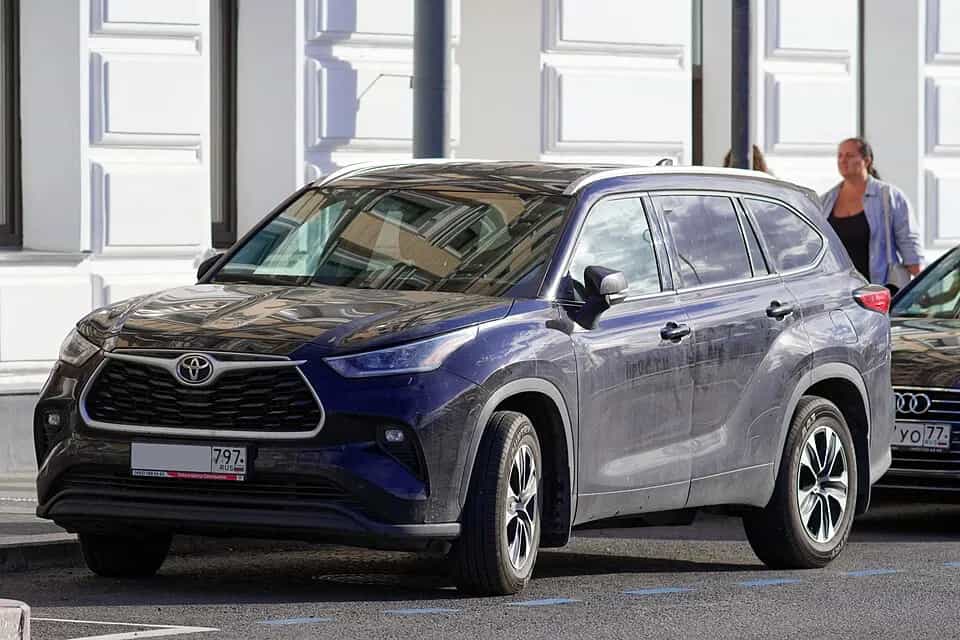
Toyota Highlander
Importing a used Toyota Highlander from the USA
The Highlander is Toyota's mid-size, three-row family SUV, and it is one of America's best-selling models in the segment — which is precisely why the US used market offers such depth of choice. Toyota never sold the Highlander in most of Europe, so importing a used one from the States is often the only way to get this specific seven-seat crossover with its familiar Toyota running gear. One point matters for your paperwork from the outset: Highlanders sold in the US have been built both at Toyota's plant in Princeton, Indiana and, for some generations and hybrid variants, in Japan. That means the customs duty rate depends on where your particular car was actually assembled, which the VIN reveals — so origin is checked per vehicle rather than assumed. The 19% German import VAT applies in every case.

From launch to today
The Highlander launched for 2001 on a car-based platform, offering the space of an SUV with the manners of a sedan. The second generation (2008–2013) grew larger and added a hybrid option in the US. The third generation (2014–2019) sharpened the styling and improved the interior. The fourth generation (2020–present) moved to Toyota's TNGA platform, adopted a more efficient hybrid system and, for the US, later added the larger Grand Highlander as a companion model. When you import a used Highlander from the USA you are typically choosing between a third-gen (plentiful, proven) or an early fourth-gen car.
Engines and drivetrain in detail
The workhorse engine for years was the 3.5-litre 2GR V6, producing around 270–295 hp depending on model year and paired with a six- or eight-speed automatic. It is a genuinely durable unit with a strong reputation. The hybrid versions combined a 3.5 V6 (earlier) or a 2.5-litre four-cylinder (fourth generation) with electric motors for meaningfully better fuel economy — the newer 2.5 hybrid is the efficiency choice. Drive is front-wheel drive as standard with available all-wheel drive; US AWD systems vary from simple on-demand setups to the more sophisticated torque-vectoring rear axle on higher fourth-gen trims. There is no diesel.
Trim levels and variants
US trims run L, LE, XLE, the off-road-styled TRD Sport (fourth gen), Limited and the top Platinum, the latter adding leather, a panoramic roof, a large touchscreen, a head-up display and a premium JBL audio system. The body is a single five-door, three-row SUV configuration seating seven or eight depending on whether the second row is a bench or captain's chairs. Because the US market skews toward well-equipped XLE, Limited and Platinum cars, imports often arrive with equipment levels that were never offered here.
Used availability in the USA
Supply is broad and steady. Third-generation Highlanders (2014–2019) are abundant with typical mileages from 50,000 to 130,000 miles, and family-owned examples with full dealer service history are common. Fourth-generation cars and hybrids are increasingly available as lease returns cycle through. Toyota's reputation for longevity means a well-maintained high-mileage Highlander can still be a sound import — the key is history and condition, not just the odometer.
When importing makes sense
A used Highlander from the USA is aimed at families who want a comfortable, reliable three-row SUV with proven Toyota mechanicals in a spec — colour, trim, hybrid system — that European Toyota dealers did not offer. It is a sensible choice for high-mileage, low-drama family transport, and the hybrid appeals to buyers wanting lower running costs. It is less suited to those seeking sharp handling or serious off-road ability; the Highlander is a comfort-first crossover, not a rugged 4x4.
Facts and figures
| Attribute | Typical figure (US-market) |
|---|---|
| Body style | Five-door, three-row SUV (crossover) |
| Generations imported | 3rd gen (2014–2019), 4th gen (2020–) |
| Assembly plants | Princeton, Indiana (USA) and Japan |
| Common petrol engine | 3.5 L 2GR V6 |
| Power (V6) | approx. 270–295 hp |
| Hybrid | 3.5 V6 hybrid (earlier), 2.5 four hybrid (4th gen) |
| Transmission | 6- or 8-speed automatic; eCVT (hybrid) |
| Drivetrain | FWD standard, AWD available |
| Length | approx. 4,855–4,950 mm |
| Seating | 7 or 8 |
| Fuel | Petrol / petrol-hybrid |
| Top trims | Limited, Platinum |
| Origin for customs | Plant-dependent — verified by VIN |
Reliability and common problems
The Highlander is one of the more dependable three-row SUVs on the market, but it is not flawless. Some 2014–2016 V6 cars showed early wear on the transmission and occasional torque-converter shudder; a fluid service history helps. Water can collect in the tail-light housings and cause moisture or bulb failures on some third-gen cars. Interior rattles from the second- and third-row hardware are a common complaint rather than a serious fault. On hybrids, the traction battery is durable but its health should be checked on older, high-mileage examples. Overall the 2GR V6 and Toyota's hybrid drivetrain are known for going a long way with routine oil and fluid changes — the usual advice of buying on history applies.
How US versions differ
US Highlanders use amber front markers and red rear turn signals, run mph instrumentation and typically lack a rear fog lamp — all items the TÜV will expect to be corrected. Infotainment (Entune on older cars, the newer Toyota system on fourth-gen) works but ships with US navigation data and radio bands. US safety systems such as Toyota Safety Sense are present and generally accepted for approval, though radar and camera calibration should be confirmed. Headlight aim and beam pattern must suit right-hand traffic.
From US purchase to registration
Start by selecting the generation, powertrain (V6 or hybrid) and trim that fit your needs. A VIN and origin check then establishes where the car was built — Indiana or Japan — which drives the duty rate, and pulls the history. Secure escrow protects your payment until the vehicle is verified. Ocean freight carries the car to a European port; on arrival, customs clearance sets the duty and levies the 19% import VAT. TÜV and individual approval follow, then German registration.
Costs, duty and taxes at a glance
Key point: duty depends on the plant of build; only a VIN check secures the 0% rate. Import VAT of 19% applies regardless.
Because the Highlander is built in more than one country, the customs treatment is decided per vehicle. If your car's VIN shows US assembly and you can provide the origin evidence, it may qualify for the 0% EU import duty available for goods of proven US origin under Regulations (EU) 2026/1455 and 2026/1461 with direct transport; if it was built in Japan, the standard duty rate for the actual origin applies instead. There is no blanket duty-free promise. In all cases the 19% German import VAT (Einfuhrumsatzsteuer) is charged on the customs value. As an independent broker we forward these official amounts without adding any margin.
TÜV, approval and license plates
Typical preparation includes adding a rear fog lamp and, if required, separate rear indicators, adjusting the headlights for right-hand traffic, and confirming the odometer reads in a form the authorities accept. The Highlander is a mainstream crossover with few structural modifications to worry about, so approval is usually straightforward once the lighting and documentation are in order.
Pre-purchase checklist
Match the VIN to the title and check the build plant. Pull a Carfax or AutoCheck history for accidents, branded titles and odometer consistency. Inspect the underbody for rust — a southern or western US car is preferable. Confirm the automatic transmission shifts cleanly with no shudder. On hybrids, verify battery health and hybrid warning-light history. Check the tail-lights for moisture. Confirm the title is clean rather than salvage or rebuilt.
Import FAQ
Should I import a V6 or hybrid Highlander?
The 3.5 V6 is smooth and simple; the hybrid — especially the fourth-gen 2.5 — offers markedly better fuel economy for family use. Choose on running-cost priorities.
Does a used US Highlander qualify for 0% import duty?
Only if the VIN proves US assembly and you have the origin evidence. Japanese-built cars follow the duty rate for their actual origin. The 19% import VAT always applies.
How reliable is the Highlander?
Very, by class standards. The 2GR V6 and Toyota hybrid systems are known for longevity with routine maintenance; buy on documented history.
Is the third row usable for adults?
For shorter trips, yes; it is best sized for children or occasional adult use, which is normal for the segment.
Can a high-mileage Highlander still be a good buy?
Often yes, provided the service records are complete and the mechanical checks pass. Toyotas routinely cover high mileages.
How does the Highlander differ from the Grand Highlander?
The Grand Highlander is a larger, roomier companion model with a bigger third row, aimed at buyers needing more space.
Will US infotainment work in Germany?
It functions, but navigation maps and radio bands are US-based; smartphone mirroring is the usual workaround.
How long does importing take?
Generally a few weeks of transit plus the time needed for customs, TÜV and registration after arrival.
To begin, explore Toyota in the Carhub, compare the larger Grand Highlander, the smaller RAV4 and the two-row Venza, or see current Highlander listings.