Toyota GR Supra

Importing a used Toyota GR Supra from the USA

The GR Supra revived one of the most storied names in Japanese performance, and it did so with a turbocharged inline-six and rear-wheel drive — the classic Supra recipe. The current A90 generation was developed alongside the BMW Z4 and built in Austria, and it sold strongly in the United States, which today is a rich source of clean, well-specified used cars. Buyers who want to import a used Toyota GR Supra from the USA often do so to secure a specific colour, a manual gearbox car or a special edition at genuine value.

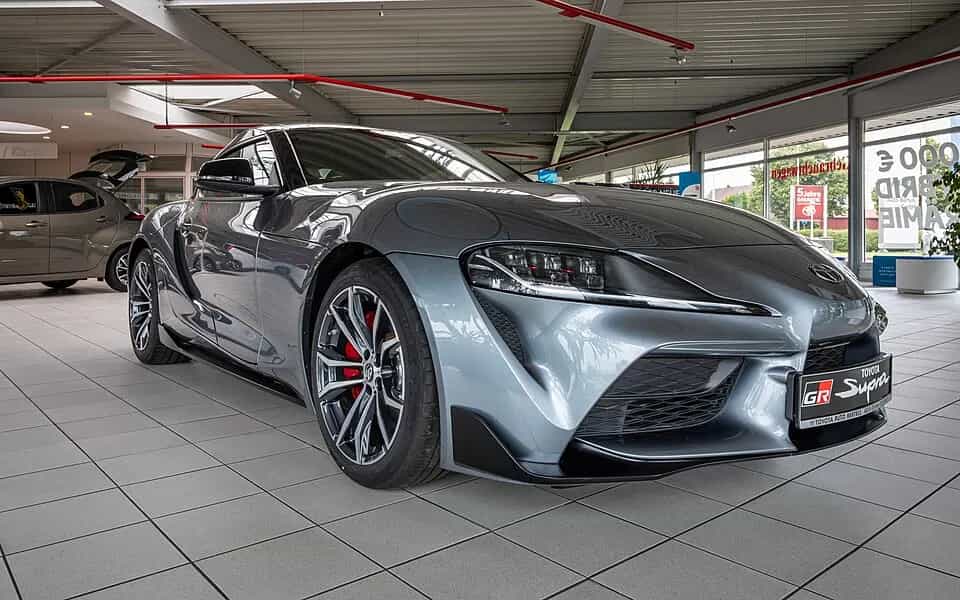
Toyota GR Supra – used car imported from the USA
Photo: Dietmar Rabich · CC BY-SA 4.0 · Wikimedia Commons

From launch to today

This is the fifth-generation Supra (chassis A90/J29), launched for the 2020 model year after decades of the nameplate lying dormant. It shares its platform and engines with the BMW Z4 and is assembled by Magna Steyr in Graz, Austria. The car evolved quickly: the 3.0-litre six gained a power increase for 2021, a four-cylinder 2.0 joined the range, and for 2023 Toyota added a six-speed manual for the 3.0 — a change enthusiasts had campaigned for. Special editions such as the A91 series and the A91-MT added to the appeal.

Engines and drivetrain in detail

The headline engine is the BMW-sourced B58 3.0-litre turbocharged inline-six. It launched at 335 hp and rose to 382 hp for 2021, with a broad, muscular torque curve. The entry car uses the B48 2.0-litre turbocharged four-cylinder with 255 hp — lighter over the nose and a sweet-handling car in its own right. Transmission choices are the ZF eight-speed automatic across the range and, from 2023, an intelligent six-speed manual on the 3.0. Every GR Supra is rear-wheel drive with an active limited-slip differential on the six-cylinder cars, a stiff chassis and near-ideal weight distribution.

Trim levels and variants

The GR Supra is a two-seat fastback coupe. US trims centred on the 2.0 and the 3.0 (later 3.0 Premium), with the Premium adding a larger head-up display, a JBL sound system and wireless smartphone integration. Special editions brought unique colours, matte finishes and forged wheels. The GR badge signals Toyota's Gazoo Racing performance division.

Used availability in the USA

Supply is good and the cars are still young, so most used GR Supras have moderate mileage and full equipment. The 3.0 dominates enthusiast interest, and post-2021 cars with the 382 hp engine are especially sought after, as are the rare manual cars from 2023 on. As with any modern sports coupe, some examples have been modified — the B58 responds strongly to tuning — so a stock car with clean history is the easiest import.

When importing makes sense

The GR Supra suits the driver who wants a compact, rear-drive coupe with real straight-line pace and the character of a turbo straight-six. If you want a manual 3.0, a specific special edition or simply a well-kept car at fair value, the American market is one of the best places to find it.

Facts and figures

GenerationFifth generation, A90/J29 (2020–present)
Engines2.0 turbo inline-four (B48); 3.0 turbo inline-six (B58)
Power (2.0)255 hp
Power (3.0)335 hp, then 382 hp from 2021
Transmissions8-speed ZF automatic; 6-speed manual (3.0, from 2023)
DriveRear-wheel drive
DifferentialActive limited-slip (3.0)
0–100 km/h (3.0)approx. 4.1–4.3 s
Top speed250 km/h (limited)
Body2-seat fastback coupe
Lengthapprox. 4,380 mm
Weight distributionclose to 50:50
AssemblyGraz, Austria (Magna Steyr)
Platform partnerBMW Z4 (G29)

Reliability and common problems

GR Supra reliability is strong, helped by the proven BMW B58 engine, one of the most robust modern turbo sixes. Known GR Supra common problems are relatively minor: early cars had a few software and infotainment niggles addressed by updates, some owners note wind noise or rattles from the hatch and interior trim, and the run-flat tyres are firm and expensive to replace. On tuned cars, watch the usual consequences of raised boost — clutch and driveline stress on manuals, and heat management under sustained hard use. The B48 four-cylinder is likewise durable. As ever, a full service history and confirmation of whether the car is stock matter more than a low odometer alone.

How US versions differ

US cars use mph-primary instruments, North American lighting with side markers, and US driver-assistance calibration. Some equipment names and packages differ, and the wireless smartphone integration on Premium cars varies by year. The GR Supra is otherwise the same car sold worldwide, which makes it a clean import; lighting compliance and a rear fog lamp are the main registration items.

From US purchase to registration

We select a car to your specification, then run a VIN and origin check to confirm the exact build and engine. Payment is held in secure escrow until the vehicle and documents are verified. We arrange ocean freight, clear the car through customs on arrival, guide it through the TÜV and any individual approval, and complete registration so it arrives road-legal.

Costs, duty and taxes at a glance

In short: the 0% duty rate applies only with documented US origin (VIN/plant) – German import VAT of 19% is always due.

The GR Supra is assembled in Graz, Austria, so it is not of US origin and the 0% preferential duty under Regulations (EU) 2026/1455 and 2026/1461 will normally not apply — that rate is limited to vehicles with provable US origin. The standard 10% passenger-car customs duty is the usual baseline, checked against the VIN. The 19% German import VAT (Einfuhrumsatzsteuer) always applies and is calculated separately on top. As an independent broker we pass through the official charges without adding a margin and set them out before you commit.

TÜV, approval and license plates

The mechanical hurdles are small on so modern a car. Typical work covers confirming or fitting E-approved lighting, adding a rear fog lamp, and documenting the odometer in km. Because the B58 is a favourite tuning platform in the US, any modifications — exhaust, tune, suspension — must be certified for the TÜV, so a stock car is the simplest to register.

Pre-purchase checklist

Decode the VIN to confirm model year, engine and whether it is a manual or automatic. Pull a Carfax or AutoCheck report for accident and title history. Confirm the title is clean rather than salvage or rebuilt. Establish whether the car is stock or tuned and obtain evidence of any work. Inspect tyres, brakes and the underbody for track use. Check the service record. Verify honest, consistent mileage.

Import FAQ

Where is the GR Supra built?

It is assembled by Magna Steyr in Graz, Austria, on a platform shared with the BMW Z4.

Which engine does the GR Supra use?

The 3.0 uses BMW's B58 turbo inline-six (335 hp, then 382 hp from 2021); the 2.0 uses the B48 turbo four with 255 hp.

Can I import a manual GR Supra?

Yes. Toyota added a six-speed manual for the 3.0 from the 2023 model year, and those cars are available on the US used market.

Will an imported GR Supra qualify for 0% duty?

Usually not. It is built in Austria, so it is not of US origin; the standard 10% duty normally applies, confirmed via the VIN.

Does the 19% import VAT always apply?

Yes. German import VAT is always charged and calculated separately from any customs duty.

How reliable is the GR Supra?

Very reliable for a sports car, thanks largely to the proven B58 engine; the main watch points are minor trim rattles and the cost of run-flat tyres.

Is a tuned Supra harder to import?

Yes. Modifications must be certified for the TÜV and a heavily tuned car needs careful mechanical inspection before purchase.

How long does the import take?

Typically several weeks from purchase, covering freight, customs clearance and the TÜV and registration steps.

Start with Toyota in the Carhub, compare it with the Toyota GR86 and the BMW Z4 it shares its bones with, and view our current Toyota GR Supra listings.