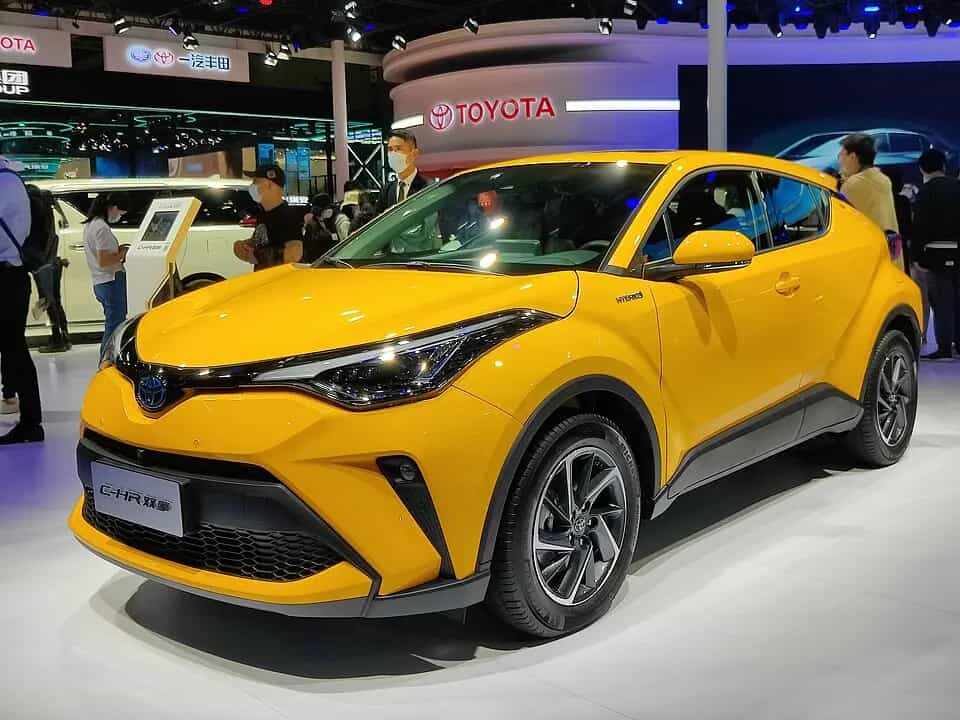
Toyota C-HR
Importing a used Toyota C-HR from the USA
The Toyota C-HR is a striking subcompact crossover that Toyota sold in the United States from the 2018 to the 2022 model year. As an independent broker, USCar Trader imports used C-HRs on your behalf without adding a vehicle margin. There is an interesting origin twist here that matters for customs: the US-market C-HR was not built in America but in Turkey (and, earlier, Japan), so an American-registered C-HR you import is typically a Turkish-built car. If you want a distinctively styled, economical and famously reliable small Toyota crossover, here is what to know before you import a used Toyota C-HR from the USA.

Model history: years and generations
The US C-HR belongs to the first generation, launched globally for 2017 and in the US for 2018. It sits on Toyota's TNGA-C platform, shared with the Corolla and Corolla Hatchback, which gives it a composed chassis and tidy handling for the class. A useful refresh for 2020 updated the front styling, added Android Auto to complement the existing Apple CarPlay, and expanded the trim range. Toyota withdrew the C-HR from the US after 2022, replacing it in showrooms with the Corolla Cross. A new, all-electric C-HR is planned for the US market for 2026, but for a used import from the American market you are looking at the 2018 to 2022 petrol cars.
Engines, transmissions and drive
The US C-HR is a single-powertrain car: a 2.0-litre naturally aspirated four-cylinder from Toyota's M20A family producing around 144 hp and roughly 184 Nm, driving the front wheels through a CVT automatic with a physical launch gear for smoother starts. All-wheel drive was never offered on the US C-HR, and there was no hybrid version in America, unlike Europe. Performance is modest and the car is tuned for economy and refinement rather than pace, but the drivetrain is exactly the kind of simple, durable Toyota engineering that makes running costs low.
Equipment lines and body styles
The C-HR is a five-door, five-seat crossover with a coupe-like roofline and hidden rear door handles. US trims run LE, XLE and Limited, with the sporty-looking Nightshade Edition added later for blacked-out exterior details. Higher trims add blind-spot monitoring, larger wheels, leather-trimmed seats, dual-zone climate and upgraded audio. Toyota Safety Sense with adaptive cruise, lane-departure alert and automatic emergency braking was standard across the range, so even base US cars are well equipped for safety.
The US used market
Availability is solid for a car with a five-year US run. Typical import candidates are 2018 to 2022 cars with light to moderate mileage, often from urban owners who valued the styling and easy footprint. As always, favour cars from dry southern and western states to minimise underbody corrosion, and prefer 2020-or-later cars for the styling refresh and Android Auto. Interiors are durable and the mechanicals rarely give trouble.
Is an import right for you?
The C-HR suits a buyer who wants a small, stylish, dependable crossover with low running costs and does not need all-wheel drive or strong acceleration. It is easy to park, cheap to run and backed by Toyota's reliability reputation. If you need more space or a hybrid, the related Corolla Cross is worth a look; if the bold design and compact size appeal, the C-HR is the one to import.
Specs at a glance
| Attribute | Typical used Toyota C-HR (US, 1st gen) |
|---|---|
| Body style | Subcompact 5-door crossover |
| Platform | Toyota TNGA-C |
| Engine | 2.0 L four (M20A) |
| Output | approx. 144 hp |
| Torque | approx. 184 Nm |
| Transmission | CVT automatic |
| Drive | Front-wheel drive |
| Length | approx. 4,360 mm |
| Wheelbase | approx. 2,640 mm |
| Seating | 5 |
| Fuel | Petrol |
| Safety | Toyota Safety Sense standard |
| Assembly | Turkey (Sakarya) |
Common issues buyers should know
Toyota C-HR reliability is a real strength; the 2.0 M20A engine and CVT are among the more dependable powertrains in the subcompact class. The most frequent complaints are not mechanical but ergonomic: rear visibility is poor because of the high beltline and small rear glass, and rear-seat space is tight. On the mechanical side, watch for the usual small-car items, such as 12-volt battery health, occasional infotainment quirks on early cars, and normal wear to suspension bushings and tyres. Some owners note the CVT can feel droning under hard acceleration, which is a characteristic rather than a fault. Confirm the engine has had regular oil changes and the CVT fluid has been checked at the recommended intervals.
Differences from the European version
The most important difference is the drivetrain: the US C-HR is petrol-only and front-wheel drive, whereas Europe offered hybrids. US cars use MPH-primary instruments, US-spec headlights (beam pattern, frequently no rear fog lamp) and US-market infotainment and radio bands. Because the car itself was built in Turkey for both markets, the underlying hardware is very familiar to European workshops, which simplifies servicing.
Import step by step
Select the car and verify the VIN and build origin. Pull a Carfax or AutoCheck history for accidents, title status and odometer consistency. Secure the purchase through escrow rather than a direct wire to an unknown seller. Book roll-on/roll-off or container ocean freight to a North Sea port. Clear German customs on arrival. Present the car for TUEV individual approval with lighting and instrument changes completed. Register it locally. USCar Trader coordinates the chain as your broker while you remain the buyer of record.
Customs and taxes: what applies
Remember: no origin proof, no 0% duty – and 19% German import VAT is due on every import.
Two separate charges apply. The EU import duty depends on the actual country of manufacture. The 0% rate introduced on 1 July 2026 under Regulations (EU) 2026/1455 and 2026/1461 applies only to cars of provable US origin. The US-market C-HR is built in Turkey, so it does not qualify for the US-origin 0% rate; the applicable rate is determined by the plant and origin evidence, and for a non-US-origin passenger car the standard rate is 10%. Separately, the 19% German import VAT (Einfuhrumsatzsteuer) always applies. We never advertise duty-free import and we itemise both charges honestly, with no vehicle margin from USCar Trader.
Modifications and single-vehicle approval
Typical work is limited: adapt the headlights to a compliant beam pattern, fit or activate a rear fog lamp, and have the odometer and displays assessed. Once the individual approval (Einzelabnahme) is issued, registration proceeds normally.
What to verify before buying
Confirm the VIN matches the title and note the Turkish build origin. Pull a full Carfax/AutoCheck for accidents and title brands. Inspect the underbody for rust and prefer dry-state cars. Verify oil-change and CVT-service history. Check tyres, 12-volt battery and infotainment. Confirm the title is clean rather than salvage or rebuilt.
Common questions
Can I import a used Toyota C-HR from the USA duty-free?
No. The US-market C-HR is built in Turkey, so it does not qualify for the US-origin 0% duty; the standard 10% rate applies, plus the 19% import VAT.
Does the US Toyota C-HR have all-wheel drive or a hybrid?
No. The US C-HR is front-wheel drive and petrol-only; the hybrid and AWD options were European-market features.
Which model years should I import?
The US C-HR ran from 2018 to 2022. A 2020-or-later car is preferable for the styling refresh and Android Auto support.
Is the Toyota C-HR reliable?
Yes. The 2.0 engine and CVT are dependable. The main drawbacks are tight rear space and limited rear visibility, not mechanical faults.
What replaced the C-HR in the US?
Toyota replaced it with the Corolla Cross after 2022; a new electric C-HR is planned for the US for 2026.
How long does importing take?
Usually several weeks, driven mainly by ocean freight scheduling and TUEV appointment availability.
Does USCar Trader sell new Toyota cars?
No. We are an independent broker for used US vehicles only, with no manufacturer partnership and no vehicle margin.
Ready to start? Browse Toyota in the Carhub, compare related crossovers such as the Toyota Corolla Cross and the Toyota RAV4, or the Toyota Corolla, and view current C-HR listings.