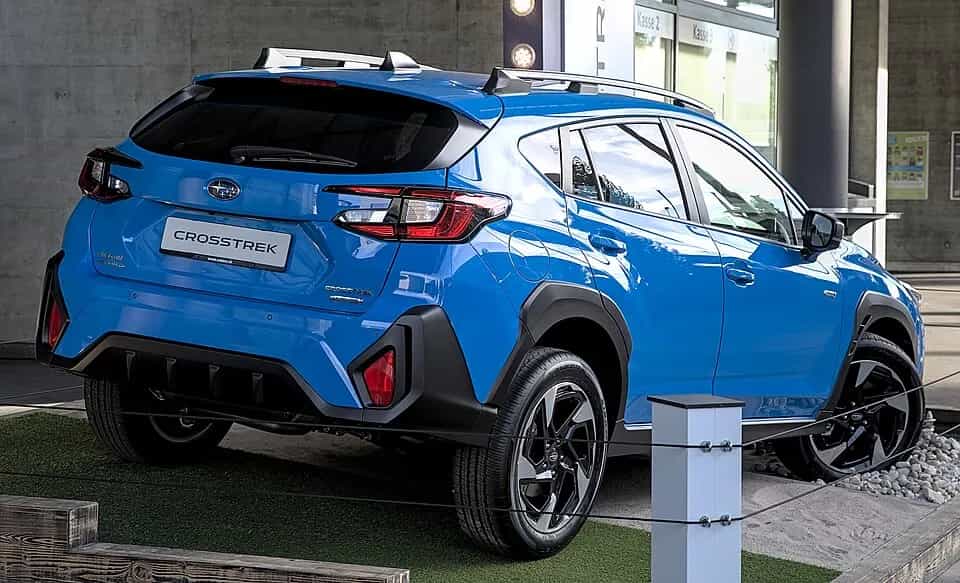
Subaru Crosstrek
Importing a used Subaru Crosstrek from the USA
The Subaru Crosstrek is one of the most abundant compact crossovers on the American used market, and that abundance is exactly what makes it interesting for a German buyer. Standard symmetrical all-wheel drive, a boxer engine, genuine ground clearance and a lifted Impreza body give it a character no European rival copies directly. As an independent broker for used US vehicles, USCar Trader sources these cars from private sellers, auctions and franchised trade-ins across the States, then handles the ocean freight, customs clearance and paperwork so a car built for Colorado winters can end up registered in Germany.

From launch to today
The nameplate launched for 2013 as the XV Crosstrek, dropping the XV prefix from 2016. That first generation (2013-2017) sat on the Impreza platform and introduced the recipe: 220 mm of ground clearance, plastic wheel-arch cladding and Lineartronic CVT or a 5-speed manual. A gas-electric Crosstrek Hybrid ran from 2014 to 2016. The second generation (2018-2023) moved to the Subaru Global Platform, gaining a stiffer shell, better refinement and, from 2019, a 2.5-litre engine on Sport and Limited grades plus a Plug-in Hybrid with a modest electric range. The current third generation arrived for 2024 with sharper styling, an updated interior and a larger portrait touchscreen. From this generation, Crosstreks are also assembled at Subaru of Indiana in Lafayette alongside Japanese production, which matters for import duty.
Engines and drivetrain in detail
Base cars use the naturally aspirated 2.0-litre FB20 flat-four, roughly 148-152 hp and 145 lb-ft, paired with the Lineartronic CVT and full-time AWD. From 2019, Sport and Limited trims received the 2.5-litre FB25 boxer, around 182 hp and 176 lb-ft, which transforms overtaking and highway cruising. Early first-generation cars could still be had with a 5-speed manual, prized by enthusiasts, but the manual disappeared as the range matured. Every Crosstrek runs Subaru's symmetrical all-wheel drive with an X-Mode traction system on most trims, and hill-descent control on higher grades. This is the drivetrain that gives the car its reputation on gravel, snow and forest roads.
Trim levels and variants
The Crosstrek is a five-door crossover hatchback only; there is no coupe or long-wheelbase variant. US trim ladders have run from Base and Premium through Sport, Limited and the off-road-flavoured Wilderness (2024 onward), which adds retuned suspension, all-terrain tyres and greater clearance. Higher trims bring the larger STARLINK infotainment, heated seats, EyeSight driver assistance, moonroof and a power tailgate. Because American buyers option cars generously, imported examples frequently carry equipment German-market compacts charge extra for.
Used availability in the USA
Supply is deep and geographically spread. Crosstreks sell strongly in the northern states, the Pacific Northwest and mountain regions, so well-kept, rust-aware cars are realistic finds. Typical import candidates fall in the 2017-2022 window with mileage that reflects commuter or outdoor-lifestyle use. Look closely at winter-belt cars for underbody corrosion and at desert-state cars for sun-baked trim and tyres. Because the model sold in huge numbers, you are choosing from many examples rather than settling for one.
When importing makes sense
A used Crosstrek suits a buyer who wants dependable all-weather traction, a raised driving position and a compact footprint without the running costs of a large SUV. It appeals to anyone importing a specific US-spec configuration, a Wilderness grade or simply a clean, well-optioned example at a value the German market rarely matches. If you tow heavy or cover long autobahn distances at speed, the 2.5-litre car is the one to seek out.
Facts and figures
| Item | Detail (typical US-spec) |
|---|---|
| Body style | 5-door compact crossover |
| Base engine | 2.0 L FB20 flat-4 (boxer) |
| Base output | approx. 148-152 hp / 145 lb-ft |
| Optional engine | 2.5 L FB25 flat-4 (2019+) |
| Optional output | approx. 182 hp / 176 lb-ft |
| Transmission | Lineartronic CVT (early 5-speed manual) |
| Drive | Symmetrical all-wheel drive (standard) |
| Ground clearance | approx. 220 mm (8.7 in) |
| Length | approx. 4,485 mm |
| Kerb weight | approx. 1,430-1,560 kg |
| Fuel tank | approx. 63 L |
| Towing (braked, US rating) | approx. 680-1,500 lb depending on trim |
| Seating | 5 |
| Fuel | Petrol (regular) |
Reliability and common problems
Crosstrek reliability is generally strong, but a few patterns are worth knowing before you buy. Some 2.5-litre FB25 engines consume oil, so check the level and service history carefully and budget for regular top-ups on affected cars. The Lineartronic CVT is durable when serviced but expensive to replace if neglected; confirm the fluid has been changed and listen for shudder. Second-generation cars had reports of STARLINK infotainment freezes and parasitic battery drain, often addressed by software updates. Wheel bearings, rear differential mounts and the occasional oil-cooler seal are typical age-related items. Front windscreens are large and stone-chip prone, and cameras for EyeSight sit behind the glass, so replacement glass must be recalibrated.
How US versions differ
US cars use amber rear turn signals in many years but often combine them with red brake lenses that need checking against German lighting rules; a rear fog lamp is not fitted from the factory and must be retrofitted. Headlights are US-beam pattern and the speedometer reads in mph. Daytime running lights, tyre-pressure monitoring and EyeSight function normally, though menu language and radio bands may differ. These are routine conversion points rather than obstacles.
From US purchase to registration
Selection of a specific car; VIN and origin check to establish the build plant (Japan or Lafayette, Indiana); secured payment via escrow; inland transport to the export port and ocean freight to a European harbour such as Bremerhaven; customs clearance on arrival; a German TUEV individual approval (Einzelabnahme) with any required modifications; then registration at your local authority. USCar Trader coordinates each stage and keeps you informed as the car moves.
Costs, duty and taxes at a glance
In short: the 0% duty rate applies only with documented US origin (VIN/plant) – German import VAT of 19% is always due.
Two charges are separate and must not be confused. First, import duty: because the Crosstrek carries a neutral origin, the rate depends on where your specific car was actually built. A US-plant car (Lafayette, Indiana) with provable US origin via VIN and plant code can qualify for the 0% EU import duty under Regulations (EU) 2026/1455 and 2026/1461, valid since 1 July 2026 for direct transport until 31 December 2029. A Japanese-built Crosstrek does not qualify and is charged the standard third-country passenger-car duty. There is nothing automatic or guaranteed here; origin must be proven. Second, and always payable regardless of origin, is the 19% German import VAT (Einfuhrumsatzsteuer). USCar Trader adds no margin and simply passes through freight, duty and VAT as they fall.
TÜV, approval and license plates
Expect to retrofit a rear fog lamp, verify or adjust the headlight beam pattern, and confirm the mph speedometer is acceptable or add a km/h reference. The odometer reading is documented for the individual approval. Once TUEV issues the paperwork, the car is registered normally and receives German plates.
Pre-purchase checklist
- Decode the VIN and confirm the build plant for the duty question.
- Pull a full Carfax or AutoCheck history for accidents, title and mileage.
- Inspect the underbody for rust on northern-state cars.
- Confirm CVT fluid and boxer-engine service records.
- Check oil consumption on 2.5-litre cars.
- Verify a clean (not salvage or rebuilt) title.
- Test EyeSight cameras and STARLINK for faults.
Import FAQ
Can I import a used Subaru Crosstrek from the USA to Germany?
Yes. USCar Trader brokers used US-market Crosstreks and manages freight, customs and the TUEV process end to end.
Is the import duty really 0%?
Only if your specific car is provably US-built (for example the Lafayette, Indiana plant) under the current EU regulations. Japanese-built cars pay the standard duty. Origin is verified by VIN and plant code, never assumed.
Does the 19% import VAT always apply?
Yes. The German Einfuhrumsatzsteuer of 19% is due on every import regardless of the car's origin.
Which engine should I look for?
The 2.5-litre FB25 (2019 onward, Sport and Limited) offers noticeably stronger highway performance than the 2.0-litre base engine.
Are Crosstreks reliable?
Broadly yes, with oil consumption on some 2.5 engines and CVT servicing being the main points to check.
What mileage is normal for an import candidate?
Cars in the 2017-2022 range with commuter mileage and documented service are the sweet spot.
Do I need to change the lighting?
Typically yes: a rear fog lamp retrofit and a headlight check are standard TUEV items.
How long does the whole import take?
From purchase to German registration usually spans several weeks, driven largely by ocean-freight scheduling.
Browse the full Subaru in the Carhub, compare the closely related Subaru Forester and Subaru Outback, or view current Crosstrek listings to start your import.