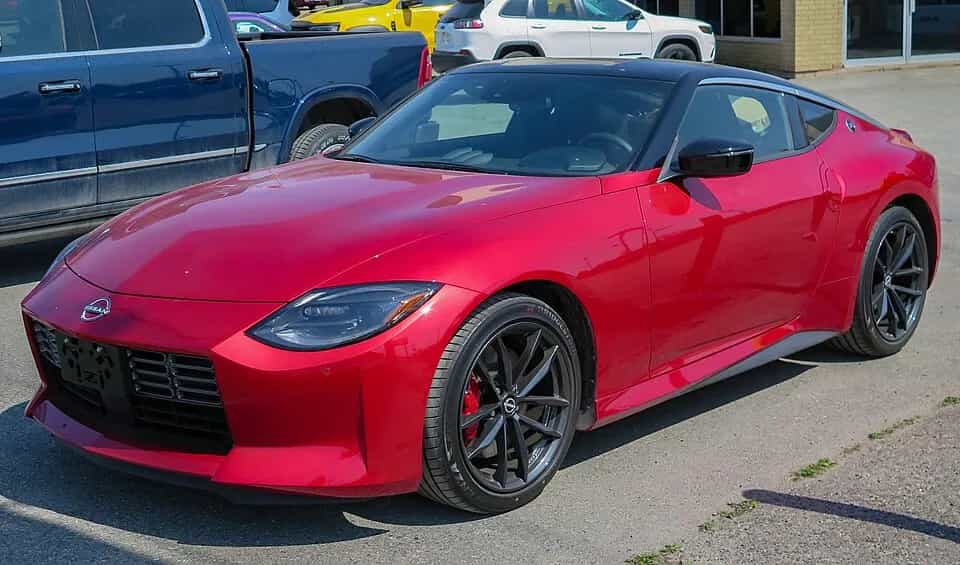
Nissan Z
Importing a used Nissan Z from the USA
The current Nissan Z is exactly the kind of car that makes importing from America worthwhile: a front-engine, rear-drive sports coupe with a twin-turbo V6 and a proper six-speed manual, sold in far greater numbers and variety in the United States than in Europe. For German enthusiasts, the appeal is straightforward — a modern, analogue-feeling sports car with retro styling that nods to the 240Z and 300ZX, available used in the US market well before comparable European supply materialises. If you want to import a used Nissan Z from the USA, you are buying one of the last affordable turbocharged manual coupes still in production.

Model history and generations
The car launched for the 2023 model year under the internal code RZ34, replacing the long-running 370Z (Z34). It keeps the essential front-mid-engine, rear-drive layout of its predecessors but wraps it in new bodywork and a thoroughly modernised interior with a digital instrument cluster and updated infotainment. A high-performance Z Nismo joined the range for 2024, sharpening both the output and the chassis. Because the model is recent, every used example on the American market is low-mileage and close to current specification.
Engines and drivetrain
The heart of the Z is the VR30DDTT, a 3.0-litre twin-turbocharged V6 producing around 400 hp and 350 lb-ft of torque — the same engine family found in the Infiniti Q60 Red Sport. Drive goes to the rear wheels through either a genuine six-speed manual with a rev-matching function or a nine-speed automatic with paddle shifters. The Z Nismo raises output to roughly 420 hp and is offered exclusively with the automatic, tuned for quicker responses. A limited-slip differential features on the manual and performance versions, and larger brakes come with the higher trims.
Which trim makes sense
The Z is a two-seat coupe only. US trims run Sport, Performance and the range-topping Nismo, plus early launch-edition cars called the Proto Spec. The Performance grade adds the mechanical LSD, larger brakes, wider wheels and adaptive-feel extras, while the Sport is the leaner, lighter entry point. Options that show up frequently on US cars include the Bose audio system, heated seats and the digital gauge cluster with a dedicated track display.
Supply on the US market
Being a new-generation car, the used pool is made up of nearly new examples, typically 2023–2025 with low mileage. Manual-transmission cars are genuinely available in the US, which matters because they are the enthusiast's choice and are harder to find elsewhere. Condition is generally excellent, though a few cars will have been modified or tracked, so history and a careful inspection remain important even on young vehicles.
Who benefits from importing
The Z suits the driver who wants a turbocharged rear-drive coupe with a manual gearbox and distinctive looks, the buyer chasing the Nismo before European supply appears, and anyone who values the analogue character that most rivals have abandoned. It is not the car for buyers needing rear seats, all-wheel drive or low running costs.
Technical data
| Vehicle class | Two-seat sports coupe |
| Generation | RZ34 (2023–) |
| Engine | VR30DDTT 3.0 L twin-turbo V6 |
| Power (Sport/Performance) | approx. 400 hp |
| Power (Nismo) | approx. 420 hp |
| Torque | approx. 350 lb-ft |
| Transmission | 6-spd manual w/ rev-match / 9-spd automatic |
| Drive | Rear-wheel drive |
| Differential | Limited-slip (manual / Performance) |
| Body | 2-door coupe |
| Seats | 2 |
| Fuel | Petrol (premium) |
| US trims | Sport, Performance, Nismo, Proto Spec |
| Origin (import) | Neutral — determined by VIN/plant |
Known weak points and maintenance
As a young design built on proven Nissan/Infiniti hardware, the Z has no long-term chronic faults yet, but a few points are worth noting. The VR30DDTT V6 runs hot under sustained track use, so an oil cooler and careful cooling maintenance matter for cars that see circuit time; watch for evidence of hard use and check for oil leaks around the turbos. Early cars had software refinements to the nine-speed automatic's shift logic, so confirm updates were applied. The clutch and rev-match system on manual cars are durable but should be tested for smooth engagement. Overall Nissan Z reliability looks strong, and reported common problems are minor and mostly tied to abuse rather than design.
US and EU spec compared
The Z was sold widely in the US from launch, so the American used market simply has more cars, more manuals and more Nismo examples than Europe. The legal differences for import are the familiar ones: US headlamps, amber front side markers and red rear markers that are not ECE-compliant, and the absence of a rear fog lamp. The speedometer reads in mph, and the infotainment is configured for the US market.
The import process in detail
Choose the exact car and confirm its condition; verify the VIN and the actual build plant to establish the customs origin; place funds in escrow rather than paying the seller directly; arrange ocean freight from a US port; clear customs at a European port such as Bremerhaven; complete the TUEV and individual approval (Einzelabnahme); then register the car with your local authority.
What customs clearance really costs
Bottom line: what matters is the factory shown by the VIN – proven US origin unlocks 0% duty. The 19% import VAT always applies.
The Z carries a neutral origin, so the import duty is not fixed in advance — it depends on where the specific car was actually built, which the VIN and plant code confirm. Where provable US origin exists, the 0% preferential EU rate under Regulations (EU) 2026/1455 and 2026/1461 can apply for direct transport (in force since 1 July 2026, through 31 December 2029); where the plant is elsewhere, the standard passenger-car rate applies. Separately and in every case, the 19% German import VAT (Einfuhrumsatzsteuer) is due on the customs value. We never call any import duty-free or guaranteed, and we take no margin.
TUEV, modifications and registration
Expect to fit ECE-compliant headlights and side markers, add a rear fog lamp, and have the speedometer verified or converted to km/h. Any aftermarket exhaust, suspension or wheel changes must be documented and approved. The car is otherwise well suited to individual approval once the lighting is compliant.
Check before you buy
- Decode the VIN and confirm the build plant for the customs origin.
- Pull a Carfax or AutoCheck report for accident and title history.
- Inspect for signs of track use, aftermarket tuning or modified ECU.
- Check the turbos and cooling system for leaks or heat damage.
- Test the clutch and rev-match on manual cars for smooth engagement.
- Verify the title is clean, not salvage or rebuilt.
Common questions
Can I import a manual Nissan Z from the USA?
Yes, and the manual is genuinely available in the US market, which is a major reason enthusiasts import the Z.
Does the 0% customs rate apply to a Nissan Z?
Only where the VIN proves US origin. The Z is neutral origin, so the rate depends on the actual plant. The 19% import VAT always applies.
How much power does the Nissan Z make?
Around 400 hp from the twin-turbo V6, rising to roughly 420 hp in the Nismo.
Is the Nissan Z reliable?
So far yes; it uses proven hardware. Focus your inspection on evidence of track use and cooling health.
Can I import the Z Nismo?
Yes. The Nismo is automatic only and rarer, so expect a higher purchase price and more competition for clean cars.
What TUEV changes are needed?
Mainly lighting: ECE headlights and markers plus a rear fog lamp, and the speedometer in km/h.
How is the car shipped?
By RoRo or container from a US port to a European port, then customs clearance and inland transport.
How long does the import take?
Typically several weeks from purchase to registration, mostly ocean freight and customs time.
Browse the full range in the Nissan in the Carhub, compare it with the older Nissan 370Z and the flagship Nissan GT-R, or cross-shop the Toyota GR86, and view current Nissan Z listings.