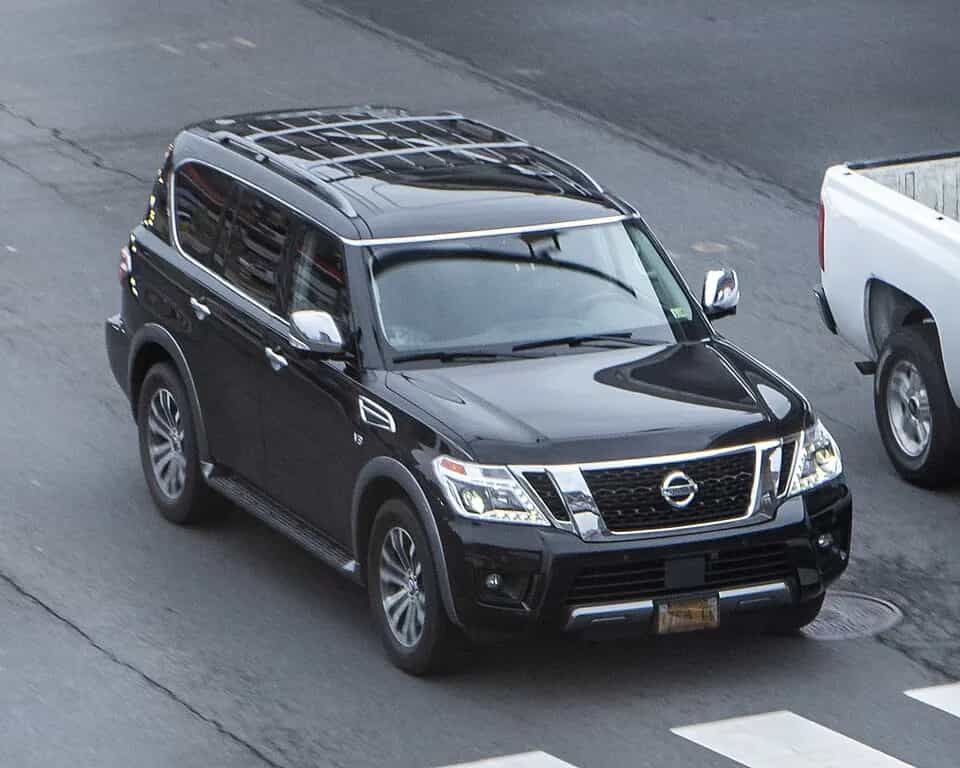
Nissan Armada
Importing a used Nissan Armada from the USA
The Armada is Nissan's full-size, body-on-frame SUV, a rugged eight-seater built around the same mechanical hardware as the Patrol and the Titan pickup. It was never a common sight on German roads, which is exactly the appeal for buyers who want a genuinely large, tow-capable American-market SUV. Importing a used Nissan Armada from the USA gives you a lot of vehicle for the money, but the neutral origin and the Japanese build location make the customs picture something to understand up front.

Model history: years and generations
The Armada nameplate arrived in the US in 2004 on the F-Alpha platform. The relevant used cars for import today are mostly the second generation, launched for the 2017 model year, which switched the Armada to the global Patrol (Y62) architecture. This generation received a significant mid-cycle refresh for 2021 with new front styling, a larger touchscreen and updated driver-assist. For 2025 Nissan launched an all-new third-generation Armada with a twin-turbo V6, so the used market now spans the long-running 2017 to 2024 V8 cars and the newest V6 models. The bulk of affordable used stock is the 2017 to 2024 range.
Engines, transmissions and drive
The heart of the second-generation Armada is Nissan's VK56VD 5.6-litre naturally aspirated V8, producing around 390 hp and 560 Nm, driving through a seven-speed automatic. It is a smooth, torquey, old-school engine that suits the car's relaxed character and gives it a healthy towing rating. Rear-wheel drive is standard, with a proper part-time four-wheel-drive system optional and common on higher trims. The 2025 third-generation car replaces the V8 with a 3.5-litre twin-turbo V6 producing around 425 hp and a nine-speed automatic, but most imports for the next few years will be the V8.
Equipment lines and body styles
The Armada is a five-door, three-row full-size SUV seating seven or eight. US trims run through SV, SL and the well-equipped Platinum, with a luxury-focused Reserve trim added later. Platinum cars bring leather, a Bose audio system, heated and cooled seats, a rear entertainment system, and the fullest driver-assist package. The closely related Infiniti QX80 is the upmarket twin. There is no diesel and no short-wheelbase version in the US line-up.
The US used market
Armada volumes are modest compared with mainstream SUVs, but there is a steady supply of used cars from 2017 onward, many well-equipped Platinum examples from warm-climate states. Typical mileage reflects family and highway use. Because these are large, comfortable cruisers, many have covered high freeway distances, so a thorough history check is important. Condition is generally good on garage-kept Platinums; watch for towing wear on cars used as trailer haulers.
Is an import right for you?
The Armada suits a buyer who genuinely needs a big three-row SUV with strong towing capacity, eight seats, and a comfortable V8 cruising character, and who wants something far removed from the usual European large SUVs. It rewards drivers who value space and towing over fuel economy and tight-street manageability. If you mostly drive in cities or care deeply about running costs, the Armada's size and thirst will be a daily consideration.
Specs at a glance
| Body style | 5-door, 3-row full-size SUV |
| Platform | Nissan Y62 (Patrol) body-on-frame |
| Engine (2017-2024) | 5.6 L VK56VD V8, approx. 390 hp |
| Torque | Approx. 560 Nm |
| Engine (2025+) | 3.5 L twin-turbo V6, approx. 425 hp |
| Transmission | 7-speed automatic (V8) |
| Drive | RWD or part-time 4WD |
| Length | Approx. 5,306 mm |
| Wheelbase | Approx. 3,075 mm |
| Kerb weight | Approx. 2,600-2,720 kg |
| Towing capacity | Up to approx. 3,855 kg |
| Seating | 7 or 8 |
| Fuel tank | Approx. 98 L |
| Fuel | Petrol |
| Origin | Typically built in Kyushu, Japan |
Common issues buyers should know
The VK56 V8 has a strong reputation for durability, which is a big part of the Armada's appeal, but the car is not trouble-free. Owners report brake wear on the heavy chassis, occasional issues with the electronic tailgate and sliding second-row mechanisms, and infotainment lag on pre-2021 cars. Some report intermittent electrical faults and, on higher-mileage cars, front suspension and steering-component wear. Fuel economy is heavy by nature. When researching Nissan Armada reliability and common problems, focus on transmission service history, brake and suspension condition, and whether the cooling system has been maintained, since these large V8s work hard when towing.
Differences from the European version
US Armadas use US-spec lighting with no rear fog lamp, amber side markers and US beam patterns that must be adapted. Infotainment, radio tuning and navigation are set for North America. The car is wide by European standards, which matters for garages and narrow streets, and some driver-assist features are calibrated for US roads. Displays default to US units. These are all handled during approval but should be anticipated.
Import step by step
Start by selecting the right Armada and trim. Run a VIN and origin check; the Armada is typically built in Japan, so this step is decisive for the customs rate. Pay via secure escrow, book ocean freight to a German port such as Bremerhaven, then clear customs on arrival. Present the car for TUEV individual approval, complete any required modifications, and register it with your local authority.
Customs and taxes: what applies
Bottom line: what matters is the factory shown by the VIN – proven US origin unlocks 0% duty. The 19% import VAT always applies.
USCar Trader is an independent broker and takes no margin on the vehicle. Two separate charges apply. The customs duty depends on the provable origin: for a car with documented US origin, Regulations (EU) 2026/1455 and 2026/1461 allow a 0% rate from 1 July 2026 under direct transport and valid VIN/plant proof, in force until 31 December 2029. Because the Armada is typically manufactured in Japan rather than the USA, the standard duty rate normally applies, and this must always be confirmed against the actual VIN rather than assumed. Separately, the 19% German import VAT (Einfuhrumsatzsteuer) applies on the customs value in every case, regardless of origin. We never promise duty-free or guaranteed rates.
Modifications and single-vehicle approval
Typical work includes adapting the headlights, fitting a rear fog lamp, and confirming metric speedometer and odometer readings. Wide-body dimensions and lighting are checked. Once the TUEV individual approval is issued, you register the car and receive German plates.
What to verify before buying
Confirm the VIN and build plant. Order a Carfax or AutoCheck history for accidents and title status. Verify transmission and cooling-system service, especially on towing cars. Inspect brakes, suspension and the power tailgate. Check the title is clean, not salvage or flood. Test the four-wheel-drive system and all three rows of seating.
Common questions
Will I pay import duty on an Armada?
Probably yes. The Armada is typically built in Japan, so the standard duty usually applies unless a US-origin VIN can be proven.
Does the 19% import VAT always apply?
Yes. The German import VAT of 19% applies on every import regardless of the duty rate.
Is the Nissan Armada reliable?
The VK56 V8 is durable; the main concerns are brakes, suspension wear and infotainment lag on older cars.
How much can the Armada tow?
Suitably equipped V8 cars are rated up to roughly 3,855 kg, which is strong for the class.
How many seats does it have?
Seven or eight depending on whether it has second-row captain's chairs or a bench.
Which trim is best to import?
The Platinum is the most complete, with leather, Bose audio and the fullest driver-assist package.
Is it very thirsty?
Yes. It is a large V8 SUV and fuel consumption is high, especially when towing.
How long does the import take?
Typically several weeks from purchase to registration, driven by ocean freight and the TUEV appointment.
Explore more with Nissan in the Carhub, compare the Nissan Pathfinder and the Infiniti QX80, or browse the current Armada listings.