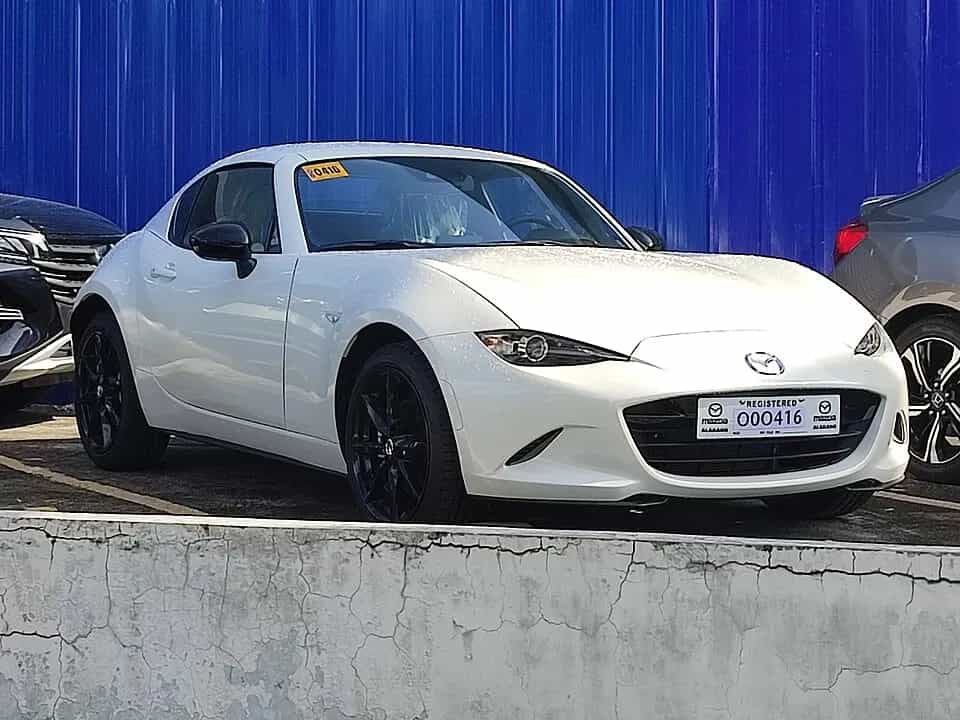
Mazda MX-5 Miata RF
Importing a used Mazda MX-5 Miata RF from the USA
The MX-5 Miata RF turns the world's favourite lightweight roadster into a targa-topped coupe, and the American market bought them in large numbers under the Miata name. That makes the US a rich hunting ground for the retractable-fastback version, especially in colours and trims that were popular there. Importing a used Mazda MX-5 Miata RF from the USA gives a German enthusiast a wider choice of well-kept, sun-belt cars, many of which have led the easy weekend life these little sports cars were made for.
The ND-generation MX-5 is built at Mazda's Hiroshima plant in Japan, so a US-market Miata RF is Japanese in origin rather than American. Under the current rules the applicable EU import duty depends on the vehicle's actual origin, so USCar Trader checks the VIN and plant data on every car and sets expectations accordingly — a US-sold Miata does not automatically qualify for the 0% US-origin rate, and we never present it as guaranteed.

Model history: years and generations
The RF belongs to the fourth-generation MX-5, the ND, which launched for 2016 as a return to compact, lightweight roadster principles. The RF (Retractable Fastback) arrived for the 2017 model year, adding a power-folding hard roof with fixed rear buttresses that give it a mini-coupe silhouette when closed. A significant mid-life update came for 2019, when the 2.0-litre engine gained power and a higher redline, and detail improvements followed through the ND2 and ND3 updates including a steering-wheel telescope and revised limited-slip options.
Engines, transmissions and drive
US RF cars use the 2.0-litre Skyactiv-G four-cylinder. Early 2017-2018 cars make around 155 hp, while the 2019-onward revision lifts output to roughly 181 hp and raises the redline to 7,500 rpm, transforming the car's top-end urgency. Power goes to the rear wheels through a slick six-speed manual or a six-speed automatic. Enthusiasts overwhelmingly favour the manual, and higher trims add a limited-slip differential, Bilstein dampers and a front strut brace for sharper handling.
Equipment lines and body styles
The RF is sold only as the fastback body, distinct from the soft-top roadster. US trims run through Club and Grand Touring lines, with the Club aimed at driving purists (LSD, sport suspension, sometimes a BBS/Brembo/Recaro package) and the Grand Touring adding leather, adaptive lighting and comfort features. Because these cars are cherished, the US used market includes many low-mileage, well-optioned examples.
The US used market
Miata RFs are plentiful and generally well cared for, often second cars driven in fair weather. Cars from California, Arizona and the Southeast tend to have the cleanest bodies and no salt exposure. Mileages are usually modest for the age, and a documented service history is easy to find on such a mainstream, enthusiast-supported model. As always, a full Carfax or AutoCheck report and evidence of regular oil changes matter more than the odometer figure alone.
Is an import right for you?
The RF suits a driver who wants open-air motoring with a bit more security and refinement than the fabric roof, plus the coupe-like looks of the folded fastback. It is ideal as a weekend and back-road car rather than a load-carrier. Buyers who want the lightest possible MX-5 might prefer the soft-top, but for those drawn to the RF's styling and quieter cabin, importing a clean US car is a smart way to find the right specification.
Specs at a glance
| Attribute | Typical value (MX-5 Miata RF) |
|---|---|
| Body style | Two-seat retractable-fastback targa |
| Generation | ND (fourth generation), RF from 2017 |
| Engine | 2.0 L Skyactiv-G inline-four |
| Power 2017-2018 | approx. 155 hp |
| Power 2019 onward | approx. 181 hp |
| Redline (2019+) | 7,500 rpm |
| Transmission | 6-speed manual or 6-speed automatic |
| Drive layout | Rear-wheel drive |
| Differential | Limited-slip on Club/manual |
| Roof | Power-folding hardtop with fixed buttresses |
| Kerb weight | approx. 1,100 kg (RF, heavier than soft-top) |
| Fuel | Petrol |
| Assembly plant | Hiroshima, Japan |
| Origin | Japan — duty rate reflects actual origin |
Common issues buyers should know
The ND MX-5 is one of the more dependable sports cars you can buy, and the Skyactiv-G engine is a proven, undramatic unit. That said, a few MX-5 Miata RF common problems are worth knowing. Early 2016-2018 2.0-litre engines drew some attention for a small number of failures, largely resolved on later cars, so service history matters. The RF's power roof mechanism is more complex than the soft-top and should be exercised and inspected for smooth operation. Paint is thin and stone chips on the nose are common, and the infotainment on early cars feels dated. Owners also note some cabin wind and road noise. Regular oil changes and gentle warm-ups keep these engines healthy for the long term.
Differences from the European version
US Miatas run mph-primary instruments, US-market radio bands and FMVSS lighting. For German approval the headlights (beam pattern), side markers and the rear fog lamp are the main items, since a US car may not have a rear fog lamp fitted as standard. Mechanically the car is the same as the European MX-5 RF, which makes parts and servicing simple, and the tyre sizes are common.
Import step by step
The route is consistent: select and inspect the car in the US, run a VIN and origin check to establish the duty rate, pay via escrow, ship by ocean freight (container is popular for a low, valuable car), clear customs on arrival, pass TÜV and any individual approval, then register. USCar Trader handles each stage as an independent broker without marking up the car.
Customs and taxes: what applies
Remember: no origin proof, no 0% duty – and 19% German import VAT is due on every import.
Keep the two charges separate. First, the EU import duty: a 0% rate under Regulations (EU) 2026/1455 and 2026/1461 requires provable US origin and direct transport, valid from 1 July 2026 until 31 December 2029. Because the ND MX-5 is built in Japan, a US-sold RF will generally fall under the standard rate that applies to its actual origin rather than the US-origin 0% — the VIN check confirms this per car, and nothing is guaranteed. Second, and always payable, the 19% German import VAT (Einfuhrumsatzsteuer) is due on every import, calculated on the customs value plus freight and any duty. USCar Trader passes both through at cost.
Modifications and single-vehicle approval
Typical work includes fitting or converting headlights, adding a rear fog lamp, and confirming the speedometer. Any aftermarket exhaust, suspension or wheels fitted in the US must be documented and assessed. Once the TÜV report is issued the car is registered for its German plates.
What to verify before buying
Before buying a used MX-5 RF, work through these: decode the VIN and confirm the model year and engine revision; obtain a full Carfax or AutoCheck history; operate the folding roof through a full cycle and inspect it; check the front end and sills for stone chips or accident repair; verify service records, especially oil changes; confirm the title is clean; and inspect for any track use or modifications.
Common questions
Does a US MX-5 Miata RF qualify for 0% EU import duty?
Generally no, because the ND MX-5 is built in Japan, so it falls under the rate for its actual origin. The 0% US-origin rate requires provable US build, which this model does not have; the VIN confirms it per car.
Is the 19% import VAT always charged?
Yes. The German Einfuhrumsatzsteuer of 19% applies to every import regardless of the vehicle's origin or the duty rate.
Which model year should I look for?
The 2019-onward cars with roughly 181 hp and a 7,500 rpm redline are the enthusiast's pick, though clean early 155 hp cars remain enjoyable and often cheaper.
Manual or automatic?
Most buyers prefer the six-speed manual for the classic MX-5 experience, and manual Club cars often add a limited-slip differential.
How is the RF different from the soft-top?
The RF has a power-folding hardtop with fixed rear buttresses, giving a coupe-like look and a quieter cabin, at the cost of a little extra weight.
Are these cars reliable?
Yes, the ND MX-5 is very dependable. Just check service history on early 2.0-litre cars and confirm the roof mechanism works smoothly.
Will parts be easy to source in Germany?
Yes. The car is mechanically identical to the European MX-5 RF, so parts and servicing are straightforward.
What should I inspect on the body?
Check the nose and sills for stone chips and repairs, and look for any signs of track use, since these cars are popular for spirited driving.
Start with Mazda in the Carhub, compare it with the soft-top Mazda MX-5 Miata or rear-drive rivals like the Toyota GR86 and Subaru BRZ, or view current MX-5 Miata RF listings.