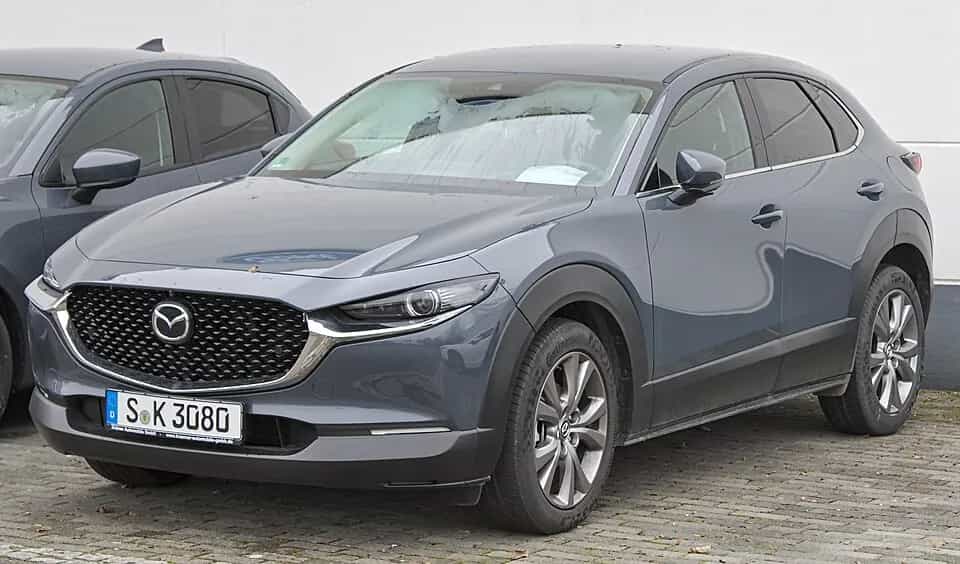
Mazda CX-30
Importing a used Mazda CX-30 from the USA
The Mazda CX-30 is a subcompact crossover that punches well above its size on material quality and driving feel. In the United States it is sold in trims and engine combinations that differ from the European line-up, most notably the potent 2.5-litre turbo, which makes a used US example genuinely appealing to enthusiasts here. USCar Trader acts as your independent broker: we find the right car, verify it, and manage the shipping and paperwork, without holding a franchise or taking a margin on the vehicle. If you want to import a used CX-30 from the USA, here is what you need to know.

Model history and generations
Mazda revealed the CX-30 in 2019 and it reached the US market as a 2020 model. It sits on the same platform as the current Mazda3 and slots between the tiny CX-3 and the larger CX-5. There has been one generation to date, with a mid-cycle update that added the turbocharged engine to the US range for 2021 and later refined the trim structure. The design language is Mazda's Kodo styling: long bonnet, minimal surface fussiness and a cabin that feels a class above the price. Interior updates over the years improved the infotainment and added extra standard driver assistance.
Engines and drivetrain
US CX-30s centre on two petrol fours. The standard 2.5-litre Skyactiv-G naturally aspirated engine produces around 186 hp and 252 Nm, a smooth and willing unit for everyday use. The headline choice is the 2.5-litre Skyactiv-G Turbo, rated at roughly 227 hp on regular fuel or about 250 hp on premium, with a stout 434 Nm. Both drive through a conventional six-speed automatic, which Mazda deliberately kept over a CVT for a more connected feel. Front-wheel drive is standard; Mazda's i-Activ all-wheel drive is widely available and common on turbo cars. Note that the European Skyactiv-X and mild-hybrid units were not offered in the US.
Which trim makes sense
The CX-30 is a five-door, five-seat crossover only. US trims run from the base model through Select, Preferred, Premium and the Turbo and Turbo Premium Plus grades. Higher trims add leather, a Bose sound system, a sunroof, adaptive cruise control, a head-up display and a 360-degree camera. American cars are frequently well equipped, so a used import can undercut the cost of a comparably specced European car while adding the turbo option that many buyers here covet.
Supply on the US market
The CX-30 sells strongly in the US, so availability of used examples is good across model years and trims. Expect the typical moderate mileage of an American daily driver, with plenty of one- to four-year-old cars coming off lease. We favour cars from dry southern and western states, where bodies and undertrays stay clean and the interiors avoid heat-cracked trim. Buying used means judging each car on history, condition and equipment rather than on any list price.
Who benefits from importing
A US CX-30 makes sense for the driver who wants premium feel and sharp handling in a compact footprint, and especially for anyone chasing the 2.5 Turbo AWD combination that offers hot-hatch pace in an understated crossover. It suits city and commuter use, smaller families and buyers who value build quality over outright space. If the turbo grade is what you are after, importing is often the most direct way to get it.
Technical data
| Attribute | Typical figure (2.5 Turbo AWD) |
|---|---|
| Body style | 5-door subcompact SUV |
| Seats | 5 |
| Engine | 2.5 L turbo inline-4 (Skyactiv-G) |
| Power | approx. 227-250 hp |
| Torque | approx. 434 Nm |
| Transmission | 6-speed automatic |
| Drivetrain | i-Activ AWD (FWD on base) |
| 0-100 km/h | approx. 6.0-6.5 s |
| Length | approx. 4.40 m |
| Wheelbase | approx. 2.65 m |
| Kerb weight | approx. 1,500-1,600 kg |
| Fuel | Petrol |
| Cargo (rear up) | approx. 570 L |
| Model years | 2020 onward |
Known weak points and maintenance
Mazda CX-30 reliability is a strong point, and the mechanicals are well proven, but a few Mazda CX-30 common problems deserve attention. The naturally aspirated 2.5 can experience carbon build-up over time, mitigated on later engines by cylinder deactivation and by keeping to service intervals. Early cars had software niggles with the i-Activsense driver aids and the infotainment, largely resolved by updates. Check the front-camera and radar calibration after any windscreen work, inspect the alloy wheels for kerb and pothole damage, and confirm the electric tailgate and sunroof operate cleanly. Brake wear can be moderate on turbo cars driven hard.
US and EU spec compared
US cars run miles per hour, US radio bands and psi tyre pressures, and the rear lighting and headlight beam pattern follow US standards. The turbo engine and the trim mix differ from Europe, and US fuel recommendations reference regular or premium octane by AKI rather than RON. Driver-assist features generally carry over, but the lighting is the main item for German approval. Factory navigation maps cover North America only; smartphone mirroring handles local routing.
The import process in detail
Selection comes first, with a careful options and turbo check. Then VIN and origin verification to establish the build plant. Payment is handled through escrow for security. The car is shipped by ocean freight to a northern European port, cleared through customs on arrival, presented for a German TUEV individual approval, and finally registered locally. We manage each step and keep the timeline transparent.
What customs clearance really costs
Key point: duty depends on the plant of build; only a VIN check secures the 0% rate. Import VAT of 19% applies regardless.
Two charges apply separately. The import duty rate depends on origin: the 0% rate under Regulations (EU) 2026/1455 and 2026/1461 (in force since 1 July 2026, direct transport, valid to 31 December 2029) applies only where US origin is provable. US-market CX-30s have typically been built in Mexico for North America, so the actual duty rate follows the plant shown by the VIN and documents; we never assume duty-free entry. The German import VAT (Einfuhrumsatzsteuer) of 19% always applies, calculated on customs value plus duty and freight. Both are stated openly and we add no margin.
TUEV, modifications and registration
Expect to verify or convert the headlights to European specification, confirm a working rear fog lamp, and have the odometer read and documented in kilometres. Without a COC, a US CX-30 goes through individual approval (Einzelabnahme) with a test report, after which you register the car at your local authority.
Check before you buy
Match the VIN across every document and decode the build plant. Pull a Carfax or AutoCheck report for accident, title and odometer history. Inspect the underbody and wheel arches for corrosion, particularly on northern-state cars. Confirm full service history with oil-change evidence. Verify a clean, non-salvage title, and test the driver aids, sunroof, camera and both keys.
Common questions
Where is the US Mazda CX-30 built?
US-market CX-30s have generally been produced in Mexico for North America, so the VIN and origin check determines the applicable customs rate.
Can I import the 2.5 Turbo version?
Yes. The turbocharged CX-30, often with i-Activ AWD, is one of the main reasons buyers here import a US example.
Does the 0% EU duty automatically apply?
No. It applies only with provable US origin. Given the Mexican build, the rate depends on the documented plant.
Is the 19% import VAT always charged?
Yes. The German Einfuhrumsatzsteuer of 19% is due on every import, separate from any duty.
How reliable is the CX-30?
It is among the more dependable cars in its class, provided the service history is complete and intervals were kept.
What about the headlights for TUEV?
US headlights usually need verification or conversion, and a rear fog lamp must be fitted and working for approval.
How much cargo space is there?
Around 570 litres with the rear seats up, competitive for a subcompact crossover.
Do you take a margin on the car?
No. USCar Trader is an independent broker; you pay the vehicle price plus transparent import costs.
See the full range in the Mazda in the Carhub, compare it with the larger Mazda CX-5 or the rugged Mazda CX-50, and browse the current CX-30 listings.