Importing a used Mazda CX-9 from the USA
An important planning note: the CX-9 is built in Hiroshima, Japan.
 0049 (0)89 2000 791 00
 Mo - Fr 8:00am - 8:00pm
USCar Trader import service
Choose a specific vehicle. Where data is available, its detail page shows the import cost calculation. We assess any possible duty benefit with you before purchase.
Important: A 0% EU import-duty rate may be available for a vehicle covered by Regulation (EU) 2026/1455 that has US origin and is imported directly into the EU. CETA may apply to a vehicle with preferential Canadian origin. Whether the requirements are met is assessed for the individual case. Please contact us before purchase; we review the possible duty benefit and provide non-binding support through the process. Import VAT and other costs are assessed separately.
CarHub · Mazda
The Mazda CX-9 is the three-row, seven-seat SUV Mazda aimed squarely at the American family market, and it is one of the better-driving vehicles in its class — a genuinely engaging big SUV with a premium-feeling cabin.

Price:30,499.00 USD

Price:24,308.00 USD

Price:25,071.00 USD

Price:11,376.00 USD

Price:11,367.00 USD
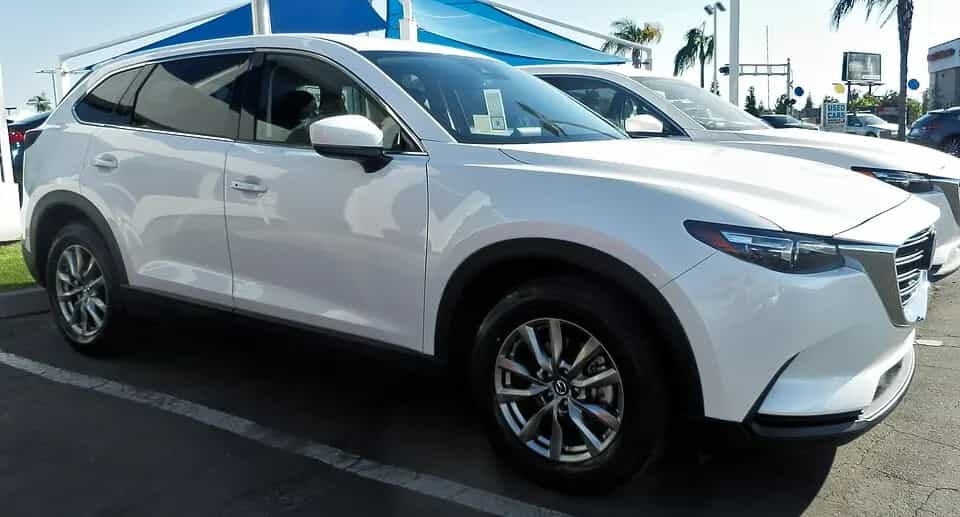
Model profile
An important planning note: the CX-9 is built in Hiroshima, Japan.
The CX-9 has run through two generations.
Powertrain and equipment
The first-generation CX-9 used a 3.5-litre and then a 3.7-litre Duratec V6 (around 273 hp), with a six-speed automatic and front- or all-wheel drive.
The CX-9 is a five-door, three-row SUV only. US trims ran Sport, Touring, Grand Touring and the range-topping Signature, the last of which brought Nappa leather, genuine rosewood trim, LED lighting and a more luxurious ambience.
Vehicle selection
Second-generation CX-9s from 2016–2023 are plentiful in the US used market, typically showing 50,000 to 160,000 km.
The CX-9 suits a buyer who wants a three-row family SUV that drives better and feels more premium than most rivals, in a design that is uncommon on European roads.
Vehicle data
| Body style | Typical value (2016–2023 CX-9): 5-door 3-row SUV, 6–7 seats |
|---|---|
| Length | Typical value (2016–2023 CX-9): approx. 5,075 mm |
| Wheelbase | Typical value (2016–2023 CX-9): approx. 2,930 mm |
| Kerb weight | Typical value (2016–2023 CX-9): approx. 1,900–2,050 kg |
| Seating | Typical value (2016–2023 CX-9): 6 or 7 |
| Engine | Typical value (2016–2023 CX-9): 2.5 L Skyactiv-G turbo four |
|---|---|
| Output | Typical value (2016–2023 CX-9): ~227 hp (regular) / ~250 hp (premium) |
| Torque | Typical value (2016–2023 CX-9): approx. 420 Nm |
| Transmission | Typical value (2016–2023 CX-9): 6-speed automatic |
| Drivetrain | Typical value (2016–2023 CX-9): FWD or i-Activ AWD |
| Fuel tank | Typical value (2016–2023 CX-9): approx. 74 L |
| Fuel type | Typical value (2016–2023 CX-9): Petrol |
| Towing capacity | Typical value (2016–2023 CX-9): approx. 1,588 kg (3,500 lb) |
|---|---|
| Build plant | Typical value (2016–2023 CX-9): Hiroshima, Japan |
Values are reproduced verbatim from the existing article table. The documents for the specific vehicle govern.
Pre-purchase review
The second-generation CX-9 is generally dependable, but there are known items. The infotainment and Bluetooth can be temperamental on earlier cars, and software updates address some of it. The 2.5 turbo is a robust engine, though there were water-pump and PCM-related campaigns on certain build ranges, and the brake booster was subject to a recall on some cars, so confirm those were handled.
Germany and Europe
US CX-9s run amber front turn signals, US-spec headlamps and no rear fog lamp, a miles-per-hour speedometer, and US navigation and units.
USCar Trader coordinates every step as your intermediary.
Typical work includes fitting a rear fog lamp, converting the lighting to European standard (rear signal function and headlamp compliance), verifying a km/h speedometer and documenting the odometer reading in kilometres.
USCar Trader services
As a buyer based in Germany, you do not have to inspect the vehicle yourself in the United States or Canada. Within the agreed scope, USCar Trader can coordinate document review, a separately commissioned on-site inspection and purchase processing.
Covered inspection points are agreed in advance. An on-site inspection records condition at the appointment and is not a guarantee.
Next step: Before commissioning, USCar Trader and the customer agree which document, history, inspection and transaction checks suit the vehicle and are included in the service. This records what was actually checked.
Import process
The import process for a Mazda CX-9 is planned around the specific listing, location, documents and commissioned service scope.
Questions and answers
No, not automatically. A 0% EU import-duty rate may be available for a vehicle covered by Regulation (EU) 2026/1455 that has US origin and is imported directly into the EU. CETA may apply to a vehicle with preferential Canadian origin. Whether the requirements are met is assessed for the individual case. Please contact USCar Trader before purchase; we review the possible duty benefit and provide non-binding support. Import VAT and other costs are assessed separately.
Generally yes. The 2.5 turbo is solid; check that water-pump, PCM and brake-booster recalls were completed and that any infotainment updates are installed.
The 2.5-litre Skyactiv turbo makes about 227 hp on regular fuel or 250 hp on premium, with a strong 420 Nm of torque.
Yes, it has three rows seating six or seven, though the third row is best suited to children or shorter trips, as with most SUVs its size.
The CX-9 is the mature, well-understood used option; the CX-90 that replaced it is newer and larger. For value and known reliability, the CX-9 is the pragmatic choice.
Usually several weeks: ocean freight is commonly two to five weeks, plus port handling, customs clearance and German registration.
Yes, after fitting a rear fog lamp, converting the lighting and confirming metric speedometer and odometer readings.
No. We are an independent broker and intermediary for used vehicles only; we hold no stock and add no vehicle margin.
More vehicles