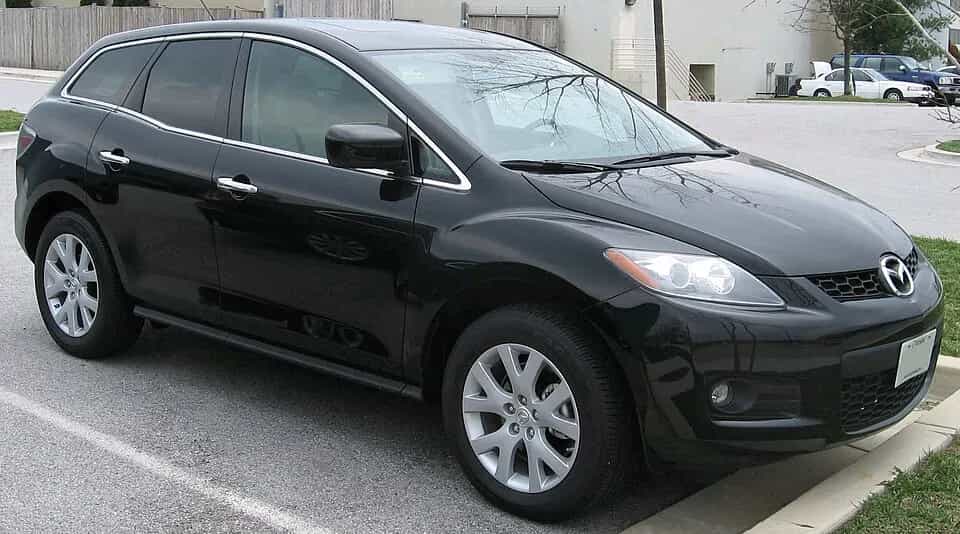
Mazda CX-7
Importing a used Mazda CX-7 from the USA
The Mazda CX-7 was Mazda's sporty mid-size crossover, and America was one of its biggest markets — which is exactly why the US used market is the best hunting ground today. It paired coupe-like styling with a turbocharged engine borrowed from the Mazdaspeed cars, giving it a driving character that stood apart from the sensible crowd. USCar Trader arranges the import from start to finish as an independent broker: sourcing, history verification, ocean freight, customs and German approval, with no dealer margin and no manufacturer tie-in.

Model history and generations
The CX-7 had a single generation, sold from the 2007 to the 2012 model year. It launched with a turbocharged engine and sharp, low-roof styling inspired by Mazda concept cars. A mid-cycle refresh for 2010 updated the front end and, importantly, added a naturally aspirated engine option to broaden appeal and improve running costs. Production ended in 2012 when the more conventional CX-5 took over Mazda's compact-crossover role.
Engines and drivetrain
The signature engine is the 2.3-litre MZR DISI turbo — direct-injected and turbocharged, producing around 244 hp — shared in concept with the Mazdaspeed3 and Mazdaspeed6. From 2010, a naturally aspirated 2.5-litre four (around 161 hp) joined as the entry engine for buyers who wanted lower fuel and insurance costs. The turbo was paired with a six-speed automatic and offered front-wheel drive or Mazda's Active Torque-Split all-wheel drive; the 2.5 was front-drive only with a five-speed automatic. The turbo cars are the enthusiast pick, but they demand disciplined maintenance.
Which trim makes sense
The CX-7 was a five-door, five-seat crossover only. US trims ran from Sport and Touring up to the loaded Grand Touring, which added leather, a Bose audio system, a sunroof, xenon headlights and heated seats. AWD was generally tied to the turbo engine, so a well-specified Grand Touring turbo AWD is the configuration many importers seek.
Supply on the US market
Being a one-generation model, supply is spread across 2007–2012 cars. Earlier cars are turbo-only; 2010-and-later cars give you the choice of the calmer 2.5. Mileage varies widely given the age, so condition and service history dominate. Southern and western US cars are frequently rust-free, which helps at the German inspection. Verify oil-change discipline carefully on turbo examples — it is the single biggest factor in long-term health.
Who benefits from importing
The CX-7 appeals to a buyer who wants a distinctive, sporty crossover with real turbo urge and a shape that has aged well — something you rarely see on German roads. If you understand that the turbo engine rewards proper care, importing a used Mazda CX-7 from the USA gives you a characterful alternative to the mainstream compact SUVs.
Technical data
| Body style | 5-door mid-size crossover |
| Generation | Single generation, 2007–2012 |
| Turbo engine | 2.3 MZR DISI turbo, ~244 hp |
| NA engine (2010+) | 2.5 inline-4, ~161 hp |
| Torque (turbo) | approx. 380 Nm |
| Transmission | 6-speed auto (turbo), 5-speed auto (2.5) |
| Drive | FWD or Active Torque-Split AWD |
| 0–100 km/h (turbo) | roughly 7.5 s |
| Length | approx. 4.68 m |
| Wheelbase | approx. 2.75 m |
| Kerb weight | roughly 1,700–1,850 kg |
| Fuel | Petrol (premium for turbo) |
| Seats | 5 |
| Boot | approx. 400 l (seats up) |
| Build country | Japan (Hiroshima) |
Known weak points and maintenance
The turbo CX-7 has well-known Mazda CX-7 common problems, most stemming from the direct-injected 2.3 turbo. Timing chain stretch and premature turbocharger wear are the headline concerns, and both are strongly linked to oil maintenance — short intervals with the correct oil are essential, as the small oil feed line to the turbo can coke up if neglected. Carbon build-up on intake valves (typical of direct injection) and occasional VVT and water-pump issues also appear. The naturally aspirated 2.5 is markedly less troublesome and is the choice for buyers prioritising Mazda CX-7 reliability over outright performance. On any car, listen for chain rattle on cold start and check for turbo oil consumption.
US and EU spec compared
US cars use mph clusters, amber side markers and US-aimed headlights, and usually lack a rear fog lamp — all handled during conversion. Some infotainment and radio-band details differ from European spec. Mechanically the car is the same family sold in other markets, so servicing is straightforward.
The import process in detail
Selection of the right CX-7, then a VIN and origin check, a secure escrow payment, US inland transport and ocean freight to Europe, customs clearance, the TÜV individual approval (Einzelabnahme), and German registration.
What customs clearance really costs
Remember: no origin proof, no 0% duty – and 19% German import VAT is due on every import.
Two charges stay separate. Import duty depends on the actual plant of manufacture: the 0% EU rate under Regulations (EU) 2026/1455 and 2026/1461 applies only with provable US origin, confirmed via the VIN and plant. The CX-7 was built in Japan, so it does not carry US origin and a standard import duty rate normally applies — we verify the exact figure from the VIN before you commit. Separately, the 19% German import VAT (Einfuhrumsatzsteuer) always applies, calculated on customs value plus duty and freight. We add no hidden margin.
TÜV, modifications and registration
Typical work includes converting the headlights, fitting a rear fog lamp, verifying the odometer, and presenting the US title. Turbo cars with any aftermarket tuning must be documented or returned to standard to pass the Einzelabnahme.
Check before you buy
Match the VIN to the title; pull a full Carfax or AutoCheck report; on turbo cars demand oil-service records and listen for timing chain rattle; check for turbo oil smoke; confirm a clean, non-salvage title; inspect for rust on northern cars; and test the AWD system on a road test where possible.
Common questions
Can I import a used Mazda CX-7 from the USA?
Yes. USCar Trader manages sourcing, freight, customs and TÜV so the car is ready to register.
Does the Mazda CX-7 qualify for 0% import duty?
Only US-origin cars qualify. The CX-7 is Japanese-built, so a standard duty rate normally applies; we confirm from the VIN.
Which engine should I choose?
The 2.3 turbo is faster and more characterful; the 2.5 (2010+) is calmer and more economical to run.
How reliable is the Mazda CX-7?
The turbo needs strict oil discipline to avoid timing chain and turbo issues; the 2.5 is the more relaxed choice.
Is AWD available?
Yes, Active Torque-Split all-wheel drive was offered, generally with the turbo engine.
Do I always pay German import VAT?
Yes, 19% Einfuhrumsatzsteuer always applies, separate from any customs duty.
What should I check before buying a turbo car?
Oil-change history, cold-start chain rattle and any signs of turbo oil consumption.
Are parts available in Germany?
Yes — the CX-7 shares many components with other Mazdas, so parts and service are accessible.
Discover more Mazda in the Carhub, compare the successor Mazda CX-5 and the larger Mazda CX-9, or view current CX-7 listings.