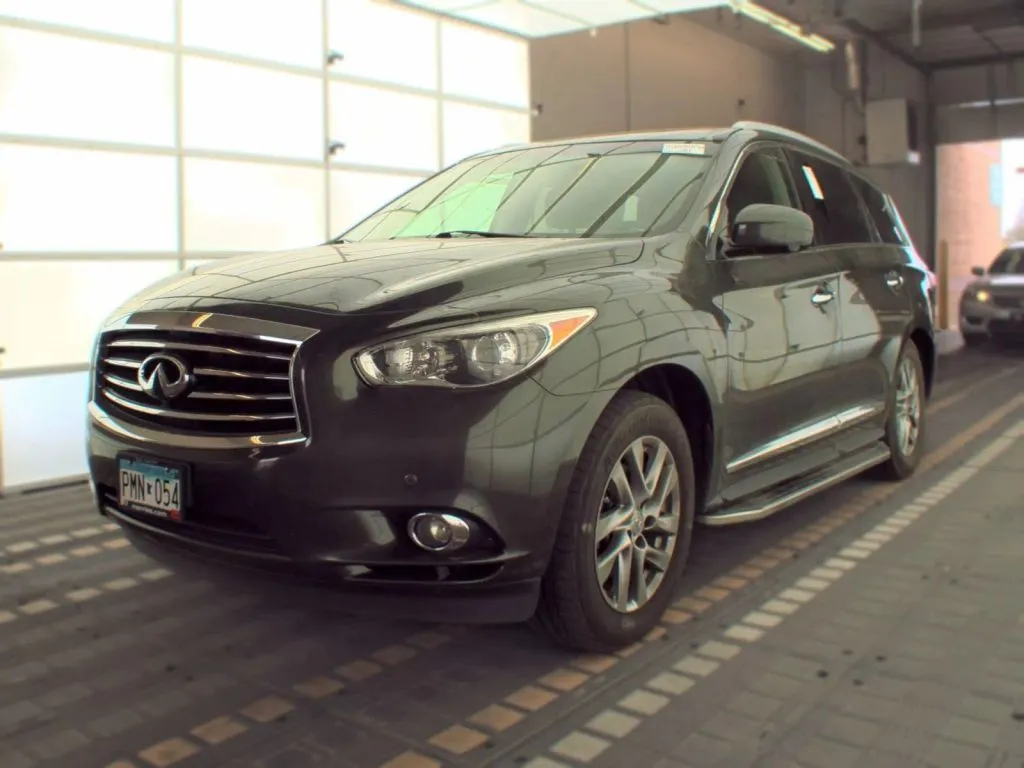
Infiniti JX
Importing a used Infiniti JX from the USA
The Infiniti JX is a three-row luxury crossover that most European buyers have never seen, because Infiniti's US-focused lineup meant this model sold overwhelmingly in North America. It is the direct predecessor of the QX60, and mechanically the two are the same vehicle under different names. If you want to import a used Infiniti JX from the USA, the American market is the natural source. USCar Trader works as an independent broker: we find a documented example, verify its VIN and build origin, and manage the shipping and customs clearance to Germany.

Model history and generations
The JX arrived as the JX35 for the 2013 model year, Infiniti's first purpose-built seven-seat crossover on Nissan's D platform, closely related to the Nissan Pathfinder of the same era. It was a single model year under the JX name: for 2014 Infiniti's new alphanumeric naming scheme renamed it the QX60, with essentially the same body and mechanicals. So a JX badge specifically denotes a 2013 car, while later years wear the QX60 name. Buyers who want the original JX35 are therefore looking at a narrow model-year window.
Engines and drivetrain
The JX35 uses Nissan's well-known 3.5-liter VQ35DE V6, producing roughly 265 hp and 248 lb-ft. Power goes through an Xtronic continuously variable transmission (CVT). It was offered in front-wheel drive or with Infiniti's Intelligent All-Wheel Drive, which can direct torque to the rear axle when needed. The VQ35 is a long-serving, generally robust engine; the CVT is the component that most defines the driving character and the maintenance story of this vehicle.
Which trim makes sense
The JX came only as the three-row, seven-seat crossover. Equipment was organised around option packages — Premium, Premium Plus, Theater, Technology, and Deluxe Touring — rather than distinct trim names, so a well-optioned JX can carry navigation, a surround-view camera, adaptive cruise, a backup collision intervention system, and rear entertainment screens. There was no coupe, sport, or shortened variant; the family-hauler body was the entire remit.
Supply on the US market
Because the JX name applied only to 2013, the used pool of true JX badged cars is a single model year, though the near-identical QX60 that followed is plentiful. Most JX35 cars are well-equipped all-wheel-drive family vehicles that have covered typical family mileage. Condition varies with ownership; many were used as daily school-run and highway cars. A JX with full service records — especially CVT servicing — is worth prioritising over a cheaper car with gaps in its history.
Who benefits from importing
The JX suits a buyer who wants a comfortable, quiet, seven-seat luxury crossover that is genuinely uncommon in Germany. It appeals to families who value the VQ35 V6's smoothness and the flexible third row, and to enthusiasts who like the idea of the original JX35 nameplate before the QX60 rebrand. It is best for someone who values comfort and space over sporting pretensions.
Technical data
| Attribute | Detail (typical US-spec) |
|---|---|
| Model year (JX name) | 2013 (JX35) |
| Later name | QX60 (from 2014) |
| Body style | 3-row crossover, 7 seats |
| Engine | 3.5L VQ35DE V6 |
| Output | approx. 265 hp / 248 lb-ft |
| Transmission | Xtronic CVT |
| Drivetrain | FWD or Intelligent AWD |
| 0–60 mph | approx. 7.5 s |
| Length | approx. 4,996 mm |
| Wheelbase | approx. 2,900 mm |
| Curb weight | approx. 1,900–2,050 kg |
| Towing capacity | approx. 1,588 kg (3,500 lb) |
| Fuel | Premium unleaded |
| Assembly | Smyrna, Tennessee (USA) |
| Seating | 7 |
Known weak points and maintenance
JX reliability centers on two components. The VQ35 V6 is a long-proven engine and is generally durable, needing routine maintenance rather than major repairs. The Xtronic CVT is the part that demands attention: these transmissions are sensitive to heat and fluid condition, and neglected units can develop shudder, whining, or premature wear. Regular CVT fluid service and, ideally, an auxiliary cooler on hard-worked cars make a real difference. Beyond the driveline, watch for the timing chain tensioner and cover on high-mileage V6s, and check the panoramic sunroof for leaks and drainage issues. Electronics and infotainment of this era can feel dated but are usually reliable. A JX with documented CVT servicing is a much safer buy.
US and EU spec compared
As a US-market vehicle, the JX carries American lighting with amber markers, a mph-primary cluster, US emissions calibration, and a navigation system with North American maps only. The infotainment lacks European map data, and radio tuning steps differ. These items define what needs adapting for German registration.
The import process in detail
The sequence is consistent. Selection: agree on and inspect the car. VIN and origin check: decode the VIN, confirm the US assembly in Tennessee, and review the vehicle's history. Escrow: place funds in secure escrow released on agreed milestones. Ocean freight: container or RoRo shipping to a North German port such as Bremerhaven. Customs clearance on EU arrival. TÜV and Einzelabnahme for technical approval. Registration with your local authority.
What customs clearance really costs
Remember: no origin proof, no 0% duty – and 19% German import VAT is due on every import.
Two separate charges apply and must not be merged. Import duty depends on provable origin. This model's origin is listed as neutral, so the rate follows the actual build plant identified by the VIN. Where a JX is of provable US origin and shipped directly, the 0% EU rate under Regulations (EU) 2026/1455 and 2026/1461 can apply for the window from 1 July 2026 to 31 December 2029 — with that documented origin, never as a guarantee. Separately, the 19% German import VAT (Einfuhrumsatzsteuer) always applies on the customs value. As a broker we take no vehicle margin; the car price and the official charges are presented to you distinctly.
TÜV, modifications and registration
For approval, plan lighting changes first: headlamp beam pattern, side-marker treatment, and adding a rear fog lamp where required. The odometer and speedometer must present kilometers. Documentation of the vehicle's technical specification supports the Einzelabnahme, and any US-specific equipment is checked against German requirements.
Check before you buy
Confirm before buying: 1) decode the VIN and verify the US assembly and 2013 model year for a true JX; 2) obtain a Carfax or AutoCheck report for accidents and title status; 3) review CVT service history closely and check for shudder or whine on a test drive; 4) inspect the panoramic sunroof for leaks and clogged drains; 5) check underbody and subframe for rust, especially on northern-state cars; 6) confirm a clean title, not salvage or rebuilt; 7) test the all-wheel-drive engagement and all third-row functions.
Common questions
Is the Infiniti JX the same as the QX60?
Effectively yes. The JX35 was renamed QX60 for 2014; the 2013 JX and early QX60 are mechanically the same vehicle.
Is the JX reliable to import?
The VQ35 V6 is durable; the main consideration is the CVT, which needs documented fluid servicing to stay healthy.
Was the JX sold in Europe?
No. It was a North-America-focused model, which is part of its rarity as an import.
Does the 0% EU import duty apply?
Only with provable US origin from the VIN and direct shipping within the 2026–2029 window; otherwise the rate follows the build plant. It is never guaranteed.
Does import VAT still apply?
Yes. The 19% German import VAT applies on the customs value in every case.
What is the biggest thing to check on a JX?
The CVT. Confirm regular fluid changes and drive the car to check for shudder, whine, or hesitation.
How many seats does the JX have?
Seven, across three rows, with a sliding second row for third-row access.
How long does importing take?
Usually several weeks, mostly set by shipping schedules and customs clearance.
To begin, explore Infiniti in the Carhub, compare related models like the Infiniti QX60, the Infiniti QX50 and the Infiniti FX, or view current JX listings.