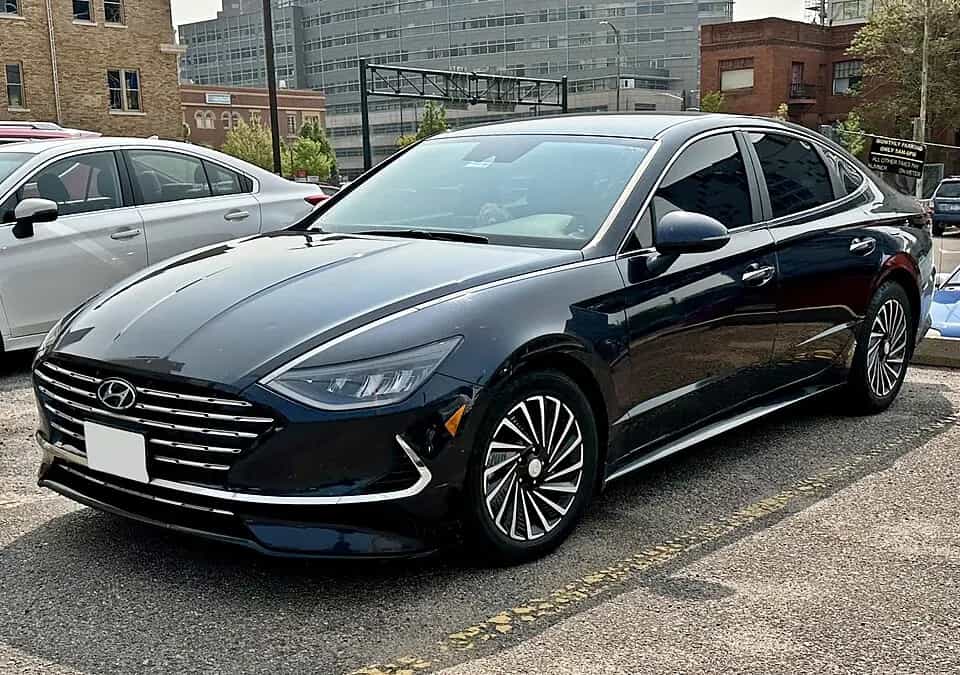
Hyundai Sonata Hybrid
Importing a used Hyundai Sonata Hybrid from the USA
The Hyundai Sonata Hybrid is one of the more sensible ways into a full-size American hybrid sedan: roomy, quietly efficient and built in large enough numbers on the US market that clean, well-documented examples turn up regularly. As an independent broker, USCar Trader helps you find, vet and ship a used Sonata Hybrid from the United States to Germany and the wider EU. This page walks through what actually matters when you import a used Sonata Hybrid from the USA — the generations, the hybrid drivetrain, the trims, and the real-world used market — before the second half covers technical data, reliability and the full import process.

Generations at a glance
The Sonata nameplate goes back decades, but the hybrid version becomes genuinely relevant from the seventh generation onward. The LF generation (2015–2019) paired a 2.0-litre Nu GDI four-cylinder with an electric motor and a lithium-polymer battery, and Hyundai notably kept a conventional six-speed automatic rather than a CVT — a decision that gives the car a more natural, geared feel than many rivals. A Plug-in Hybrid variant with a larger battery and roughly 43 km of electric range was also sold in this era.
The DN8 generation (2020–2023, facelifted for 2024) is the modern one to target. It moved to Hyundai's sharper 'sensuous sportiness' design, a longer wheelbase and a revised 2.0-litre Smartstream hybrid system, again mated to a six-speed automatic. Higher trims offered a solar panel roof that trickle-charges the 12-volt and hybrid batteries, plus the digital key and blind-spot camera view. If you want the most contemporary infotainment and driver assistance, the DN8 is the sweet spot.
Powertrain lineup
Across both modern generations the Sonata Hybrid uses an Atkinson-cycle 2.0-litre four-cylinder combined with a permanent-magnet electric motor. Combined system output sits around 193 hp (LF) and roughly 192 hp (DN8), which is modest on paper but delivered smoothly. The key engineering point for buyers used to European hybrids: this is a parallel hybrid with a real six-speed torque-converter automatic, not a planetary e-CVT. It drives like a normal automatic that happens to sip fuel. Drive goes to the front wheels only; there is no AWD Sonata Hybrid. Expect EPA combined figures in the low-to-mid 40s mpg for the LF and mid-40s to around 50 mpg for the most efficient DN8 Blue trim.
Trims in the US market
The Sonata Hybrid is a four-door sedan only — there is no wagon or coupe. On the DN8 the US line-up is straightforward: Blue (the efficiency-focused entry trim, lightest and most frugal), SEL (the volume trim with heated seats and more assistance features) and Limited (leather, panoramic sunroof or solar roof, Bose audio, ventilated seats, surround-view camera). LF-era cars used SE, Limited and Ultimate designations. When you import a used Sonata Hybrid, matching the trim to the equipment you actually want matters more than the model year, because the feature jump between Blue and Limited is significant.
The used market stateside
The United States is a deep, liquid market for this car. Retail volumes, rental fleets and lease returns mean plenty of three-to-eight-year-old examples with complete service records and accessible Carfax or AutoCheck histories. Typical import candidates fall in the roughly 30,000–130,000 km range for DN8 cars and higher for LF examples. Southern and western states offer the rust-free bodies German buyers want; salt-belt cars from the Midwest and Northeast deserve extra underbody scrutiny. Condition, documented maintenance and a clean title matter far more than a slightly lower odometer reading. We do not quote Euro prices here — the point is that supply is healthy and choice is wide.
Who should import one
A used Sonata Hybrid suits the high-mileage commuter or family driver who wants a large, comfortable, genuinely economical sedan without paying premium-brand money. It is a rational, low-drama choice: soft ride, big boot, long standard warranty history in the US, and fuel economy that rewards motorway and mixed driving. It is less suited to buyers wanting all-wheel drive, sporting dynamics or a diesel-style long-distance cruiser. If you value comfort and running costs over badge, importing a used Sonata Hybrid from the USA is an easy case to make.
Key specifications
| Attribute | Typical figure (DN8 Sonata Hybrid) |
|---|---|
| Body style | 4-door midsize sedan |
| Engine | 2.0 L Atkinson-cycle 4-cyl (Smartstream) + electric motor |
| System output | approx. 192 hp combined |
| Transmission | 6-speed automatic |
| Drivetrain | Front-wheel drive |
| Battery | Lithium-polymer, ~1.6 kWh (full hybrid) |
| 0–100 km/h | approx. 8–9 s |
| EPA combined economy | ~45–50 mpg (Blue trim highest) |
| Length | approx. 4,900 mm |
| Wheelbase | approx. 2,840 mm |
| Kerb weight | approx. 1,540–1,600 kg |
| Boot volume | approx. 450 L |
| Fuel | Petrol (hybrid) |
| Seats | 5 |
| Generations imported | LF (2015–2019), DN8 (2020–2024) |
How reliable is it?
The Sonata Hybrid has a solid reliability record, but there are known items worth checking. The 2.0-litre GDI and Smartstream engines are generally durable; carbon build-up on intake valves is a characteristic of direct injection and benefits from occasional induction cleaning. On some 2011–2019 Hyundai/Kia GDI engines there were recalls and extended warranties relating to connecting-rod bearing wear (the 'Theta II' saga) — although the hybrid uses a different unit than the affected 2.0T/2.4L Theta engines, always confirm any recall completion via VIN. Other points to verify: the 12-volt auxiliary battery (a common cause of no-start faults), the electric water pump and hybrid cooling, brake actuator software updates, and infotainment head-unit glitches on early DN8 cars. The high-voltage battery itself is robust and typically covered by long US warranty terms; ask for a battery state-of-health reading where possible. For a used Sonata Hybrid, a documented service history and completed recall work are the strongest reliability signals.
What US models do differently
US-spec cars run amber rear turn signals in many trims, mph-primary instrument clusters and US daytime-running-light and side-marker configurations. Radio tuning steps and the TA/RDS traffic functions differ from European broadcasting, and some driver-assist calibrations are set to US standards. None of this prevents registration, but several items must be brought to EU/German type conformity during approval. Equipment content can also differ: a US Limited may carry features bundled differently than any European Sonata.
Seven steps to your import
The process is methodical: 1) Selection — we identify suitable used Sonata Hybrid listings across US auctions and dealers. 2) VIN and origin check — we read the VIN and plant code to establish the build location, which drives the customs treatment. 3) Escrow — funds are held securely until the car is confirmed and released. 4) Ocean freight — container or RoRo shipping to a North European port such as Bremerhaven. 5) Customs clearance — import declaration with origin-correct duty plus 19% import VAT. 6) TUEV / individual approval — technical inspection and any modifications for §21 individual approval. 7) Registration — final registration at your local authority.
Customs, taxes and costs explained
In short: the 0% duty rate applies only with documented US origin (VIN/plant) – German import VAT of 19% is always due.
Two separate charges apply and we never blend them into a margin. First, the customs duty: under EU Regulations 2026/1455 and 2026/1461 (in force since 1 July 2026, direct transport, valid until 31 December 2029), vehicles of provable US origin can qualify for a 0% import duty rate. Because the Sonata Hybrid is origin-neutral in our data — some Sonata production is US-built in Alabama while hybrid variants are frequently built in Korea — the VIN and plant code decide the outcome. If the specific car is not of US origin, the standard EU third-country rate for passenger cars (10%) applies. Nothing here is 'duty-free' or guaranteed. Second, the German import VAT (Einfuhrumsatzsteuer) of 19% always applies, calculated on the customs value plus duty and freight. We present both line items transparently.
German TÜV and registration
Typical work for German approval includes converting or adding a rear fog lamp, verifying headlight compliance (US beam patterns and any required adaptation), confirming the speedometer shows km/h, and documenting the vehicle to obtain a §21 individual approval or COC-based path where available. The odometer reading is recorded and cross-checked against the US history. Once TUEV issues the report, registration at the Zulassungsstelle follows.
The buyer checklist
- Decode the VIN and confirm the plant/origin before anything else.
- Pull a full Carfax or AutoCheck history for accidents, title and odometer records.
- Confirm a clean title — avoid salvage or rebuilt unless deliberately chosen and priced accordingly.
- Inspect for rust, especially on salt-belt cars; favour southern/western examples.
- Request the service history and any hybrid battery state-of-health data.
- Verify all recalls are completed via VIN.
- Check the 12-volt battery, infotainment and any warning lights.
Questions and answers
Can I import a used Sonata Hybrid duty-free?
No — nothing is duty-free or guaranteed. A 0% duty rate is possible only with provable US origin under the 2026 regulations; otherwise the standard 10% passenger-car rate applies. The 19% import VAT always applies.
Is the Sonata Hybrid reliable?
Yes, broadly. It has a strong record; the main things to verify are completed recalls, the 12-volt battery, and induction cleaning for the GDI engine.
Does the Sonata Hybrid have all-wheel drive?
No. Every Sonata Hybrid is front-wheel drive. If you need AWD, this is not the car.
What is the difference between the LF and DN8 generations?
The LF (2015–2019) is the earlier model; the DN8 (2020–2024) has newer design, infotainment, driver assistance and a solar roof option on top trims.
How long does importing take?
Typically several weeks from purchase to registration, driven mainly by ocean freight scheduling, customs clearance and the TUEV appointment.
Will the hybrid battery be a problem at high mileage?
The high-voltage battery is durable and was warranted for long terms in the US. Where possible we obtain a state-of-health reading before purchase.
Can the car be registered in Germany?
Yes, after TUEV individual approval and the usual lighting and speedometer conformity work, it registers normally.
Do I pay VAT even if duty is 0%?
Yes. The 19% import VAT is entirely separate from customs duty and always applies.
Ready to move? Browse the full Hyundai in the Carhub, compare closely related sedans such as the Hyundai Sonata, the Toyota Camry and the Honda Accord, or view current Sonata Hybrid listings and let USCar Trader handle the import.