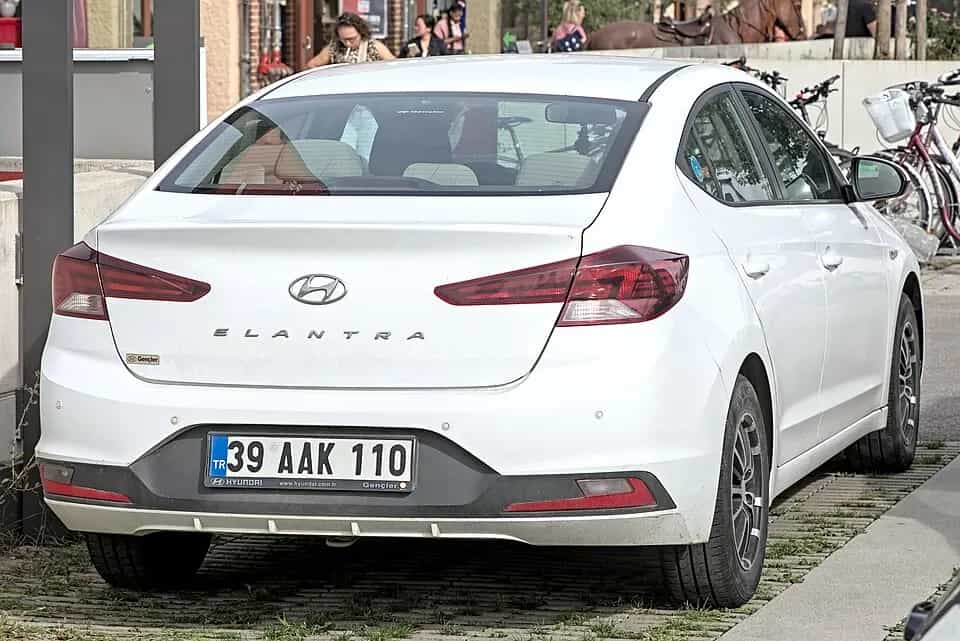
Hyundai Elantra
Importing a used Hyundai Elantra from the USA
The Hyundai Elantra is one of America's staple compact sedans — cheap to run, roomy for its class and, in its newer forms, surprisingly stylish. It is sold in vast numbers across the United States, which creates a large and price-competitive used pool. For a European buyer the appeal is specific: certain versions, above all the sharp N-Line and the track-focused Elantra N, were either scarce or badged differently in Europe, so importing a used Hyundai Elantra from the USA is a way to secure a configuration you might struggle to find on the domestic market. As always, USCar Trader handles this strictly as an independent broker — no dealer margin, no manufacturer tie, just help finding, checking and importing the right car.

Production years and key changes
Three generations matter for import today. The fifth-generation MD (2011–2016) introduced the flowing 'Fluidic Sculpture' styling and made the Elantra a genuine value benchmark. The sixth-generation AD (2017–2020) was more conservative but added refinement and, mid-cycle, the sporty Sport/N-Line trim with a turbo engine. The seventh-generation CN7 (2021 onward) is the standout: a dramatically styled sedan with sharp creases, a large twin-screen dashboard, and for the first time a proper hybrid and the 276 hp Elantra N performance model. Buyers focused on driving character usually gravitate to the CN7 N-Line and N; those focused on economy and value look across all three.
What is under the hood
The core US Elantra engine for years was the 2.0-litre Nu four-cylinder, an Atkinson-cycle unit of roughly 147 hp paired in the CN7 with a continuously variable 'IVT' transmission for strong fuel economy. Earlier MD and AD cars used 1.8-litre and 2.0-litre Nu engines with a conventional six-speed automatic or manual. The enthusiast versions are the interesting ones: the 1.6-litre turbocharged Gamma (around 201 hp) in the Sport and N-Line, driving through a seven-speed dual-clutch gearbox, and the 2.0-litre turbo Theta in the Elantra N with roughly 276 hp, offered with an eight-speed wet DCT or a six-speed manual. The Elantra is front-wheel drive across the board — there is no AWD version.
Trims and body styles
For import purposes the Elantra is a four-door sedan (US 'GT' hatchbacks were a separate line). Typical US trims run SE, SEL, Limited, N-Line and, at the top, the standalone N. The hybrid slots into the CN7 range as a highly economical option. Higher trims add features that flatter the value story: a 10.25-inch touchscreen, wireless charging, heated and ventilated front seats, a Bose audio system and a full suite of Hyundai SmartSense driver aids. American cars are frequently well specified, so an imported Limited or N-Line can undercut the equipment of a comparable European compact.
What the US market offers
Elantra supply is enormous and the model depreciates quickly, which works in an importer's favour. CN7 cars from 2021 to 2023 are widely available, often as former lease or rental vehicles with complete service histories and mileages typically between roughly 25,000 and 90,000 miles. The performance N and N-Line trims are rarer and hold value better, so patience helps. Southern and western states again offer the cleanest, rust-free examples — an important point for a car destined for German winters.
Who this import is for
A used imported Elantra suits the buyer who wants an efficient, well-equipped compact sedan at a keen price, or the enthusiast chasing the Elantra N — a genuine hot sedan with a limited-slip differential and adaptive dampers that Europe largely missed. Commuters, young families and driving enthusiasts on a budget all fit the profile. If you value hybrid economy in a conventional three-box sedan, the CN7 hybrid is another reason to look west.
Technical data and figures
| Attribute | Typical US-spec figures |
|---|---|
| Generations considered | MD (2011–2016), AD (2017–2020), CN7 (2021–) |
| Body style | 4-door compact sedan |
| Length (CN7) | approx. 4,675 mm |
| Width (CN7) | approx. 1,825 mm |
| Height (CN7) | approx. 1,415 mm |
| Wheelbase (CN7) | approx. 2,720 mm |
| Base engine | 2.0 L Nu MPI, ~147 hp |
| N-Line engine | 1.6 L turbo Gamma, ~201 hp |
| Elantra N engine | 2.0 L turbo Theta, ~276 hp |
| Hybrid | 1.6 L GDI + electric motor |
| Transmissions | IVT (CVT), 6-speed auto, 7-/8-speed DCT, 6MT |
| Drivetrain | Front-wheel drive |
| Curb weight | approx. 1,270–1,450 kg |
| Fuel tank | approx. 47 litres |
| Trunk capacity | approx. 402 litres |
| Seating | 5 |
| 0–100 km/h (Elantra N) | approx. 5.3 s (DCT) |
Reliability: trouble spots to check
The Elantra is generally dependable, but a few areas deserve attention. Hyundai's Nu and, more critically, the related Theta engine family drew recalls and extended warranties in the US for issues including bearing wear and, in some cases, engine failure — so it is essential to check whether any given VIN was covered by a recall or engine replacement and whether the work was completed. The seven-speed dual-clutch gearbox in turbo cars can feel hesitant at low speed and needs correct maintenance. Some owners report paint that marks easily and infotainment quirks. Steering-related recalls affected certain CN7 units. On the whole, a documented service history and a completed recall record turn most of these risks into non-issues.
US vs. Europe differences
US Elantras use headlights aimed for right-hand traffic, typically lack a rear fog lamp, and read speed in mph. The Elantra N and N-Line in the US were tuned and equipped slightly differently from any European equivalent, and some infotainment and connected services are geo-locked to North America. Equipment content on mid and high US trims often exceeds a comparable-age European car, which is part of the value case. Emissions hardware is OBD-compatible, but the exact engine and calibration should be documented for the individual approval.
How the import works
Selection comes first: pin down the exact trim, engine and options. Next, a VIN and origin check establishes the build plant and pulls the full history, including any recall status. Payment is handled through a secure escrow-style arrangement. The car is then booked onto ocean freight (container or RoRo) to a European port, cleared through customs on arrival, presented for TÜV and individual approval (Einzelabnahme) with any necessary modifications, and finally registered locally. USCar Trader coordinates each stage and keeps the paperwork moving.
Import duty, VAT and fees
Key point: duty depends on the plant of build; only a VIN check secures the 0% rate. Import VAT of 19% applies regardless.
Keep the two charges separate. The EU import duty can be 0% under Regulations (EU) 2026/1455 and 2026/1461 (in force since 1 July 2026, direct transport, valid until 31 December 2029), but only where US origin is provably established from the VIN and plant code. Elantras sold in the US were built at more than one plant over the years, including Korean and, at times, US assembly — so origin has to be verified per car and can never be assumed 'duty-free'. Separately and always, the 19% German import VAT (Einfuhrumsatzsteuer) is due on the customs value plus freight, whatever the origin. As a broker, USCar Trader adds no margin to the vehicle price.
From modifications to registration
Common approval items are adapting the headlights for right-hand traffic, adding a rear fog lamp, and ensuring the speedometer shows km/h. The odometer is converted from miles and documented. Once the individual approval is granted, you receive the papers needed to register the car at your local Zulassungsstelle.
Pre-buy inspection points
- Decode the VIN to confirm engine, trim and build plant.
- Check recall history — especially any engine or steering recalls — and whether repairs were completed.
- Pull a Carfax or AutoCheck report for accidents, title brands and odometer consistency.
- Inspect for rust and prior collision repair, favouring dry-state cars.
- Confirm a clean (non-salvage) title unless knowingly buying a project.
- On turbo/DCT cars, assess clutch behaviour and service records.
- Verify all driver-assist features and the touchscreen function correctly.
What buyers ask most
Why import a used Hyundai Elantra from the USA?
Chiefly to access versions Europe rarely offered — the Elantra N and N-Line — or to buy a well-equipped, fast-depreciating compact sedan at a competitive price. The total landed cost including VAT decides the value.
Will an imported Elantra get 0% EU import duty?
Only with proven US origin from the VIN and plant code under the 2026 regulations. Elantra production spanned several plants, so origin must be checked per car and is never guaranteed upfront.
Is the 19% import VAT always payable?
Yes. The German import VAT of 19% applies on import regardless of origin, on the customs value plus freight.
How reliable is the Hyundai Elantra?
Generally reliable, but check for any engine or steering recall on the specific VIN and confirm the work was done. A full service history resolves most concerns.
Does the Elantra come with all-wheel drive?
No. Every Elantra, including the N, is front-wheel drive.
What is the difference between N-Line and Elantra N?
The N-Line is a sporty trim with the 1.6 turbo (~201 hp); the Elantra N is a full performance model with a 2.0 turbo (~276 hp), a limited-slip differential and adaptive dampers.
What mileage should I expect?
Recent CN7 cars commonly show roughly 25,000–90,000 miles, often as former lease vehicles with good records.
Is USCar Trader a dealer?
No. We are an independent broker for used US vehicles, without dealer margin or manufacturer partnership.
Start here: explore Hyundai in the Carhub, compare the larger Hyundai Sonata or rivals such as the Toyota Corolla and Honda Civic, or view current Elantra listings.