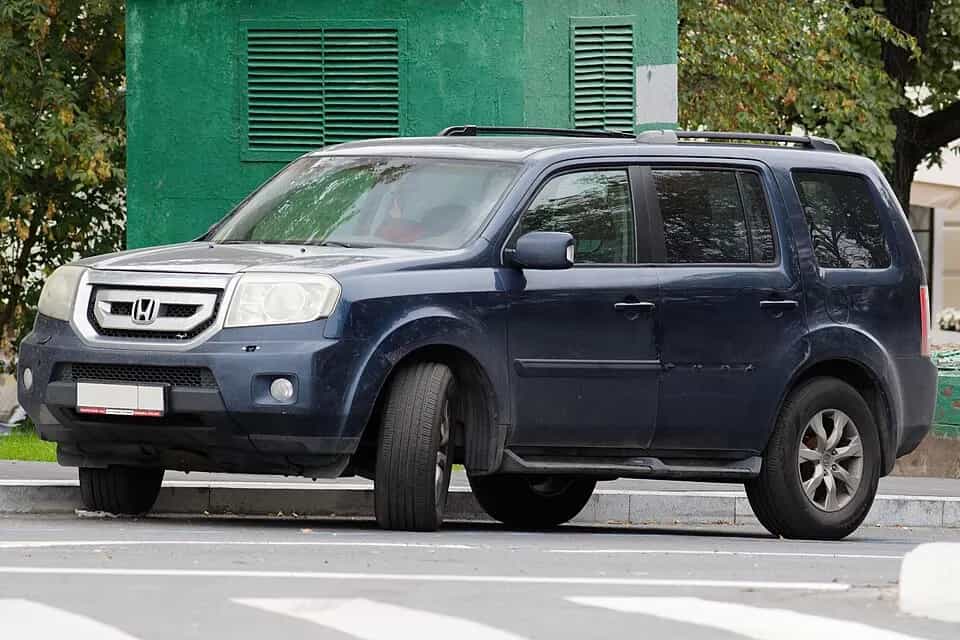
Honda Pilot

Importing a used Honda Pilot from the USA

The Honda Pilot is a three-row family SUV that has been a mainstay of the North American market for two decades. It was never a regular European model, so importing a used Pilot from the USA is the natural way to own one here — and the US used market supplies plenty of well-kept, sensibly-priced examples with the V6 and, on later cars, all-wheel drive. As an independent broker, USCar Trader sources the vehicle and manages the import for you. One important note on customs up front: Honda is a Japanese marque, and although the Pilot has long been built in the United States, the applicable EU duty rate depends on the actual plant of build, so the VIN and origin must always be checked rather than assumed.

Honda Pilot – used car imported from the USA
Photo: Retired electrician · CC0 · Wikimedia Commons

Generations at a glance

Three generations feed today's import pool. The second-generation Pilot (2009–2015) is boxier and rugged, with a 3.5-litre V6 and a 5-speed automatic. The third generation (2016–2022) is smoother and more car-like, introducing a 6-speed and later a 9-speed automatic, plus a 10-speed on top trims from the 2019 refresh. The fourth generation (2023-onward) is a ground-up redesign: more upright styling, a stronger 3.5 V6, a 10-speed automatic across the range, and the addition of the more capable TrailSport off-road trim. Each generation offers up to eight seats.

Powertrain lineup

The Pilot has stuck faithfully to a naturally aspirated 3.5-litre V6. Second-generation cars make around 250 hp; the third generation raised output to roughly 280 hp; and the current fourth generation produces about 285 hp with a stiffer block and revised internals. Transmissions evolved from a 5-speed automatic, through 6-, 9- and 10-speed units, to the current 10-speed. Front-wheel drive is standard, with Honda's i-VTM4 torque-vectoring all-wheel drive optional and strongly preferred for European conditions. The V6 uses Variable Cylinder Management (VCM) to save fuel by deactivating cylinders — relevant to the reliability section below.

Trims in the US market

Trim lines run through LX, EX, EX-L, Touring, Elite and, on the newest car, the rugged TrailSport and luxurious Black Edition. Higher trims add leather, a larger touchscreen, rear entertainment, a premium sound system and driver-assistance features. All Pilots are five-door SUVs seating seven or eight depending on whether the second row uses a bench or captain's chairs.

The used market stateside

Pilots are family-fleet favourites and come off lease and out of one-owner households in large numbers, typically three to eight years old. Import candidates commonly run from around 40,000 to 150,000 km. Because Hondas are bought by pragmatic owners, service histories are often complete, which matters for the powertrain checks below. As with any US car, a warm-climate origin state usually means a cleaner underbody.

Who should import one

The Pilot suits families who want a spacious, sensible, comparatively economical three-row SUV that is easier to place on European roads than the full-size American SUVs. It is a practical rather than flashy choice, and a well-documented AWD example makes a dependable everyday import.

Key specifications

Vehicle classMid-size three-row SUV
Generations2nd (2009–2015), 3rd (2016–2022), 4th (2023–)
Engine3.5L naturally aspirated V6
Power (by generation)approx. 250 / 280 / 285 hp
Fuel-saving techVariable Cylinder Management (VCM)
Transmissions5-, 6-, 9- and 10-speed automatic
DriveFWD or i-VTM4 AWD
Seating7 or 8
Length (4th gen)approx. 5,010 mm
Widthapprox. 1,995 mm
Max towing (AWD, equipped)up to ~2,270 kg depending on spec
FuelPetrol (regular unleaded)
Cargo (behind 3rd row)approx. 510+ litres
Off-road trimTrailSport (4th gen)
Origin (verify by VIN)Commonly Lincoln, Alabama (US) — confirm

How reliable is it?

The Pilot's 3.5 V6 is a fundamentally durable engine, but two items dominate the Honda Pilot common problems discussion. First, Variable Cylinder Management can, over time and with certain driving patterns, lead to increased oil consumption, spark-plug fouling and premature engine-mount wear from the vibration of running on fewer cylinders; many owners take VCM condition seriously and some fit aftermarket disablers. Second, the ZF-derived 9-speed automatic used on 2016–2018 third-generation cars drew complaints about hesitation, rough or delayed shifts, and it received several software updates — a car with the latest calibration behaves far better, so confirm this on any 9-speed example. Beyond those, watch for early-third-gen infotainment quirks, occasional AC condenser failures, and normal wear items. The 6-speed and 10-speed transmissions are generally trouble-free.

What US models do differently

US Pilots use US headlight beam patterns, lack a rear fog lamp, and run US-style rear indicators that may require adaptation. The instrument cluster reads in miles and the infotainment ships with US navigation and radio bands. Honda Sensing driver aids are present on later cars but US-configured. None of this blocks German registration; it defines the type-approval work.

Seven steps to your import

Select the vehicle and agree terms; run a VIN and build-plant check to establish origin and history; place funds in escrow; ship by ocean freight (container or RoRo) from a US port to Bremerhaven or Rotterdam; clear EU customs on arrival; complete the TÜV individual approval with any required modifications; and register locally. USCar Trader coordinates the chain as your intermediary.

Customs, taxes and costs explained

Bottom line: what matters is the factory shown by the VIN – proven US origin unlocks 0% duty. The 19% import VAT always applies.

Two separate charges apply, and the Pilot is a good example of why origin must be verified. EU import duty: since 1 July 2026, under Regulations (EU) 2026/1455 and 2026/1461, a 0% rate can apply to vehicles of proven US origin shipped directly, valid until 31 December 2029. The Pilot is commonly assembled in Lincoln, Alabama, but because Honda is a Japanese brand and build location can vary, we do not promise the 0% rate — the VIN and plant code decide each case individually. Separately, the 19% German import VAT (Einfuhrumsatzsteuer) always applies, regardless of origin. As a broker we add no vehicle margin; you pay the car, transport, duties and a transparent service fee.

German TÜV and registration

Typical modifications include adding or converting a rear fog lamp, adapting rear indicators, and adjusting headlights for the European beam pattern. The odometer is documented or converted to kilometres. After the Einzelabnahme and issuance of the data sheet, the Pilot is registered normally.

The buyer checklist

Confirm the VIN and build plant (origin question — do not assume 0%); obtain a full Carfax or AutoCheck history with clean title status; on 9-speed cars, verify the latest transmission software and test shift quality; review oil-consumption history and VCM condition on the V6; check the underbody for corrosion on salt-belt cars; and match tyre and brake wear to the stated mileage. A pre-shipment inspection with photos is recommended.

Questions and answers

Does a used Honda Pilot qualify for 0% EU import duty?

Not automatically. The Pilot is often US-built, but Honda is a Japanese brand and build location can vary, so the VIN and plant code must be checked. The 19% German import VAT always applies regardless.

Which generation should I import?

The 2019–2022 third generation (with the 10-speed on higher trims) and the 2023-onward fourth generation are the strongest choices. Approach 2016–2018 9-speed cars with the transmission software confirmed.

How reliable is the Honda Pilot?

Broadly dependable, with VCM-related oil consumption and the early 9-speed's shift behaviour being the main watch points. A documented history is key.

Is the AWD version worth it?

For German conditions, the i-VTM4 all-wheel-drive version is generally preferable for traction and resale.

Can a US Pilot be registered in Germany?

Yes, after TÜV individual approval and typical lighting and odometer adjustments.

How is the Pilot shipped from the USA?

By container or RoRo ocean freight from a US port to Bremerhaven or Rotterdam, then EU customs clearance.

Is USCar Trader a dealer?

No. We are an independent broker for used US vehicles and take no vehicle margin.

Discover more Honda in the Carhub, compare the related Honda Passport, the Honda Ridgeline pickup and the Honda Odyssey minivan, or view the current Pilot listings.