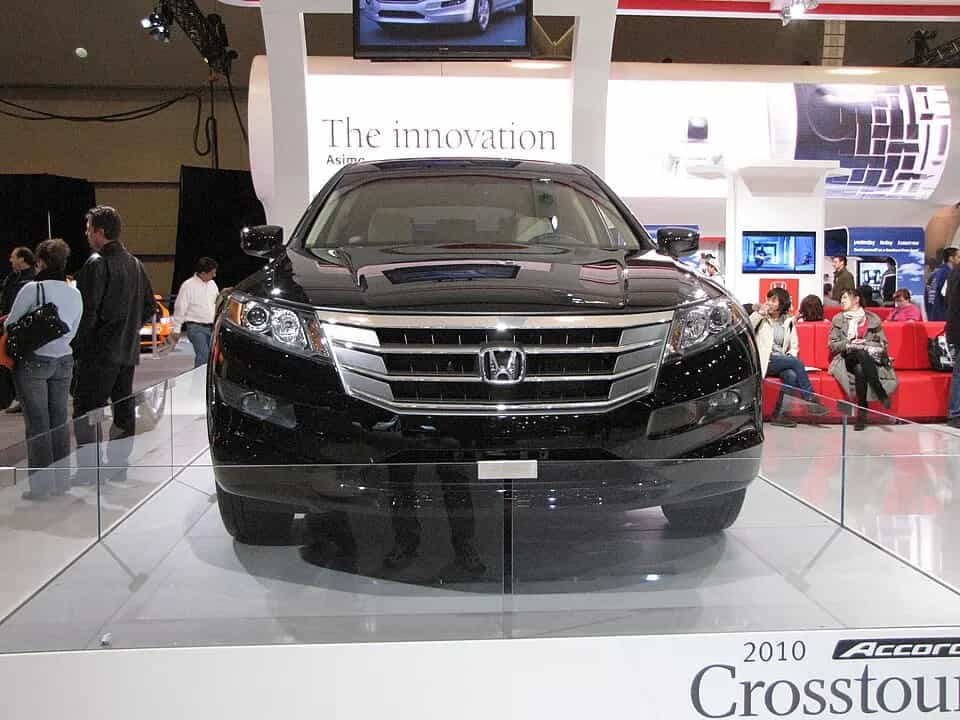
Honda Crosstour
Importing a used Honda Crosstour from the USA
The Honda Crosstour is a North-America-only model, which is exactly why it appeals to buyers who want something that never officially reached European showrooms. It is an Accord underneath, stretched into a five-door fastback crossover, and it was sold almost exclusively in the US and Canada. If you want to import a used Honda Crosstour from the USA, the American used market is essentially the only realistic source. USCar Trader works as an independent broker: we find a documented car, verify its VIN and build origin, and coordinate the shipping and clearance back to Germany.

Production years and key changes
The Crossouter launched for model year 2010 as the Accord Crosstour, based on the eighth-generation Accord. Honda dropped the Accord prefix for 2012 and gave the car a mid-cycle refresh for 2013 that softened the polarizing front end and added the four-cylinder engine option. Production ran through the 2015 model year, after which Honda discontinued it in favor of a growing conventional SUV lineup. It was a single generation with one significant facelift, so the choice largely comes down to pre- or post-2013 styling and which engine you prefer.
What is under the hood
Two engines were offered. The volume choice is Honda's 3.5-liter J35 V6, producing roughly 271 hp and 254 lb-ft, mated to a five-speed (later six-speed) automatic. From 2013 a 2.4-liter K24 four-cylinder with about 192 hp arrived, paired with a five-speed automatic and front-wheel drive only. The V6 could be ordered with Honda's Real Time all-wheel-drive system, while the four-cylinder stayed front-drive. The J35 also features Variable Cylinder Management, deactivating cylinders under light load to save fuel.
Trims and body styles
The Crossouter came only as the five-door fastback wagon-crossover. Trims mirrored the Accord family: EX and EX-L, with the top EX-L V6 adding leather, a navigation option, a premium audio system, and available all-wheel drive. There was no coupe or sedan variant — the tall hatchback body was the whole point of the car.
What the US market offers
Because the Crossouter sold in modest numbers, the used pool is smaller than a mainstream Accord or CR-V, but it is steady across the US. V6 front-drive EX-L cars are the most common; all-wheel-drive V6 examples and the later four-cylinder are less numerous. Many were owned by buyers who wanted a refined, comfortable highway cruiser, so well-kept, higher-mileage cars with full service records are typical. As with any Honda of this era, a clean maintenance history matters more than a low odometer number.
Who this import is for
The Crossouter suits a buyer who wants Accord reliability and refinement in a raised, cargo-friendly body that is genuinely rare on European roads. It is a sensible pick for someone who values a comfortable V6 highway car with all-weather capability but does not want a conventional SUV. Enthusiasts of unusual, discontinued models will appreciate that it was never sold new in Germany, giving it real curiosity value.
Technical data and figures
| Attribute | Detail (typical US-spec) |
|---|---|
| Production years | 2010–2015 |
| Body style | 5-door fastback crossover |
| V6 engine | 3.5L J35 V6 with VCM |
| V6 output | approx. 271 hp / 254 lb-ft |
| I4 engine (2013+) | 2.4L K24 four-cylinder |
| I4 output | approx. 192 hp / 162 lb-ft |
| Transmissions | 5-speed auto (I4), 6-speed auto (V6 late) |
| Drivetrain | FWD, or Real Time AWD (V6) |
| Seating | 5 |
| Length | approx. 4,999 mm |
| Wheelbase | approx. 2,776 mm |
| Curb weight | approx. 1,600–1,750 kg |
| Cargo (seats up) | approx. 720 L |
| Fuel | Regular unleaded |
| Assembly | Ohio, USA |
Reliability: trouble spots to check
Crossouter reliability is a strong point, reflecting its Accord roots. The most discussed weak spot is the J35's Variable Cylinder Management, which on some cars leads to elevated oil consumption and premature spark-plug or piston-ring wear; many owners fit a VCM disabler as preventive care. Watch for the age-related items common to this platform: front motor mounts, power-steering pump seepage, and rear brake wear. The five-speed automatic is durable but responds well to regular fluid changes. Interiors hold up well, though navigation units of this era feel dated. Overall, a serviced V6 Crossouter is among the more dependable used US imports in its class.
US vs. Europe differences
As a US-market-only car, the Crossouter carries American lighting with amber markers, a mph speedometer, US emissions tuning, and often a navigation database keyed to North America. The infotainment lacks European map data, and the radio tuning steps differ from European FM spacing. These are the kinds of items to plan for when registering the car in Germany.
How the import works
The sequence is consistent. Selection: agree on and inspect the target car. VIN and origin check: decode the VIN, confirm the US assembly, and review history. Escrow: place funds in secure escrow released on agreed milestones. Ocean freight: container or RoRo shipping to a North German port. Customs clearance on arrival in the EU. TÜV and Einzelabnahme for technical approval. Registration with your local authority to put the car on the road.
Import duty, VAT and fees
Key point: duty depends on the plant of build; only a VIN check secures the 0% rate. Import VAT of 19% applies regardless.
Keep the two charges separate. Import duty depends on the vehicle's provable origin. This model's origin is listed as neutral, so the exact rate follows the actual build plant shown by the VIN. Where a Crossouter is of provable US origin and shipped directly, the 0% EU rate under Regulations (EU) 2026/1455 and 2026/1461 can apply for the window from 1 July 2026 to 31 December 2029 — but only with that documented origin, never as a guarantee. Separately, the 19% German import VAT (Einfuhrumsatzsteuer) always applies on the customs value. As a broker we take no vehicle margin; the car price and the official charges are shown to you independently.
From modifications to registration
For approval, plan on lighting adjustments: headlamp beam pattern, side-marker handling, and adding a rear fog lamp if not present. The odometer and speedometer must present kilometers, and documentation of the car's technical specification supports the Einzelabnahme. These changes are routine for a US import of this type.
Pre-buy inspection points
Confirm before you buy: 1) decode the VIN and verify US assembly and model year; 2) obtain a Carfax or AutoCheck report for accidents and title status; 3) on V6 cars, review oil-consumption history and whether VCM has been managed; 4) inspect for underbody rust, especially on cars from northern US states; 5) check the maintenance record for timing service and transmission fluid; 6) verify the title is clean, not salvage; 7) test the all-wheel-drive system engagement on AWD cars.
What buyers ask most
Is the Honda Crosstour reliable?
Yes. It shares Accord mechanicals and is generally dependable, with the main caveat being VCM-related oil use on some V6 examples.
Was the Crosstour sold in Europe?
No. It was a North-America-only model, which is part of its appeal as an import.
Which engine should I choose?
The 3.5L V6 is the smoother, more capable choice and the only one offered with all-wheel drive; the 2.4L four-cylinder is more economical and front-drive only.
Does the 0% EU import duty apply?
Only with provable US origin from the VIN and direct shipping within the 2026–2029 window; otherwise the rate follows the actual build plant. It is never guaranteed.
Does import VAT still apply?
Yes. The 19% German import VAT applies on the customs value in every case.
What is VCM and should I worry about it?
Variable Cylinder Management deactivates cylinders to save fuel; on some cars it correlates with oil consumption, which is why many owners fit a disabler.
How rare is the Crosstour in Germany?
Very. It was never sold new here, so a well-kept import stands out.
How long does importing take?
Usually several weeks, mostly determined by shipping schedules and customs clearance.
To begin, explore Honda in the Carhub, compare related models like the Honda Accord, the Honda CR-V and the Honda Ridgeline, or see current Crosstour listings.