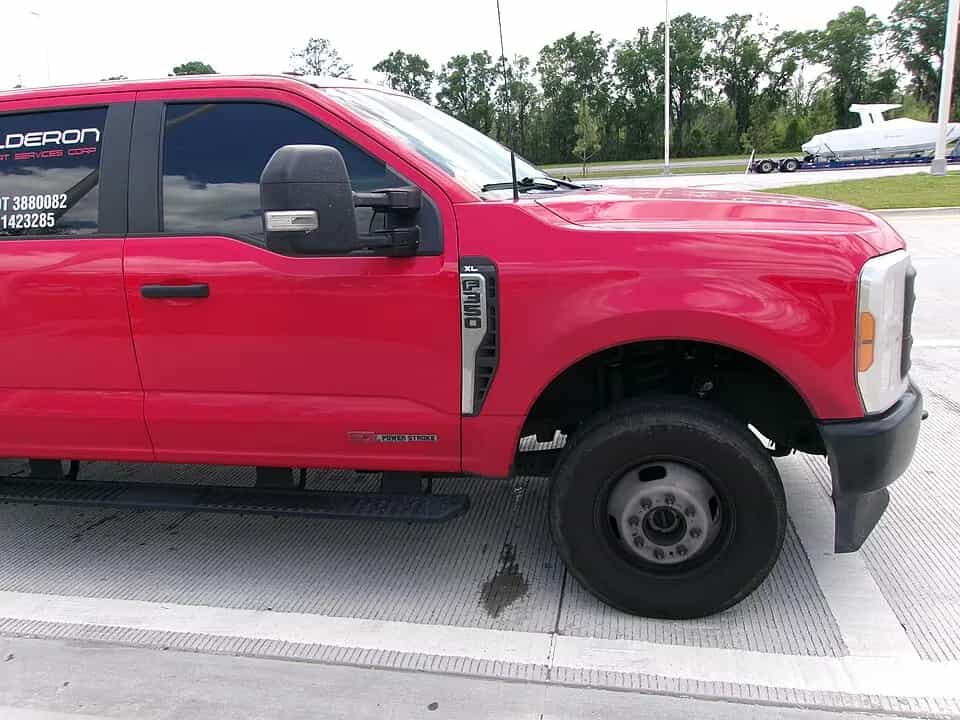
Ford F-350 Super Duty
Importing a used Ford F-350 Super Duty from the USA
The Ford F-350 Super Duty is a heavy-duty pickup built for serious work: high payloads, big towing numbers and diesel torque measured in four figures. In Germany and across the EU there is a steady demand for these trucks among businesses, horse and boat owners, and enthusiasts who want something no European manufacturer builds. Importing a used F-350 from the USA is the natural route, since the American used market is where these trucks live in volume. USCar Trader handles that import as an independent broker for used vehicles only — we do not sell the truck ourselves and take no margin on it. Heavy-duty pickups also have their own customs and tariff-classification nuances, which we address plainly below.

Model history: years and generations
Ford introduced the Super Duty line for the 1999 model year to separate its three-quarter-ton and one-ton trucks from the light-duty F-150. Key milestones followed: a major redesign for 2008, another for 2011 that introduced Ford's own 6.7-litre Power Stroke diesel, the switch to a high-strength aluminium body for the 2017 model year, and the latest redesign for 2023 with new powertrains and technology. Across these generations the F-350 has been offered in single-rear-wheel (SRW) and dual-rear-wheel (DRW, or "dually") forms, the dually giving the highest payload and towing figures.
Engines, transmissions and drive
The headline engine is the 6.7-litre Power Stroke turbodiesel V8, which over its life has climbed from around 390 hp to as much as 500 hp and up to roughly 1,627 Nm (1,200 lb-ft) in high-output form. On the petrol side, older trucks used a 6.2-litre or 6.8-litre V8, while 2020-onward trucks gained the 7.3-litre "Godzilla" gas V8 at about 430 hp — a robust, simple alternative to the diesel. Earlier diesels include the troublesome 6.0-litre (2003–2007) and the 6.4-litre (2008–2010). Transmissions moved from a six-speed TorqShift automatic to the ten-speed TorqShift for 2020 and later. Four-wheel drive with a two-speed transfer case is the norm on imported trucks.
Equipment lines and body styles
Body configurations include Regular Cab, SuperCab (extended) and Crew Cab, paired with various bed lengths, in SRW or dually form. US trims run from the work-focused XL and XLT through Lariat, King Ranch, Platinum and Limited at the luxury end, with the off-road-oriented Tremor package available on later trucks. Crew Cab Lariat and above, with the diesel, are the most common and sought-after imports.
The US used market
The Super Duty is one of the best-selling heavy-duty trucks in America, so the used pool is enormous and varied. You will find everything from high-mileage fleet and farm trucks to lightly used, loaded Crew Cabs. Diesel trucks often carry higher mileage because owners run them long distances, so a documented service history matters more here than on a passenger car. Southern and western trucks tend to be rust-free, which is important for a heavy vehicle facing German inspection. We do not quote Euro prices — condition, powertrain and mileage set the value.
Is an import right for you?
The F-350 suits a buyer with a real job for it: towing a large trailer, horsebox, boat or fifth-wheel, hauling heavy loads, or running a business that needs one-ton capability. It also appeals to those who simply want the presence and torque of an American heavy-duty diesel. It is not an everyday city vehicle — its size, fuel use and running costs demand a genuine use case — but for that use case, nothing from a European maker directly replaces it.
Specs at a glance
| Attribute | Detail (Ford F-350 Super Duty) |
|---|---|
| Class | Heavy-duty (one-ton) pickup |
| Super Duty introduced | 1999; redesigns 2008, 2011, 2017, 2023 |
| Diesel engine | 6.7 L Power Stroke turbodiesel V8 |
| Diesel output | ~390–500 hp / up to ~1,627 Nm |
| Gas engine (2020+) | 7.3 L "Godzilla" V8, ~430 hp |
| Older gas engines | 6.2 L / 6.8 L V8 |
| Transmission | 6-speed TorqShift; 10-speed TorqShift (2020+) |
| Drivetrain | Rear- or four-wheel drive, two-speed transfer case |
| Cab styles | Regular, SuperCab, Crew Cab |
| Rear axle | SRW or dual-rear-wheel (dually) |
| Max towing | Up to ~16,000+ kg (gooseneck, top spec) |
| Fuel | Diesel or petrol |
| Body (2017+) | High-strength aluminium alloy |
| Assembly | Kentucky Truck Plant / Ohio Assembly (US) |
Common issues buyers should know
Reliability depends heavily on which engine the truck has. The 6.0-litre Power Stroke (2003–2007) is notorious for EGR cooler failures, blown head gaskets and injector problems, and is best avoided unless it has documented remedial work. The 6.4-litre (2008–2010) has DPF and fuel-system weak points. The 6.7-litre Power Stroke (2011 onward) is far stronger, but on 2011–2019 trucks the Bosch CP4.2 high-pressure fuel pump can fail and contaminate the fuel system, an expensive event worth checking history for. Across generations, the front solid axle can exhibit "death wobble" if track-bar and steering components are worn. The 7.3-litre Godzilla gas V8 is mechanically simple and well regarded. On any Super Duty, inspect the frame and brake lines for corrosion and confirm regular fluid and DPF maintenance — these are the F-350 common problems that matter most.
Differences from the European version
US Super Duty trucks come with mph clusters, headlights aimed for right-hand traffic and US lighting layouts, plus imperial gauges and US navigation. Their sheer width and length affect where they can be driven and parked in Europe, and a diesel truck must meet the emissions and technical requirements applied at import. Because no equivalent is sold in Europe, the truck is assessed individually, with lighting and instrumentation the usual focus.
Import step by step
The path runs: select the specific truck and agree terms; verify the VIN and build plant to establish customs origin; place funds in escrow; arrange ocean freight (RoRo is common for large trucks) to a port such as Bremerhaven; clear customs on arrival, paying attention to the tariff classification of a goods-carrying vehicle; present the truck for TÜV / individual approval (Einzelabnahme) with any required modifications; then register it. We coordinate the chain, including the heavier logistics a one-ton truck involves.
Customs and taxes: what applies
Bottom line: what matters is the factory shown by the VIN – proven US origin unlocks 0% duty. The 19% import VAT always applies.
Two points are specific to heavy-duty pickups. First, origin: the Super Duty is built in Kentucky and Ohio, so it is generally US-built, and where US origin is provable via VIN and plant, the preferential 0% duty under Regulations (EU) 2026/1455 and 2026/1461 (in force since 1 July 2026, direct transport, valid through 31 December 2029) may apply. We never call this guaranteed or duty-free; origin is checked per truck. Second, tariff classification: pickups can be classified as goods-carrying vehicles, which under standard third-country rules carry a higher duty rate than passenger cars — another reason the provable-origin question matters. Separately and always, the 19% German import VAT (Einfuhrumsatzsteuer) applies on import. USCar Trader charges no margin on the vehicle.
Modifications and single-vehicle approval
Typical modifications include adding a rear fog lamp, adapting or aiming the headlights for right-hand traffic, converting the odometer and speedometer to metric, and confirming the lighting layout complies. Diesel trucks must satisfy the emissions requirements applied at approval. Registration follows a successful inspection.
What to verify before buying
Before buying, verify: the VIN and build plant for origin; a Carfax or AutoCheck history for accidents, title and prior commercial use; the frame, brake lines and bed for corrosion; on 2011–2019 diesels, any CP4 fuel-pump history or failure; the front-end steering and track bar for death-wobble risk; a documented service record including DPF and fluid maintenance; and a clean (non-salvage) title unless deliberately chosen.
Common questions
Which F-350 diesel should I look for?
The 6.7-litre Power Stroke from 2011 onward is the strong choice. Avoid the 6.0-litre (2003–2007) unless it has documented fixes, and be cautious with the 6.4-litre.
Is the 7.3 gas V8 a good alternative to diesel?
Yes. The 7.3-litre Godzilla is simple, durable and avoids diesel emissions complexity, at the cost of higher fuel use.
Does an F-350 qualify for 0% import duty?
It may, where US origin is provable via VIN and plant. We never promise it, and pickups can face a different tariff classification, so each truck is assessed individually.
Does the 19% import VAT always apply?
Yes. The 19% German import VAT applies to every import regardless of the duty outcome.
What is "death wobble"?
A steering oscillation on solid-front-axle trucks caused by worn track-bar and steering parts. It is fixable, but check the front end before buying.
SRW or dually?
Dual-rear-wheel trucks offer the highest payload and towing stability; single-rear-wheel trucks are easier to live with and park. Choose by your towing needs.
Can it be registered and driven in Germany?
Yes, after individual approval and the usual lighting and instrumentation modifications, though its size affects everyday use.
How is it shipped?
Large trucks are commonly shipped RoRo to a European port; container shipping is also possible depending on configuration.
Browse the full lineup in the Ford in the Carhub, or compare the closely related Ford F-250 Super Duty and the even heavier Ford F-450 Super Duty. When you are ready, see the current F-350 Super Duty listings.