Ford F-150 Lightning
Importing a used Ford F-150 Lightning from the USA
The F-150 Lightning took America's best-selling truck and made it fully electric, and it remains a rare sight on European roads. Built at Ford's Rouge Electric Vehicle Center in Dearborn, Michigan, it is a genuinely US-made vehicle, which matters for import duty. As an independent broker for used US vehicles, USCar Trader locates the specific trim, battery, and condition you want and manages the full import. We are not a dealer, add no margin, and hold no manufacturer partnership.

From launch to today
The modern F-150 Lightning launched for the 2022 model year, sharing its cab and bed with the fourteenth-generation combustion F-150 but riding on a bespoke frame with independent rear suspension and a skateboard battery. It should not be confused with the 1990s–2000s SVT Lightning, which was a supercharged petrol performance truck. Across 2022 to the current cars, Ford refined charging behaviour, software, and trim content, and adjusted battery sourcing, but the core dual-motor layout carried through. Early trucks are now entering the used market in useful numbers.
Engines and drivetrain in detail
Every F-150 Lightning uses dual electric motors and standard all-wheel drive. Two batteries are offered: the Standard Range pack of roughly 98 kWh usable, and the Extended Range pack of roughly 131 kWh. Standard Range trucks produce about 452 hp, while Extended Range versions make around 580 hp, both with a substantial 1,051 Nm (775 lb-ft) of torque available instantly. EPA range is roughly 370 km for Standard Range and up to about 515 km for Extended Range, though real-world figures fall in cold weather and when towing. DC fast charging uses the CCS1 standard on these US trucks, so European charging requires an appropriate adapter or planning around it.
Trim levels and variants
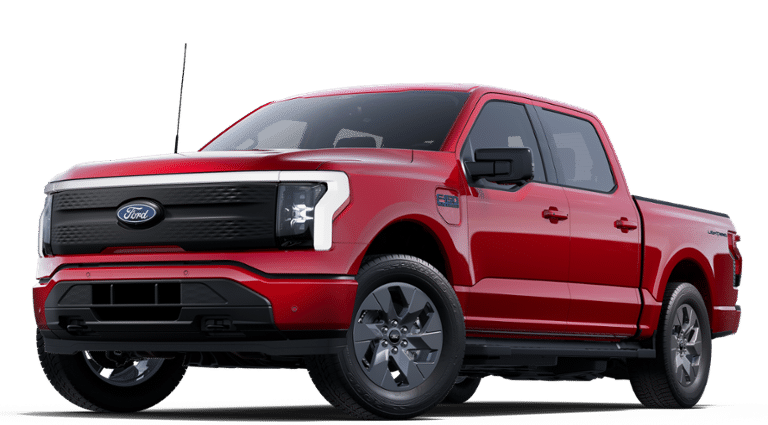
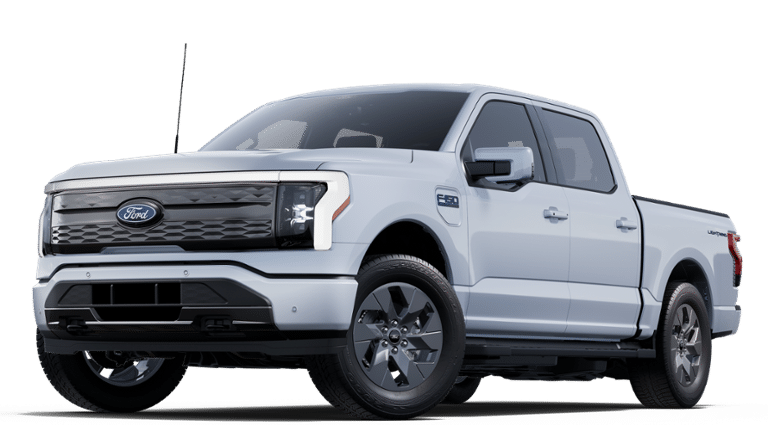
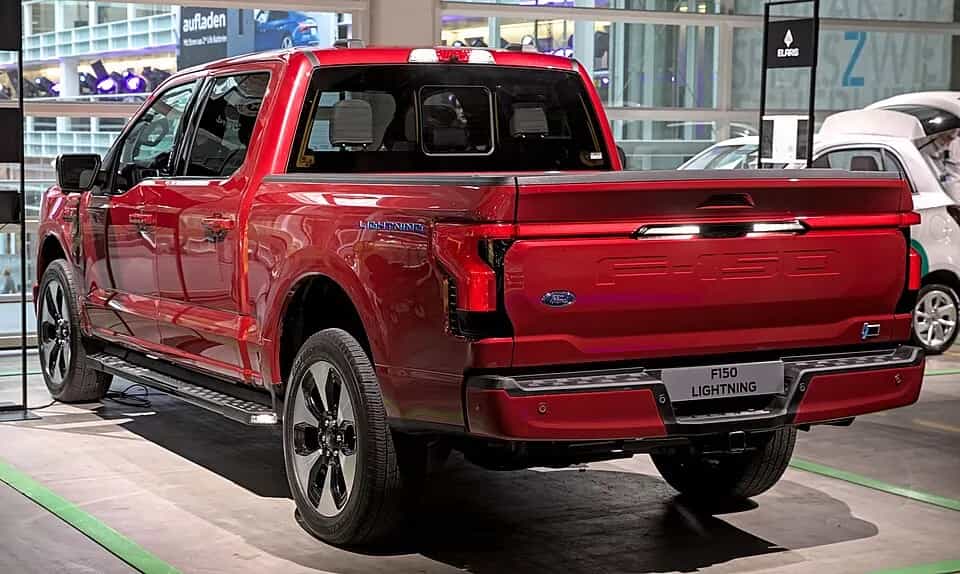
All Lightnings are SuperCrew four-door pickups with a 5.5-foot bed. Trims run from the fleet-focused Pro, through the volume XLT, to the well-equipped Lariat and the top Platinum. The front trunk (the "Mega Power Frunk") adds around 400 litres of lockable, drainable storage where the engine would be. Pro Power Onboard provides up to 9.6 kW of exportable electricity, and the Intelligent Backup Power feature can, in the US, power a home during outages.
Used availability in the USA
The USA is effectively the only meaningful source for this truck. Off-lease and early-adopter Lightnings appear regularly, many with modest mileage as second vehicles. Extended Range Lariat and Platinum trucks are the most sought-after; Pro and XLT Standard Range examples are more common and better value. Because these are recent vehicles, condition is generally strong, though battery health and charging history are the key things to verify.
When importing makes sense
The Lightning suits a buyer who wants an electric pickup with real utility and presence that few Europeans can match. Its US build gives it a favourable position on import duty, and instant torque plus AWD make it capable. Buyers should be realistic about its size on European roads and about the CCS1 charging arrangement. For the right owner with off-street charging, it is a compelling US import.
Facts and figures
| Item | Detail (Extended Range, representative) |
|---|---|
| Body style | SuperCrew four-door pickup, 5.5 ft bed |
| Powertrain | Dual electric motors, all-wheel drive |
| Battery (usable) | approx. 131 kWh (Extended Range); approx. 98 kWh (Standard Range) |
| Power | approx. 580 hp (ER); approx. 452 hp (SR) |
| Torque | approx. 1,051 Nm |
| EPA range | up to approx. 515 km (ER) |
| 0–100 km/h | approx. 4.0 seconds (ER) |
| DC fast charging | CCS1, up to approx. 150–155 kW |
| Max towing | up to approx. 4,536 kg (10,000 lb, ER with tow package) |
| Payload | up to approx. 900 kg |
| Frunk volume | approx. 400 litres |
| Length | approx. 5.91 m |
| Kerb weight | approx. 2,950–3,100 kg |
| Assembly | Dearborn, Michigan, USA |
| Model years | 2022–present |
Reliability and common problems
As an early-run EV, the Lightning has seen software and charging updates, and Ford issued a 2023 stop-ship over a battery cell manufacturing defect that affected a specific build window; a clean recall record is worth confirming. Owners report occasional 12-volt battery and infotainment quirks, and range sensitivity in cold weather is significant given the truck's mass and frontal area. Tyre wear is high because of the weight and torque. Mechanically the drivetrain is simple and durable; the priorities on a used F-150 Lightning are battery state of health, charging history, and that all recalls have been completed.
How US versions differ
US trucks are left-hand drive with mph clusters and CCS1 charging rather than Europe's CCS2, so an adapter and a charging plan are essential. The Lightning is very wide by European standards, which affects lane and parking use. Lighting must meet European requirements, including a rear fog lamp, and the daytime running and marker configuration is adjusted during approval. Onboard AC charging and connector compatibility should be checked before purchase.
From US purchase to registration
The path runs from selecting the truck, to a VIN and origin verification, to secure escrow payment, to ocean freight from a US port, to customs clearance in the EU, then TÜV individual approval (Einzelabnahme) and local registration. USCar Trader manages each step, including the documentation the customs office needs to assess origin.
Costs, duty and taxes at a glance
Key point: duty depends on the plant of build; only a VIN check secures the 0% rate. Import VAT of 19% applies regardless.
Two separate charges apply, with no broker margin. First, EU import duty: the standard passenger-car rate is 10%, but 0% can apply where US origin is provable through the VIN and Dearborn plant code under Regulations (EU) 2026/1455 and 2026/1461, in force since 1 July 2026 for directly transported vehicles until 31 December 2029. Because the Lightning is US-built, this origin case is often strong, but it is only confirmed by the VIN, never guaranteed in advance. Second, the German import VAT (Einfuhrumsatzsteuer) of 19% always applies on top, regardless of origin. We never describe an import as "duty-free".
TÜV, approval and license plates
Typical work covers headlight beam adaptation, adding a rear fog lamp, confirming the speedometer and CCS charging behaviour for the Einzelabnahme, and documenting the odometer conversion. Once approved, you register the truck locally.
Pre-purchase checklist
Confirm the VIN and Dearborn plant code against the title. Obtain a Carfax or AutoCheck report for accidents and title status. Verify battery state of health and DC charging history. Check that all safety recalls, including the 2023 battery recall, were completed. Inspect the bed, frunk seals, and undercarriage. Confirm software is up to date and the title is clean, not salvage or flood.
Import FAQ
Does the F-150 Lightning qualify for 0% EU import duty?
It is US-built in Dearborn, which often supports 0% duty, but only the VIN and plant code confirm it. The 19% import VAT always applies.
Can I fast-charge it in Europe?
Yes, with a CCS1-to-CCS2 adapter and appropriate planning, since US trucks use the CCS1 standard.
What is the real-world range?
Extended Range trucks cover roughly 350–450 km in mixed use, less in cold or when towing.
Is the Lightning reliable?
The drivetrain is simple and durable; verify battery health, charging history, and completed recalls on used examples.
How much can it tow?
Up to around 4,536 kg on Extended Range trucks with the towing package, though range drops sharply while towing.
Is it too big for European roads?
It is wide and long by European standards, so consider parking and lane width before importing.
Do I still pay VAT if duty is 0%?
Yes. The 19% German import VAT is separate and always due, even when the duty rate is 0%.
See the full Ford in the Carhub, compare other US electric pickups such as the Chevrolet Silverado EV, the GMC Sierra EV, and the Tesla Cybertruck, or view current F-150 Lightning listings.