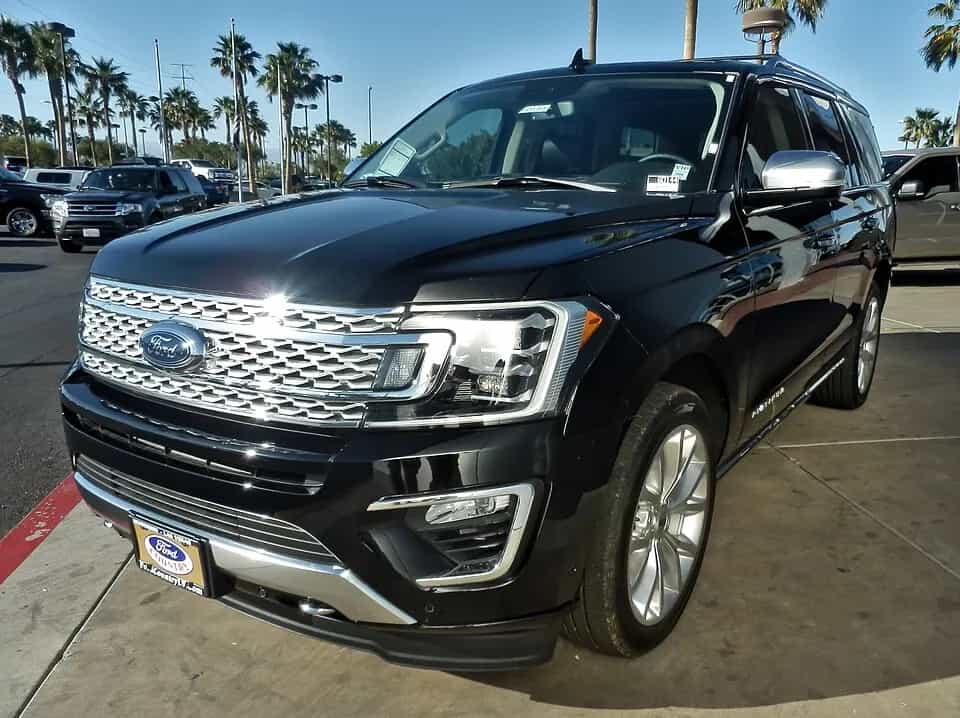
Ford Expedition
Importing a used Ford Expedition from the USA
The Ford Expedition is a full-size, body-on-frame SUV of a kind Europe simply does not build. It seats up to eight, tows heavy trailers and is assembled at Ford's Kentucky Truck Plant, making it an authentically American vehicle. For buyers who want that scale of SUV, importing a used Ford Expedition from the USA is often the only sensible route, since it was never a regular European catalogue model. USCar Trader acts as an independent broker for used US vehicles: we find the right Expedition, verify its documentation and origin, and organise transport and clearance to Germany. We are not a dealer and have no manufacturer partnership.

Generations at a glance
The Expedition arrived in 1996 as a full-size sibling to the F-150. The relevant modern generations for import are the third (2007-2017, U324) with its independent rear suspension, and the fourth (2018 onward, U553), which switched to an aluminium body to cut weight, much like the F-150. The fourth generation received a significant refresh for 2022 with new trims and technology, and an all-new version arrived for 2025. Throughout, Ford has offered a standard-wheelbase Expedition and a longer Expedition Max (earlier called EL), which adds substantial third-row and cargo space. Most export candidates are fourth-generation trucks.
Powertrain lineup
The modern Expedition is defined by the 3.5-litre EcoBoost twin-turbo V6. Depending on year and trim it produces roughly 375 to 440 hp, with the higher output reserved for the Limited and Platinum grades and the off-road-oriented Timberline. It drives through a 10-speed automatic, with rear-wheel drive standard and four-wheel drive widely optioned. Third-generation trucks used a 5.4-litre Triton V8 (and later a 3.5 EcoBoost). The EcoBoost's torque makes the Expedition a genuinely strong tow vehicle, rated well above two tonnes when properly equipped.
Trims in the US market
US trims have included XL, XLT, Limited, King Ranch, Timberline and Platinum. XLT and Limited dominate the used market; King Ranch and Platinum bring premium leather and equipment, while Timberline adds a locking rear differential and off-road hardware. The one meaningful body choice is standard versus Max wheelbase. Both are five-door SUVs with three rows; the Max is the pick for buyers who need maximum luggage space behind a raised third row.
The used market stateside
Expeditions are common across the United States, particularly in family and towing-oriented markets, so supply is steady. Many come from private owners with full service histories, while some carry fleet or livery use. Because they are large, well-maintained examples from dry states present the cleanest bodies. Typical export candidates run from around 40,000 to 130,000 km, and it is realistic to find a documented, single-owner truck if you are patient.
Who should import one
A used Ford Expedition suits buyers who need genuine eight-seat capacity, serious towing ability for a caravan, boat or horse trailer, and the comfort of a large highway cruiser. It appeals to big families, businesses that shuttle people or equipment, and anyone who wants American full-size SUV presence that European brands do not offer at this size. As a US-built vehicle, the Expedition is also straightforward from an import-origin standpoint.
Key specifications
| Vehicle class | Full-size body-on-frame SUV |
| Generations (modern) | 3rd (2007-2017), 4th (2018-) |
| Wheelbase options | Standard and Max/EL |
| Main engine | 3.5 L EcoBoost twin-turbo V6 |
| Output | ~375-440 hp by trim |
| Legacy engine | 5.4 L Triton V8 (3rd gen) |
| Transmission | 10-speed automatic |
| Drive | RWD or four-wheel drive |
| Seating | up to 8 |
| Length (Max) | approx. 5,635 mm |
| Towing (properly equipped) | up to ~4,100 kg |
| Body (4th gen) | Aluminium-intensive |
| Fuel | Petrol |
| Country of build | USA (Kentucky Truck Plant) |
How reliable is it?
Expedition reliability is generally solid, with a few known points. On third-generation 5.4 Triton engines, watch for cam phaser wear and, on very high-mileage examples, timing-chain noise. The fourth-generation 3.5 EcoBoost is durable but shares the family's need for strict oil discipline and occasional cam phaser attention on early builds; listen for a cold-start rattle. The 10-speed automatic benefits from timely fluid changes. Air suspension, where fitted on higher trims, can develop leaks with age, and the running boards on some trucks have had motor issues. Factor these Expedition common problems into any inspection.
What US models do differently
US Expeditions typically lack a rear fog lamp and use lighting aimed for American roads, both of which German registration addresses. Instruments read in miles and SYNC infotainment carries US maps. The sheer size means parking sensors and the surround-view camera are worth confirming as working, and the vehicle's mass and dimensions should be checked against your intended use and licence. These are routine considerations for a US full-size import.
Seven steps to your import
First we select suitable Expeditions and provide condition reports. The VIN and origin check confirms US build and eligibility for preferential duty. Payment runs through escrow, then the truck travels by road to port and crosses the Atlantic by container or RoRo. On arrival we handle customs clearance, arrange the TÜV inspection and any individual approval (Einzelabnahme), and support registration.
Customs, taxes and costs explained
Remember: no origin proof, no 0% duty – and 19% German import VAT is due on every import.
Two separate charges apply. EU import duty under Regulations (EU) 2026/1455 and 2026/1461, in force since 1 July 2026 for directly transported goods, can be 0% for vehicles of provable US origin, which a US-built Expedition VIN typically supports; this depends on documentation and is never guaranteed in advance. Separately, the 19% German import VAT (Einfuhrumsatzsteuer) applies to every import regardless of origin, calculated on customs value plus duty and freight. We present both clearly and add no margin.
German TÜV and registration
Typical work includes fitting or activating a rear fog lamp, correcting headlight aim, and confirming the odometer. Any towing equipment or aftermarket parts are assessed for approval. The TÜV report or individual approval provides the basis for German registration.
The buyer checklist
Decode the VIN for plant, year and engine. Pull Carfax or AutoCheck for accident, title and odometer history. Inspect the underbody and frame for rust on northern-state trucks. Check the EcoBoost or Triton for cold-start noise and service records. Test the air suspension and running boards if fitted. Verify the four-wheel-drive system. Confirm a clean, exportable title.
Questions and answers
Can I import a used Ford Expedition from the USA?
Yes. As a broker we source the vehicle, verify it and manage transport and clearance to Germany.
Does the Expedition qualify for 0% EU import duty?
Often, being US-built, but only with provable origin via the VIN and plant records. It is never guaranteed beforehand.
Is the 19% import VAT always due?
Yes. The Einfuhrumsatzsteuer applies to every import regardless of origin and is billed separately from duty.
Standard or Max wheelbase?
Choose Max if you need maximum cargo behind the third row; standard is easier to park and manoeuvre.
Can the Expedition tow a large caravan?
Yes, properly equipped it tows well above two tonnes, which is a key reason buyers import one.
How long does the import take?
Typically several weeks from purchase to registration, driven by ocean transit and clearance.
Are parts available in Europe?
Service and wear parts are broadly available; some US-specific trim may be ordered from the States.
Discover more in the Ford in the Carhub, compare the Explorer, the Bronco 4-Door and the F-150 Lightning, or browse current Expedition listings.