Ford E-Series Econoline Wagon

Importing a used Ford E-Series Econoline Wagon from the USA

The full-size Econoline has hauled American families, shuttle fleets and church groups for decades, and the passenger-focused Wagon (sold as the Club Wagon and later simply the E-350 Wagon) is the version buyers in Germany usually want: a body-on-frame, rear-wheel-drive people carrier that seats up to fifteen. Because these vans were built for the North American market, importing a used Ford E-Series Econoline Wagon from the USA is the most realistic way to put one on European plates. USCar Trader works purely as your broker and intermediary. We source, inspect and organise the logistics, we never sell new vehicles, and we take no hidden margin on the car itself.

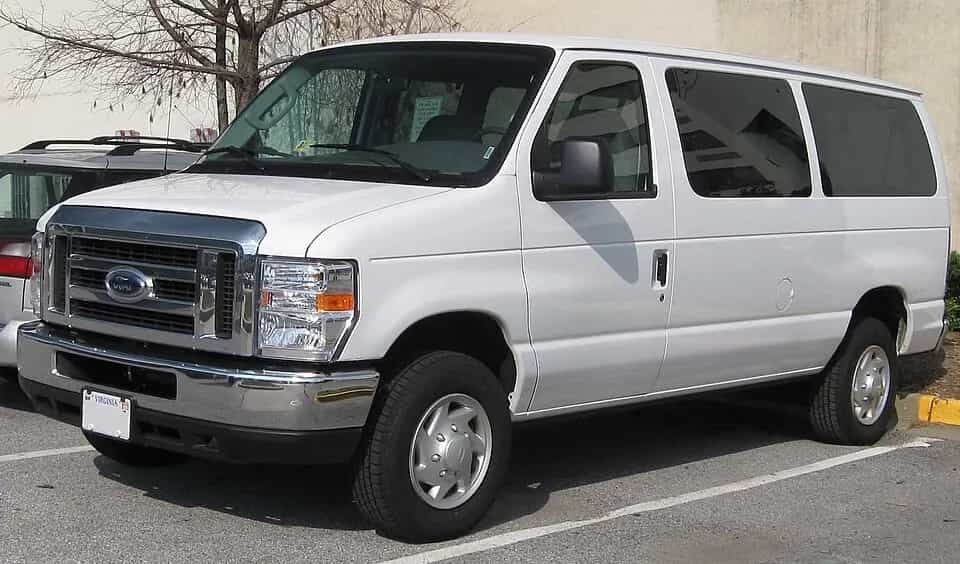
Ford e-series-econoline-wagon – used car imported from the USA
Photo: IFCAR · Public domain · Wikimedia Commons

Model history and generations

The nameplate dates back to 1961, but almost every example on the US used market belongs to the fourth generation, launched for 1992 and heavily revised in 2003 and again in 2008. Ford split the range into the light-duty E-150, the mid E-250 and the one-ton E-350 Super Duty, the last carrying the heaviest payload and the true 15-seat body. Passenger Wagon production wound down after the 2014 model year, when the Transit took over people-moving duty, although cutaway and cargo E-350/E-450 chassis continued. That long run means you will find everything from early-1990s Club Wagons to late, better-equipped 2014 Wagons with the modernised dashboard.

Engines and drivetrain

Power is pure old-school Ford. The common petrol units are the 4.6-litre and 5.4-litre Triton V8s (roughly 225 and 255 hp) and, in heavier E-350 Wagons, the 6.8-litre Triton V10 with around 305 hp and strong low-end pull for towing. Earlier vans ran the 4.2-litre Essex V6 or a 5.4 V8, and a 7.3-litre Power Stroke turbodiesel was offered before 2003, with the 6.0-litre Power Stroke appearing mainly in cutaway form. Drive reaches the rear axle through a 4-speed automatic (4R70W/4R75W), with the 5-speed TorqShift on later diesels. There is no factory all-wheel-drive Wagon, so expect rear-drive behaviour and a solid rear axle on leaf springs.

Which trim makes sense

Wagons came in XL, XLT and the plusher Chateau trim, in standard and extended (super) lengths. The extended body adds usable cargo room behind the rear bench and is the one to look for if you genuinely need to move fifteen people plus luggage. Equipment ranges from steel-wheel work-spec vans to leather-trimmed Chateau models with rear climate control, running boards and privacy glass. Quad captain's chairs, removable benches and dual air conditioning are all common configurations.

Supply on the US market

Supply is deep. These vans were sold in enormous numbers to shuttle operators, hotels, schools and large families, so the American used market carries a broad spread of years and mileages. Fleet-used examples can show high odometer readings but often have consistent service records; privately owned Wagons tend to be lower-mileage but cost more. The Sun Belt states are the place to hunt for rust-free bodies. Condition varies far more than mileage does, which is exactly why a documented history matters more than the number on the clock.

Who benefits from importing

An imported Econoline Wagon makes sense if you need real 12-to-15-seat capacity, plan a camper or overland conversion, or simply want the unmistakable full-size American van presence on German roads. It is not an economy choice, fuel use is high and the vehicle is physically large, but nothing in the European catalogue matches its blend of space, mechanical simplicity and towing muscle.

Technical data

SpecificationDetail (E-350 Super Duty Wagon, 5.4 V8)
Body styleFull-size passenger van, body-on-frame
GenerationFourth generation, 1992–2014
Length (extended)approx. 5,910 mm
Wheelbase3,505 mm (138 in)
Widthapprox. 2,030 mm
Heightapprox. 2,130 mm
Seating capacityup to 15
Example engine5.4 L Triton V8, petrol
Powerapprox. 255 hp
Torqueapprox. 475 Nm (350 lb-ft)
Transmission4-speed automatic
DrivetrainRear-wheel drive
Other engines4.6 V8, 6.8 V10, earlier 7.3 diesel
Fuel tankapprox. 132 L (35 gal)
Max towing (E-350)up to approx. 4,500 kg
AssemblyOhio Assembly, Avon Lake, USA

Known weak points and maintenance

The Econoline is a genuine workhorse, but the Triton engines have well-known habits. The two-piece spark plugs used on 2004-and-later 5.4 and 6.8 units can seize in the head or blow out, so a careful plug service history is worth confirming. Earlier 4.6 and 5.4 V8s can suffer spark-plug thread stripping, cam-phaser rattle and timing-chain tensioner wear at high mileage. Exhaust manifold bolts shear, front-end ball joints and hub bearings wear under the weight, and the leaf-sprung rear needs healthy bushings. Rust attacks the rockers, cab corners and brake lines on vans from northern states, which is another reason to favour southern examples. Nothing here is exotic, parts are cheap and plentiful, but budget for suspension and brake refreshment on a high-mileage fleet van.

US and EU spec compared

US-market Wagons run amber front turn signals combined with the brake lamp function at the rear, sealed-beam-style or DOT headlamps aimed for US traffic, and mph-dominant clusters. There is no rear fog lamp, no EU-standard tyre pressure labelling in the European sense, and daytime running arrangements differ. Larger, heavier E-350 Wagons can push past passenger-car weight thresholds, so the registration class and driving-licence category (a 15-seater may require more than a standard car licence) need to be checked before you commit.

The import process in detail

The process runs in a clear sequence: vehicle selection and price agreement; VIN and origin verification (the E-Series was assembled in Ohio, so a US-plant VIN is common but must be documented); payment via escrow for security; inland transport to the port and ocean freight to a European harbour such as Bremerhaven or Rotterdam; customs clearance on arrival; a technical inspection and individual approval (TÜV/§21) with any required conversions; and finally German registration. USCar Trader coordinates each stage as your intermediary.

What customs clearance really costs

In short: the 0% duty rate applies only with documented US origin (VIN/plant) – German import VAT of 19% is always due.

Two separate charges apply. The EU import duty can be 0% on vehicles of provable US origin under Regulations (EU) 2026/1455 and 2026/1461, in force since 1 July 2026 for directly transported goods until 31 December 2029. This is never automatic or guaranteed: it depends on documented US origin from the VIN and plant code. The Econoline is built in Ohio, which frequently supports that claim, but it still has to be evidenced. Entirely separately, the 19% German import VAT (Einfuhrumsatzsteuer) always applies on import, regardless of origin. We state both clearly and add no margin of our own.

TÜV, modifications and registration

Typical conversions are the rear fog lamp, headlamp adjustment or replacement for European beam patterns, side indicator/marker compliance, and a speedometer that reads km/h. The odometer and its accuracy are checked, and the emissions and lighting must satisfy the individual approval. Older vans may need brake and tyre attention to pass. Once the technical approval is issued, standard German registration follows.

Check before you buy

Before you buy, confirm the following: the VIN matches the title and the plant code supports US origin; a Carfax or AutoCheck report shows no salvage, flood or odometer flags; the underbody, rockers and brake lines are free of serious rust; the spark-plug and transmission service history is documented; the title is clean (not salvage or rebuilt) and lien-free; the engine shows no cam-phaser rattle or coolant loss; and the air conditioning and rear climate system actually work.

Common questions

Can I import a used Ford E-Series Econoline Wagon to Germany?

Yes. As a used North-American-market vehicle it can be imported, cleared and registered through the individual-approval route, and USCar Trader handles the process as your broker.

Does the 0% EU import duty apply to the Econoline Wagon?

It can, because the E-Series is built in Ohio, but only with provable US origin from the VIN and plant. It is never guaranteed, and the 19% German import VAT always applies on top.

How many seats does the E-350 Wagon have?

Extended E-350 Super Duty Wagons seat up to fifteen. Standard-length bodies and E-150/E-250 versions seat fewer, typically eight to twelve.

Is the 5.4 V8 or the 6.8 V10 the better choice?

The 5.4 V8 is adequate for most passenger use and lighter on fuel; the 6.8 V10 suits fully loaded 15-seat and towing duty but drinks noticeably more.

What are the biggest reliability concerns?

Triton spark-plug issues, exhaust manifold bolts, cam-phaser rattle, front suspension wear and northern-state rust are the main points to check.

Will it pass German TÜV?

Yes, once lighting, rear fog lamp and speedometer are made EU-compliant and the vehicle is mechanically sound, it can pass individual approval.

How long does shipping take?

Ocean freight from a US port to Northern Europe typically runs a few weeks, with customs and inspection added on arrival.

Explore more in the Ford in the Carhub, compare the closely related Ford Transit Passenger Van and the cargo-focused Ford E-Series Econoline Van, look at the alternative Chevrolet Express Passenger, or browse the current E-Series Econoline Wagon listings.