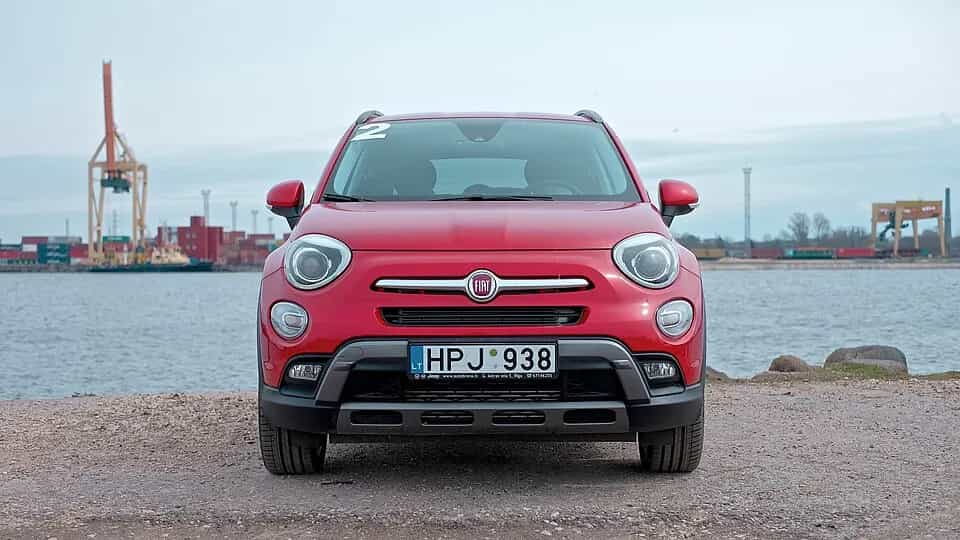
Fiat 500X
Importing a used FIAT 500X from the USA
The FIAT 500X takes the retro charm of the little 500 and stretches it into a genuinely usable subcompact crossover with a raised ride height and available all-wheel drive. It was sold in the United States between 2016 and 2019, and clean US-market cars occasionally make sense to import when the exact colour, trim and drivetrain you want is easier to find across the Atlantic. USCar Trader acts purely as an independent broker for used US vehicles — no new-car sales, no manufacturer tie, no vehicle margin.

Production years and key changes
The 500X launched globally in 2014 and reached the US for the 2016 model year. It rides on FCA's Small Wide 4x4 platform, the same architecture that underpins the Jeep Renegade — the two are effectively mechanical cousins built alongside each other at the Melfi plant in southern Italy. US cars ran with little change through 2018; the 2019 model year brought a facelift and a switch to a single, more modern turbo engine. Because assembly was in Italy, the 500X is a European-built car that happened to be sold in America, which is an important point for customs.
What is under the hood
Early US 500X models (2016–2018) offered two engines. The base 1.4-litre MultiAir turbocharged four-cylinder made about 160 hp and came with a six-speed manual and front-wheel drive. The more common 2.4-litre "Tigershark" naturally aspirated four produced around 180 hp and was paired exclusively with a nine-speed ZF automatic, available with front- or all-wheel drive. For 2019, FIAT dropped both and fitted a 1.3-litre MultiAir turbo (roughly 177 hp) with the nine-speed automatic. The AWD system is on-demand with a rear-axle disconnect for efficiency.
Trims and body styles
The 500X is a five-door crossover only. US trims included Pop, Easy, Lounge, Trekking and the sportier Sport, with the Trekking and Trekking Plus adding more rugged styling cues. Equipment ranged from steel wheels and cloth on base cars to leather, a sunroof, Uconnect touchscreen infotainment, heated seats and parking sensors higher up. AWD was the desirable option for buyers who wanted the extra traction the tall body implies.
What the US market offers
The 500X sold in modest numbers in America, so it is a niche rather than a volume find, but that also means well-kept examples exist that were used as light urban cars. Typical import candidates are 2016–2019 cars with moderate mileage and a full history report. Because it was a slow seller, sun-belt cars with clean bodies are worth seeking out, and a US history check is essential to confirm the drivetrain and service record.
Who this import is for
This car suits a buyer who loves the 500's styling but needs more space, a higher seating position and optional all-wheel drive. It is a fashion-led small crossover rather than a driver's car, so it fits someone prioritising looks, city practicality and character over outright refinement or long-term running-cost certainty.
Technical data and figures
| Item | Detail (US-market, typical) |
|---|---|
| Body style | 5-door subcompact crossover |
| Platform | FCA Small Wide 4x4 (shared with Jeep Renegade) |
| Base engine | 1.4 L MultiAir turbo I4 (2016–18) |
| Main engine | 2.4 L Tigershark I4 (2016–18) |
| Later engine | 1.3 L MultiAir turbo I4 (2019) |
| Power | approx. 160–180 hp |
| Transmission | 6-speed manual or 9-speed automatic |
| Drive | Front-wheel drive or AWD |
| Length | approx. 4,248 mm |
| Wheelbase | approx. 2,570 mm |
| Kerb weight | approx. 1,320–1,450 kg |
| Fuel tank | approx. 48 litres |
| Cargo (rear up) | approx. 350 litres |
| Fuel | Petrol |
| Assembly | Melfi, Italy |
| US model years | 2016–2019 |
Reliability: trouble spots to check
The 500X's reputation is mixed, and honesty helps here. The nine-speed ZF automatic, especially in early cars, was criticised for hesitant, jerky low-speed shifts; software updates improved it but a test drive is essential. The 2.4 Tigershark engine can consume oil and has MultiAir-related concerns on the intake side, so check oil level and service history carefully. Electrical niggles — infotainment glitches, sensors and the occasional warning-light gremlin — are the most common owner complaints. On the plus side, the shared Renegade underpinnings mean many parts are straightforward. Keep on top of oil changes, verify the timing and MultiAir servicing, and buy on condition and history rather than price alone.
US vs. Europe differences
US cars use mph speedometers, US-spec lighting without a rear fog lamp, and side-marker lamps. Infotainment and radio bands differ, and the emissions calibration is US federal/California. Since the 500X is fundamentally a European design, many components have EU equivalents, which can simplify approval and parts sourcing compared with a purely American model.
How the import works
The sequence is: choose the exact car and confirm condition and drivetrain; verify the VIN and build origin; use escrow to protect the payment; book ocean freight from a US port; clear customs on EU arrival; present for TÜV inspection and any individual approval; and finally register and plate. We manage the chain end to end.
Import duty, VAT and fees
Key point: duty depends on the plant of build; only a VIN check secures the 0% rate. Import VAT of 19% applies regardless.
The 500X was assembled in Italy, so it is not of US origin. That means the preferential 0% rate under Regulations (EU) 2026/1455 and 2026/1461 (in force since 1 July 2026, direct transport, valid until 31 December 2029), which requires provable US build, does not apply. As a returning EU-manufactured car it may qualify for returned-goods relief in some cases; otherwise the standard 10% EU passenger-car duty is charged on the customs value. In every case the 19% German import VAT (Einfuhrumsatzsteuer) is levied separately on customs value plus duty and freight. We never advertise duty-free imports and add no vehicle margin — the rate depends strictly on documented origin and status.
From modifications to registration
Expect to add or activate a rear fog lamp, adapt the rear turn-signal function, confirm headlamp compliance and convert the speedometer display. The US odometer reading on the title must match the cluster. Because the car is EU-derived, many parts already meet European norms, easing the individual approval.
Pre-buy inspection points
Before buying: decode the VIN to confirm year, engine and AWD; obtain a Carfax or AutoCheck report for accidents, title brands and odometer accuracy; test the nine-speed automatic thoroughly at low speed; check engine oil level and consumption on the 2.4; confirm a documented service history including MultiAir maintenance; inspect for prior body repairs; and make sure the title is clean rather than salvage.
What buyers ask most
Is the FIAT 500X reliable?
It is average. The engine and body are sound if maintained, but the nine-speed automatic and some electronics draw the most complaints, so history and a careful test drive matter.
Does the 500X have all-wheel drive?
Yes, AWD was optional with the 2.4 Tigershark and later 1.3 turbo, using an on-demand system with a rear-axle disconnect for efficiency.
Can I import a 500X duty-free?
No import is guaranteed duty-free. As an Italian-built car it does not qualify for the US-origin 0% rate; the standard 10% duty typically applies, with 19% import VAT always added separately.
What engines were offered in the US?
A 1.4-litre MultiAir turbo and a 2.4-litre Tigershark for 2016–2018, replaced by a 1.3-litre MultiAir turbo for 2019.
Is it related to the Jeep Renegade?
Yes, both are built on FCA's Small Wide 4x4 platform at Melfi and share much of their engineering.
How much cargo space does it have?
Around 350 litres with the rear seats up, expanding significantly when they are folded.
What should I check on the automatic?
Drive it slowly in traffic and watch for hesitation or harsh shifts; confirm any transmission software updates were applied.
Start here: see FIAT in the Carhub, compare the smaller FIAT 500 and FIAT 500L, or view current 500X listings.