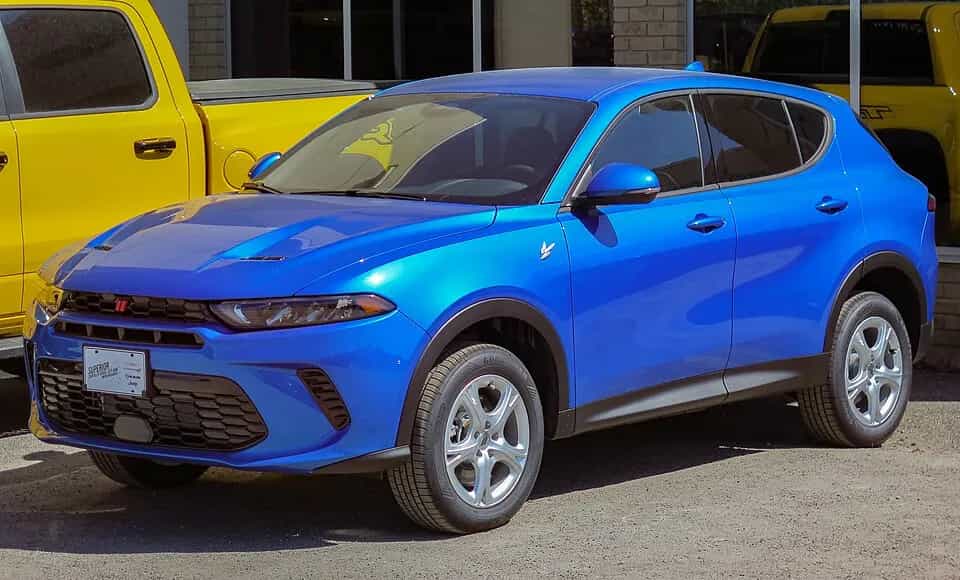
Dodge Hornet

Importing a used Dodge Hornet from the USA

The Dodge Hornet marks Dodge's return to the compact SUV class and its first electrified model, arriving as a 2023 model. It is a small, sporty crossover offered as a turbocharged GT and a plug-in hybrid R/T, both with all-wheel drive and a deliberately performance-flavoured character that sets it apart from ordinary compact SUVs. For EU buyers curious about the newest Dodge, importing a used Hornet from the USA is a way to secure a US-market example. USCar Trader works strictly as an independent broker for used vehicles — we source the exact car, verify it, and handle transport and clearance, without acting as a dealer.

Dodge Hornet – used car imported from the USA
Photo: Elise240SX · CC BY-SA 4.0 · Wikimedia Commons

Production years and key changes

The Hornet is a first-generation model launched for the 2023 model year, revived from a nameplate Dodge had explored years earlier. It sits on a Stellantis small-SUV platform and is closely related to the Alfa Romeo Tonale, with which it shares much of its structure and powertrains. Because it is a new car, there is only one generation so far, with early running changes rather than major redesigns. That shared engineering means its behaviour and componentry are already well understood through its Alfa Romeo sibling.

What is under the hood

Two powertrains are offered. The Hornet GT uses a 2.0-litre turbocharged four-cylinder producing around 268 hp, driving all four wheels through a nine-speed automatic. The Hornet R/T is a plug-in hybrid combining a 1.3-litre turbocharged four with an electric motor on the rear axle for eAWD, giving a combined output near 288 hp and a useful electric-only range of roughly 30 miles for short commutes. Both deliver strong acceleration for the class, and the R/T adds a PowerShot boost function for a brief burst of extra output.

Trims and body styles

The Hornet is a five-door compact SUV. The core split is GT (petrol turbo) and R/T (plug-in hybrid), each available in higher-spec Plus and Blacktop or Track Pack appearance and equipment levels that add larger wheels, upgraded brakes, adaptive dampers, and interior upgrades. Verify whether a car is GT or R/T, and which package it carries, as this changes both driving character and equipment substantially.

What the US market offers

As a recent model, used Hornets on the US market are low-mileage, near-new cars, typically one or two owners with modest miles. Availability is growing as early leases and purchases return to the market. Because the car is so young, most examples are in strong condition, but it is still worth confirming history and that any software updates have been applied. Dry-state cars remain the cleanest choice for a straightforward German inspection.

Who this import is for

The Hornet suits buyers who want a compact, sporty US-market crossover with the option of plug-in hybrid efficiency and standard all-wheel drive. The GT appeals to those who want simple turbo performance; the R/T PHEV suits drivers who can charge at home and want short electric commutes with a petrol backup for longer trips. If you want the newest Dodge and want to import a used Hornet from the USA, it is a distinctive alternative to the usual European compact SUVs — though, as noted below, its build origin matters for customs.

Technical data and figures

AttributeDetail (2023–present)
Body style5-door compact SUV (5 seats)
GT engine2.0 L turbo I4, ~268 hp
R/T powertrain1.3 L turbo I4 + electric motor (PHEV)
R/T combined outputapprox. 288 hp
R/T electric rangeapprox. 30 miles (WLTP-equivalent varies)
Transmission (GT)9-speed automatic
DriveAll-wheel drive (eAWD on R/T)
Lengthapprox. 4.50 m
Wheelbaseapprox. 2.64 m
Kerb weightapprox. 1,700–1,900 kg
0–100 km/h (R/T)approx. 5.6 s (with PowerShot)
FuelPetrol / plug-in hybrid
PlatformStellantis small SUV (shared with Alfa Romeo Tonale)
AssemblyPomigliano d'Arco, Italy
GenerationFirst (introduced 2023)

Reliability: trouble spots to check

Because the Hornet is new, a long-term reliability record is still forming, but its close relationship to the Alfa Romeo Tonale gives useful early signals. Reported Dodge Hornet common problems so far centre on software and infotainment glitches typical of a first-year model, occasional electrical niggles, and the usual break-in attention any new platform needs. The plug-in hybrid R/T adds the complexity of a high-voltage system, so confirming the traction battery's health and that all recalls and software updates have been completed is important. Routine maintenance on the 2.0 turbo GT is conventional; keep to the service schedule and use the correct oil specification.

US vs. Europe differences

US Hornets need European-approved headlights, a rear fog lamp, and compliant rear lighting for German registration, and the odometer conversion must be documented. US-market driver-assist features and radio bands (SiriusXM) will not work here. Charging is a key point for the R/T: the US car uses a US charging connector, so confirm compatibility with European charging standards or plan for an adapter or inlet solution before relying on it for home charging.

How the import works

The route is: select the exact car and confirm GT vs. R/T and package; verify the VIN and plant of build; place funds in escrow; ship by container or RoRo to Bremerhaven or Rotterdam; clear customs; pass TÜV and the individual approval (§21 StVZO); then register. USCar Trader coordinates each stage so the process stays on schedule.

Import duty, VAT and fees

In short: the 0% duty rate applies only with documented US origin (VIN/plant) – German import VAT of 19% is always due.

Two separate charges apply. Import duty: since 1 July 2026, Regulations (EU) 2026/1455 and 2026/1461 allow a 0% rate for vehicles of provable US origin, on direct transport, through 31 December 2029. Crucial nuance for the Hornet: although it is a US-market Dodge, it is assembled in Pomigliano d'Arco, Italy, not in the United States, so it will generally not qualify as US-origin and the 0% rate should not be assumed — the VIN and plant must be checked, and standard duty is likely to apply. We never promise 0% on this model. Second, the 19% German import VAT (Einfuhrumsatzsteuer) always applies, on the customs value plus freight, regardless of origin. USCar Trader adds no margin.

From modifications to registration

Typical approval work includes European headlights, a rear fog lamp, compliant rear indicators, and odometer documentation. For the R/T PHEV, the charging inlet and any EU homologation aspects should be reviewed. Emissions and noise are checked in the Einzelabnahme. Retain the original title and full documentation for customs and registration.

Pre-buy inspection points

Confirm before buying: 1) the full VIN and the plant of manufacture (Pomigliano, Italy) so origin and duty are assessed honestly; 2) a clean Carfax or AutoCheck with no salvage or flood record; 3) a clear (not rebuilt/salvage) title; 4) that all software updates and recalls are complete; 5) on the R/T, verified traction-battery health and charging function; 6) service and warranty history; 7) rust-free, dry-state condition for a smooth inspection.

What buyers ask most

Does the 0% import duty apply to a Dodge Hornet?

Usually not. The Hornet is built in Italy, so it generally does not qualify as US-origin; the VIN and plant must be checked and standard duty is likely to apply. The 19% import VAT always applies.

What is the difference between the Hornet GT and R/T?

The GT is a 2.0-litre turbo petrol; the R/T is a plug-in hybrid with electric-only range and eAWD, offering short EV commutes and stronger low-speed response.

Is the Dodge Hornet related to the Alfa Romeo Tonale?

Yes. They share the same Stellantis small-SUV platform and powertrains, so the Hornet's engineering is already well understood through its Alfa sibling.

Will the R/T plug-in hybrid charge in Germany?

The high-voltage system works, but the US charging connector differs from the European standard, so confirm compatibility or plan for an adapter/inlet solution.

Are there any known Hornet problems?

As a first-year model, mostly software and infotainment glitches and minor electrical items; confirm all updates and recalls are done, especially on the PHEV.

Is it worth importing such a new car?

It can be, if you want the newest Dodge unavailable through European channels, but factor in that standard duty is likely due given the Italian build.

How long does the import take?

Typically several weeks from purchase to registration, mainly determined by shipping schedules and customs clearance.

Discover the wider range in the Dodge in the Carhub, compare it with the closely related Alfa Romeo Tonale and rivals like the Jeep Compass and Jeep Renegade, and see the current Hornet listings.