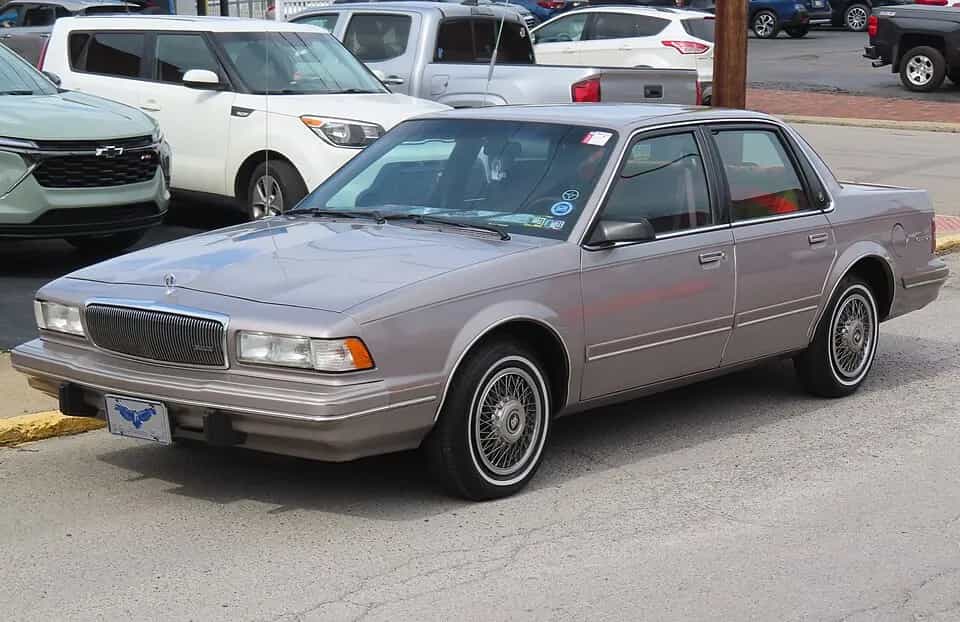
Buick Century
Importing a used Buick Century from the USA
The Buick Century is one of those quietly ubiquitous American sedans that most European buyers overlook — and that is exactly why it can be an interesting used import. Built for comfort rather than sport, it was a mainstay of American driveways for decades, which means the US used market still holds plenty of well-kept, low-owner examples. If you want a soft-riding, cheap-to-run US cruiser with a straightforward V6 and simple mechanicals, learning how to import a used Buick Century from the USA is worth the effort. As an independent broker, USCar Trader does not sell the cars itself and takes no vehicle margin — we source, verify and handle the logistics on your behalf.

Model history and generations
The Century nameplate has a long, layered history, so it helps to know which car you are actually looking at. The badge first appeared in 1936 on Buick's "banker's hot rod" full-size cars and returned in the 1950s. For anyone importing a used example today, three modern eras matter. The 1973–1977 Colonnade Century was a mid-size rear-drive coupe and sedan; the 1978–1981 G-body cars are notable for an early turbocharged 3.8-litre V6. The high-volume 1982–1996 A-body Century switched to front-wheel drive and offered sedan, coupe and the practical Estate Wagon. Finally, the 1997–2005 W-body Century — sedan only — is the most common car you will find in US classifieds, sharing much of its structure with the Buick Regal of the period.
Engines and drivetrain
Powertrains are conservative and, for the most part, robust. The 1997–2005 Century used GM's 3.1-litre 3100 SFI V6 (engine family LG8), rated around 160 hp and roughly 250 Nm, driving the front wheels through a 4-speed automatic — the 4T60-E and later 4T65-E. The 1982–1996 A-body cars are more varied: you will find the 2.5-litre "Iron Duke" four-cylinder in early models, plus 2.8, 3.0, 3.3 and the smooth 3.8-litre V6, with 3-speed and later 4-speed automatics. There was never a factory manual on the modern cars, and every version is front-wheel drive. For European use the drivetrain is easy to live with: regular unleaded, forgiving service intervals, and cheap, widely stocked US parts.
Which trim makes sense
On the 1997–2005 sedan, trims were kept simple: the Custom formed the base, the Limited added power seats, alloy wheels and more sound insulation, and there were occasional Special Edition packages. The older A-body range is where the body-style choice opens up — the Century Estate Wagon, with its long roof and fold-flat load area, is genuinely useful and increasingly sought after by enthusiasts of 1980s and 1990s American iron. Interiors across the board favour a wide front bench or split-bench, column shifter and a relaxed, living-room driving position rather than bolstered sport seats.
Supply on the US market
Because Buick sold the Century in enormous numbers to a careful, older ownership demographic, the American used market is full of tidy, one- or two-owner cars with complete service histories. Typical import candidates are 1997–2005 sedans with moderate mileage for their age, often garage-kept in the Sun Belt where rust is minimal. A-body wagons are rarer and command more attention from collectors. Condition varies widely by region: cars from Arizona, Texas, Florida or California tend to have clean underbodies, while Rust Belt examples should be inspected carefully. We do not quote European prices here — the point is that supply is deep and choice is good.
Who benefits from importing
The Century suits a specific buyer: someone who wants an honest, comfortable, low-drama American sedan or wagon rather than a status symbol or a performance car. It is a sensible pick for a relaxed daily driver, a second car, or an entry into the American-classic scene without the cost of a muscle car. If you value ride comfort, simple mechanicals and cheap maintenance over handling and badge prestige, a well-chosen used Century delivers exactly that.
Technical data
| Attribute | Typical figure (1997–2005 sedan) |
|---|---|
| Body style | 4-door sedan (A-body also coupe / wagon) |
| Layout | Front engine, front-wheel drive |
| Engine | 3.1 L 3100 SFI V6 (LG8) |
| Power | approx. 160 hp (118 kW) |
| Torque | approx. 250 Nm |
| Transmission | 4-speed automatic (4T60-E / 4T65-E) |
| Fuel | Regular unleaded petrol |
| Length | approx. 4,943 mm (194.6 in) |
| Wheelbase | approx. 2,769 mm (109 in) |
| Width | approx. 1,847 mm (72.7 in) |
| Kerb weight | approx. 1,510 kg (3,335 lb) |
| Seating | 5–6 (front bench available) |
| Emissions system | OBD-II (1996 onward) |
| Production years (modern) | 1982–2005 (A-body and W-body) |
| Assembly (sedan) | US plants (verify by VIN) |
Known weak points and maintenance
Overall Buick Century reliability is good for its class, but the 3.1-litre V6 has one well-documented weakness. The lower intake manifold gasket (LIM gasket) is prone to failure on GM's 3.1 and 3.4 V6s, which lets coolant seep into the oil or out onto the ground. It is a known, fixable issue — plenty of cars have had the updated gasket fitted — but any prospective import should be checked for milky oil, a rising or dropping coolant level, and sweet-smelling residue around the intake. The related Dex-Cool coolant, if neglected, can turn to sludge and clog the cooling system. Beyond that, the 4T65-E automatic is generally durable but appreciates fresh fluid; watch for delayed or harsh shifts. Typical age-related niggles among Buick Century common problems include failing power-window regulators, worn door-lock actuators, cracked plastic dash trim, and tired front struts. None of these are expensive in the US parts economy, which is one of the car's quiet strengths.
US and EU spec compared
The Century was never officially sold in Europe, so every example here is a genuine US-market car. It is left-hand drive, which is ideal for continental Europe. Practical differences to plan for include a speedometer reading in mph, amber-versus-red rear lighting conventions, no rear fog lamp as standard, and US-spec headlight beam patterns. The cars use US on-board diagnostics (OBD-II from 1996), which German workshops can read without trouble. Climate control, radio frequencies and units of measure are US-configured, though these rarely cause approval issues.
The import process in detail
A used import runs through a clear sequence. First, selection — we identify suitable cars in the US market that match your budget and condition expectations. Next comes the VIN and origin check, decoding the plant of manufacture, which is decisive for the customs classification. Payment is then handled through escrow for security, the car is booked onto ocean freight (usually container or RoRo) with direct transport to the EU, and on arrival it goes through customs clearance. After that the vehicle is presented for TÜV and, where needed, individual approval (Einzelabnahme under §21 StVZO), followed by German registration.
What customs clearance really costs
In short: the 0% duty rate applies only with documented US origin (VIN/plant) – German import VAT of 19% is always due.
Two charges must be considered separately, and we never describe an import as "duty-free" or guarantee an outcome. The EU import duty depends on the car's provable origin. Because this model's origin is not fixed in advance, the applicable rate is determined by the actual plant where the individual vehicle was built, verified via the VIN. Where a US build origin is proven, the 0% EU import duty under Regulations (EU) 2026/1455 and 2026/1461 can apply — valid since 1 July 2026, subject to direct transport and running until 31 December 2029. Separately, and in every case, the 19% German import VAT (Einfuhrumsatzsteuer) always applies on the customs value. As a broker we pass costs through transparently and add no vehicle margin.
TÜV, modifications and registration
Bringing a US Century to German road-legal standard is usually straightforward. Typical work includes fitting or activating a rear fog lamp, adapting rear lighting to European colour and function rules, adjusting or replacing headlights for the correct beam pattern, and confirming the odometer reading and its conversion from miles. The TÜV inspector checks brakes, tyres, emissions and general condition; older cars simply need to be sound. Once approval is granted the car is registered normally.
Check before you buy
- Decode the VIN and confirm the build plant for the customs classification.
- Pull a full Carfax or AutoCheck history — owners, title events, odometer records.
- Inspect for rust on the subframe, sills, wheel arches and floor, especially Rust Belt cars.
- Check the 3.1 V6 for intake manifold gasket symptoms: oil condition, coolant level, residue.
- Verify a clean, non-salvage, non-branded title.
- Review service records for transmission fluid and coolant maintenance.
- Test all power accessories — windows, locks, climate control.
Common questions
Is the Buick Century a reliable used import?
Yes, within its class. The mechanicals are simple and durable, and parts are cheap. The main thing to check is the 3.1 V6 intake manifold gasket, a known and fixable weak point.
Which Century should I look for?
The 1997–2005 W-body sedan is the most common and easiest to source. A-body Estate Wagons from the 1980s and 1990s are rarer and more collectible.
Is the Century left-hand drive?
Yes. Every US-market Century is left-hand drive, which suits driving in Germany and the rest of continental Europe.
What engine does it have?
Modern cars use GM's 3.1-litre V6 with a 4-speed automatic; older A-body versions offered a four-cylinder and several V6s. All are front-wheel drive.
Will I pay import duty?
It depends on the individual car's provable build origin. With US origin confirmed by VIN, 0% EU duty can apply under the 2026 regulations; otherwise the standard rate applies. The 19% German import VAT always applies separately.
Can it pass German TÜV?
Generally yes, with routine changes such as a rear fog lamp and European-compliant lighting. Sound, rust-free cars pass individual approval without major work.
Does USCar Trader sell the car to me?
No. We are an independent broker and intermediary. We source and verify the car and manage the import; we take no vehicle margin.
How is the car shipped?
By ocean freight from the USA, typically container or RoRo, with direct transport to the EU as required for the preferential duty rules.
Ready to look further? Browse the full Buick in the Carhub, compare comfortable stablemates such as the Buick LeSabre, the Buick LaCrosse and the Buick Lucerne, or go straight to the current Century listings.