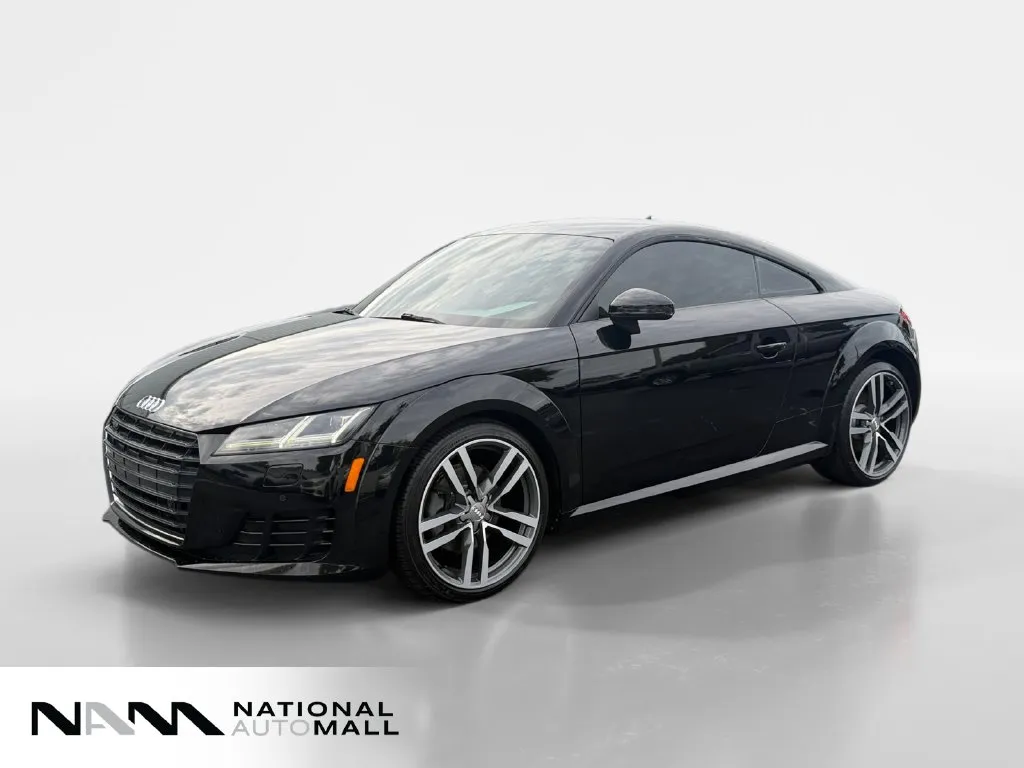
Audi TT
Importing a used Audi TT from the USA
The Audi TT is one of the most recognisable sports coupes of the last three decades, and the North American market received every generation in strong numbers. If you want to import a used Audi TT from the USA, you have a deep pool to choose from — from early Mk1 cars that are now modern classics to the sharp, digital-cockpit Mk3 and the searing five-cylinder TT RS. American cars are often well-specified, and dry-state examples tend to be free of the corrosion that plagues northern European stock. For a German enthusiast, importing a US TT can mean finding a specific colour, trim or drivetrain combination that is scarce at home.

Model history and generations
Three generations reached the US. The Mk1 (Typ 8N, 1999–2006) established the shape with its Bauhaus-inspired lines and was sold as a coupe and roadster. The Mk2 (Typ 8J, 2007–2015) moved to the MQB-predecessor aluminium-and-steel construction, grew slightly and gained the potent TTS and the first five-cylinder TT RS for the US around 2012. The Mk3 (Typ 8S, 2015–2023) introduced the all-digital Virtual Cockpit, MQB underpinnings and the most focused TT RS of all. Every generation was assembled at Audi's Győr plant in Hungary, which is relevant to customs classification and is addressed further down.
Engines and drivetrain
US TT buyers mostly ran the 2.0 TFSI turbocharged four, which grew from around 200 hp in early Mk2 cars to 220–228 hp in the Mk3, driving through either front-wheel drive or quattro all-wheel drive depending on year and market spec. The TTS lifted the same 2.0 TFSI to roughly 265–288 hp with standard quattro. The halo TT RS used Audi's charismatic 2.5-litre turbocharged five-cylinder — good for around 340 hp in the Mk2 and a mighty 394 hp in the Mk3 — always with quattro. Transmissions were the six- and later seven-speed S tronic dual-clutch, with a manual available on some earlier four-cylinder cars. The five-cylinder cars in particular have a following for their offbeat exhaust note.
Which trim makes sense
The TT came as a two-door coupe and a two-seat roadster (soft-top), plus the vestigial 2+2 rear seats on the coupe. The line runs TT, TTS and TT RS in ascending performance order. US options worth seeking include the S line/S line Competition packages, magnetic ride adaptive dampers, the Bang & Olufsen sound system and, on the Mk3, the full 12.3-inch Virtual Cockpit. Roadsters command their own audience; coupes are the more practical everyday choice.
Supply on the US market
The TT sold steadily in America, so supply is healthy across all three generations. Import candidates cluster around clean Mk2 and Mk3 coupes and roadsters, typically with mileage from 30,000 to 90,000 miles. Californian and south-western cars are the corrosion-free sweet spot. TT RS examples are rarer and command attention, so history and specification matter even more on those. No Euro prices are quoted here — a car's condition, service record and drivetrain define its value far more than model year alone.
Who benefits from importing
A used Audi TT suits the buyer who wants a compact, well-built sports coupe or roadster with genuine everyday usability. The four-cylinder cars are efficient daily companions; the TTS adds real pace with all-weather quattro traction; the TT RS is a collectible-grade performance car. If you have a specific colour, trim or the five-cylinder in mind and cannot find it locally, the US market is one of the best hunting grounds anywhere.
Technical data
| Specification | Audi TT (US market) |
|---|---|
| Body styles | 2-door coupe, 2-seat roadster |
| Generations | 8N (1999–2006), 8J (2007–2015), 8S (2015–2023) |
| Base engine | 2.0 TFSI turbo inline-4 |
| TT power | approx. 200–228 hp |
| TTS power | approx. 265–288 hp |
| TT RS engine | 2.5 TFSI turbo inline-5 |
| TT RS power | approx. 340–394 hp |
| Transmission | 6/7-speed S tronic dual-clutch; manual on some 4-cyl |
| Drivetrain | Front-wheel drive or quattro AWD |
| 0–100 km/h (TTS) | approx. 4.6–4.9 s |
| 0–100 km/h (TT RS Mk3) | approx. 3.7 s |
| Fuel | Petrol |
| Country of build | Győr, Hungary |
| Seating | 2 (roadster) / 2+2 (coupe) |
Known weak points and maintenance
The TT is broadly durable but has generation-specific weak points worth knowing before you import. Early 2.0 TFSI EA888 engines (Mk2) can consume oil through worn piston rings and are prone to timing-chain tensioner wear on higher-mileage examples — a rattle on cold start is the warning sign. The S tronic dual-clutch needs its scheduled fluid and filter service; neglected units develop harsh shifts. Mk1 and Mk2 owners report failing instrument-cluster pixels and window regulators, while roadster tops need their drains kept clear. The five-cylinder TT RS is robust but expensive to service, so continuity of maintenance history is critical. A car with full records and a recent DSG service is the one to buy.
US and EU spec compared
US TTs run amber front side markers and rear side markers, headlamps set for right-hand-traffic beam pattern, and instrumentation primarily in mph. The infotainment and navigation are US-market builds. Mechanically the cars are close to European spec, which keeps parts and service straightforward in Germany; the main conversion items are lighting and the rear fog lamp, both standard for individual approval.
The import process in detail
The sequence is straightforward: you choose a specific TT; we verify the VIN and confirm the documented plant of build and full history; your funds sit in escrow until the car is confirmed; the vehicle is shipped by ocean freight to a North European port; it clears EU customs; it is presented for TÜV inspection and, where required, individual approval (Einzelabnahme) under §21 StVZO; and finally it is registered locally. USCar Trader is an independent broker — we coordinate the whole chain and take no hidden dealer margin.
What customs clearance really costs
Key point: duty depends on the plant of build; only a VIN check secures the 0% rate. Import VAT of 19% applies regardless.
Import involves two separate charges. Customs duty first: the 0% EU rate applies only where US origin is provably documented from the VIN and plant under Regulations (EU) 2026/1455 and 2026/1461 (in force since 1 July 2026, direct transport, valid to 31 December 2029). Because the TT is built in Győr, Hungary, it will normally not meet the US-origin condition, so the standard EU passenger-car customs rate applies, with the exact figure following from the documented origin. Second, and in every case: the German import VAT (Einfuhrumsatzsteuer) of 19% is charged on the customs value plus duty and freight. We never call any import duty-free or guaranteed.
TÜV, modifications and registration
Typical approval work covers adapting the headlamps to a right-hand-traffic beam, fitting or confirming a compliant rear fog lamp, addressing the amber side markers where required, and recording the odometer reading (converted from miles for the papers). After the inspector signs off, the TT receives German registration and can be insured and driven normally.
Check before you buy
Before you buy any US TT: match the VIN to the title and confirm generation and drivetrain; pull a full Carfax or AutoCheck report for accident, title and odometer history; listen for timing-chain rattle on cold start on 2.0 TFSI cars; confirm a recent S tronic service; inspect for corrosion and prior accident repair; check the roadster roof operation and drains if applicable; and verify the title is clean rather than salvage or rebuilt.
Common questions
Is the Audi TT reliable as a used import?
Generally yes, with the usual EA888 oil-consumption and timing-chain caveats on early 2.0 TFSI cars and the need for regular dual-clutch servicing. A full history transforms the ownership case.
Does a used TT get 0% EU import duty?
Normally no, because it is built in Hungary rather than the USA. The 0% preference needs provable US origin from the VIN. The standard passenger-car rate usually applies, plus 19% import VAT.
Which TT is the most collectible?
The five-cylinder TT RS, especially the Mk3, is the enthusiast favourite for its 2.5 TFSI engine and distinctive exhaust note.
Coupe or roadster — which imports more easily?
Both import the same way. The coupe is the more practical daily car; the roadster needs its soft-top mechanism and drains checked.
Are US TT parts available in Germany?
Yes. The TT shares its engines and much of its platform with European Audi and Volkswagen Group models, so parts supply is excellent.
Do I still pay VAT on an older TT?
Yes. The 19% German import VAT applies to every used car imported from the USA, calculated on the customs value plus duty and freight.
Can you source a manual TT?
Manuals were offered on some earlier four-cylinder cars and are findable in the US, though the S tronic dominates the used pool.
How long does the whole import take?
Typically a couple of months from purchase to registration, driven mostly by shipping schedules and the approval step.
Start your search with Audi in the Carhub, compare the A5 Coupe or the hot S5, and view the current TT listings we can bring in from the USA.