

Importing a used Audi A7 from the USA
USCar Trader handles this as an independent broker.
 0049 (0)89 2000 791 00
 Mo - Fr 8:00am - 8:00pm
USCar Trader import service
Choose a specific vehicle. Where data is available, its detail page shows the import cost calculation. We assess any possible duty benefit with you before purchase.
Important: A 0% EU import-duty rate may be available for a vehicle covered by Regulation (EU) 2026/1455 that has US origin and is imported directly into the EU. CETA may apply to a vehicle with preferential Canadian origin. Whether the requirements are met is assessed for the individual case. Please contact us before purchase; we review the possible duty benefit and provide non-binding support through the process. Import VAT and other costs are assessed separately.
CarHub · Audi
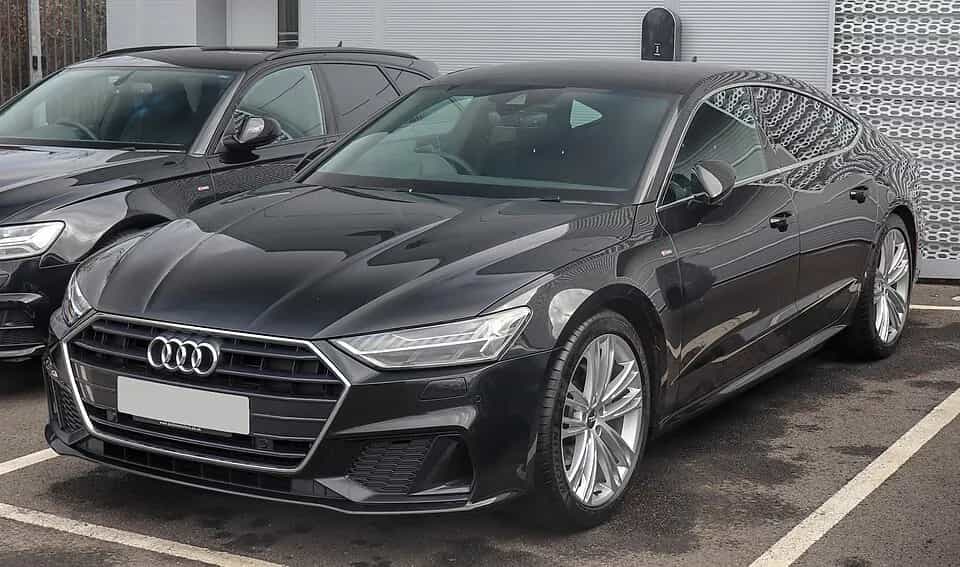
The Audi A7 Sportback is a five-door liftback that blends coupe styling with real practicality, and the United States has been a strong market for it since the first generation.
Model profile
USCar Trader handles this as an independent broker.
Two generations are relevant.
Powertrain and equipment
In the US second-generation A7, the core engine is the 55 TFSI: a 3.0-litre turbocharged V6 producing around 335 hp with a 48-volt mild-hybrid system, driving through a seven-speed dual-clutch and standard quattro all-wheel drive.
The A7 is sold only as the five-door Sportback liftback; there is no sedan or estate under this name. US trims centre on Premium, Premium Plus and Prestige, with equipment rising through each — larger displays, Bang & Olufsen audio, matrix-style lighting where available, adaptive suspension and driver-assistance packages.
Vehicle selection
Availability is good for the second-generation car, with a steady stream of low-to-moderate-mileage 2019–2023 examples, many from leases in clean condition and generous specification.
Import a used A7 Sportback from the USA if you want a specific generation, engine or high-specification configuration that the German market is not offering, or an S7 at the right colour and trim.
Vehicle data
| Body style | Detail (US-market A7 Sportback): 5-door Sportback liftback |
|---|---|
| Length | Detail (US-market A7 Sportback): approx. 4,970 mm |
| Wheelbase | Detail (US-market A7 Sportback): approx. 2,925 mm |
| Kerb weight | Detail (US-market A7 Sportback): approx. 1,900–2,000 kg |
| Seats | Detail (US-market A7 Sportback): 5 |
| Boot (seats up) | Detail (US-market A7 Sportback): approx. 535 litres |
| A7 55 TFSI engine | Detail (US-market A7 Sportback): 3.0 L turbo V6 + 48V mild hybrid, approx. 335 hp |
|---|---|
| S7 engine | Detail (US-market A7 Sportback): 2.9 L twin-turbo V6, approx. 444 hp |
| Transmission | Detail (US-market A7 Sportback): 7-speed dual-clutch (A7); 8-speed automatic (S7) |
| Drive | Detail (US-market A7 Sportback): quattro all-wheel drive (standard) |
| Fuel | Detail (US-market A7 Sportback): Petrol, premium recommended |
| Generations | Detail (US-market A7 Sportback): First gen (4G) 2011+; second gen (4K) 2019+ |
|---|---|
| 0–100 km/h (55 TFSI) | Detail (US-market A7 Sportback): roughly 5.2 s |
| 0–100 km/h (S7) | Detail (US-market A7 Sportback): roughly 4.5 s |
| Infotainment | Detail (US-market A7 Sportback): Dual-touchscreen MMI (second gen) |
Values are reproduced verbatim from the existing article table. The documents for the specific vehicle govern.
Pre-purchase review
The A7 is broadly dependable, but it is a technology-dense car and the usual Audi V6 items apply. On the supercharged first-generation 3.0 TFSI, the timing chain and its tensioner, plus the supercharger's water pump and thermostat, are known attention points as mileage rises.
Germany and Europe
US-market headlights use the FMVSS/SAE beam pattern, which differs from the ECE pattern required in the EU, so they may need adjustment or replacement with ECE-compliant units for registration.
USCar Trader services
As a buyer based in Germany, you do not have to inspect the vehicle yourself in the United States or Canada. Within the agreed scope, USCar Trader can coordinate document review, a separately commissioned on-site inspection and purchase processing.
Covered inspection points are agreed in advance. An on-site inspection records condition at the appointment and is not a guarantee.
Next step: Before commissioning, USCar Trader and the customer agree which document, history, inspection and transaction checks suit the vehicle and are included in the service. This records what was actually checked.
Import process
The assessment depends on the specific vehicle and the circumstances of the transaction. Please contact USCar Trader before purchase; we review any possible duty benefit and provide non-binding support. Import VAT and other costs are considered separately.
Questions and answers
Mechanically very similar and built in the same German plant. The differences are lighting, instrumentation units and connected services, all handled during import.
Yes. The S7 was sold in the US and appears on the used market alongside the standard A7 55 TFSI.
No, not automatically. A 0% EU import-duty rate may be available for a vehicle covered by Regulation (EU) 2026/1455 that has US origin and is imported directly into the EU. CETA may apply to a vehicle with preferential Canadian origin. Whether the requirements are met is assessed for the individual case. Please contact USCar Trader before purchase; we review the possible duty benefit and provide non-binding support. Import VAT and other costs are assessed separately.
Import VAT and other taxes or costs are assessed separately under the applicable rules and the circumstances of the individual case. A blanket answer for every vehicle would not be reliable.
Yes. quattro all-wheel drive is standard on the US A7 and S7, which suits German conditions well.
On the first-gen supercharged engine, the timing chain and water pump; on the second-gen 55 TFSI, oil consumption, the 48V system and the dual-clutch.
Typically a couple of months from purchase to German registration, driven mainly by freight and the TÜV appointment.
No. USCar Trader is a broker; we charge a transparent service fee and add no margin on the vehicle.
More vehicles