 2026-05-16
 Buying Guide
An attractive US listing may look straightforward until you spot “Salvage” or “Rebuilt”. The title helps explain the vehicle’s documented status. Here are the main terms and the checks to make before buying.
New York DMV · FZV Anlage 8
Clean Title
Usually a title without a corresponding damage brand. It does not prove an accident-free history. Check the vehicle and its records.
Understand Clean Title →Salvage Title
A significant loss or another qualifying event has been recorded under state rules. Establish the damage and paperwork status.
Understand Salvage →Rebuilt Title
The vehicle completed the applicable state process. Its damage history still matters. Assess repair quality separately.
Understand Rebuilt →What is a US vehicle title?
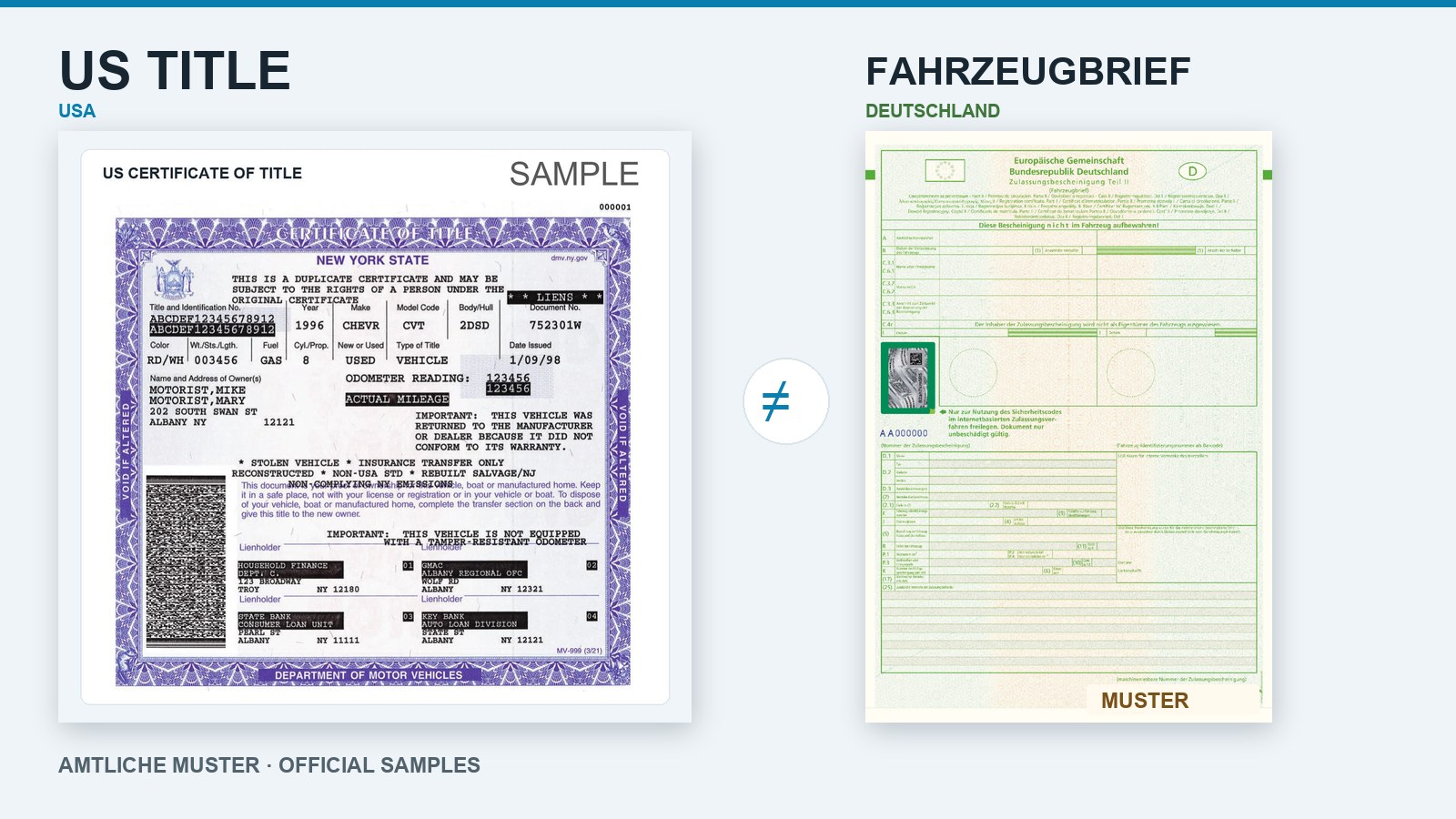
A Certificate of Title is a state-issued vehicle ownership document. It may record liens and information about the vehicle’s history. Registration for road use is a separate matter. A title does not replace a condition inspection or the requirements for registration in Germany.
For comparison: Germany’s Fahrzeugbrief is now called registration certificate Part II. It explicitly does not establish its holder as the vehicle owner. A US title records and transfers ownership under the issuing state’s rules. The two documents are therefore not legally identical equivalents. New York DMV · FZV Anlage 8
How to read a US title
VIN & vehicleDo the vehicle identification number, model and model year match the car?
Owner & transferDo the seller, recorded owner and transfer documents agree?
Brands / remarksWhat damage brands or other remarks appear on the document?
Liens / security interestsAre creditors listed, and are any required lien releases available?
View the official sample PDFHistorical status labels are called title brands. Names, thresholds and procedures vary between states. Neither the paper’s colour nor a seller’s shorthand is a quality guarantee. Read the exact wording, issuing state and historical records. California DMV: branded titles.
Clean Title does not automatically mean accident-free
Clean generally means the title has no corresponding damage brand. Accidents or repairs may still have occurred, and an empty history report does not certify the vehicle’s condition.
Compare the title and vehicle VIN, available history reports and an independent inspection. NMVTIS provides title, brand, odometer, total-loss and salvage indicators; it does not supply a complete repair history. NMVTIS: report scope.
Our guide to vehicle history reports with Carfax and ClearVIN explains how to read and compare the available records.
Salvage Title: identify the underlying loss
Salvage is a state-defined status, commonly linked to substantial damage. Flood, fire or other qualifying events may also be involved. There is no single nationwide “70 percent” rule.
The label alone does not describe the exact damage or establish that repair makes financial sense. Request pre-repair photographs, a damage description and complete ownership paperwork. Returning a salvage vehicle to US road use commonly requires the applicable state rebuilding process first. Texas DMV: salvage brands.
Rebuilt Title: repaired, with a recorded past
Rebuilt, Rebuilt Salvage and Prior Salvage generally refer to a formerly salvage vehicle that completed the required process after repair. “Rebuild” in a listing may be informal wording; check the actual document. Texas DMV: rebuilt vehicles.
Inspection requirements differ by state. New York specifically states that its salvage examination is an anti-theft examination, not a safety inspection. The administrative process therefore does not certify every aspect of the repair. New York DMV.
Other important title brands
Junk / Nonrepairable / Certificate of Destruction
These documents may designate a vehicle for parts or destruction and prohibit a return to US road registration. Do not assume this is an ordinary import suitable for registration. Examine the exact document and state rules. Texas DMV · Florida: Certificate of Destruction.
Flood / Water Damage / Fire Damage
Recorded water or fire damage. These labels can coexist with Salvage or Rebuilt. Investigate damage extent and possible subsequent faults separately. Damage brands.
Lemon Law Buyback / Manufacturer Buyback
Manufacturer repurchase, for example because of a warranty defect. This does not automatically mean accident damage. Obtain the documented defect and repair history. California DMV.
Not Actual Mileage / Odometer Discrepancy
The displayed mileage is not confirmed as the vehicle’s actual total. “Exempt” instead concerns an exemption from odometer disclosure; it does not automatically mean tampering. Odometer brands.
Bonded, Lien, Electronic Title, MSO/MCO and Bill of Sale
Bonded Title: a special process, involving a surety bond, for incomplete or disputed ownership evidence. It is not a condition certificate. Texas DMV.
Lien / Lienholder: a security interest, for example held by a lender. An unbranded title can still carry a lien. Resolve release or applicable export documentation before buying. Electronic Title / ELT: electronic recordkeeping, not a damage category. Texas DMV: electronic titles.
MSO/MCO: manufacturer documentation for a new vehicle not yet conventionally titled. Bill of Sale: a sale receipt; it does not automatically replace a required title. “Title Pending” means paperwork is outstanding. Establish an acceptable document route before payment or shipment. CBP: vehicles without conventional titles.
Prior Taxi / Police, Grey Market, Reconstructed and Replica: additional history or construction labels. Check the issuing state’s definition. California DMV: other brands.
What does the title mean for importing into Germany?
US export and German registration are separate processes. Export requires the applicable ownership and export documents. For relevant sea exports, CBP requires advance presentation of paperwork at least 72 hours before export. Agree the port’s specific procedure in good time. CBP export requirements.
A Rebuilt Title does not guarantee German registration. Original foreign paperwork, insurance and appropriate technical assessment remain relevant. With salvage, nonrepairable or unclear history, resolve document acceptance and registration requirements before buying. Berlin registration authority: used vehicles from outside the EU.
Our guide to conversion and German technical approval explains the technical steps.
Five checks before buying
- Document: complete front and back, state, VIN and exact brand.
- Ownership: seller, assignment chain and any lien release.
- History: earlier brands, losses and available pre-repair photographs.
- Condition: independent inspection and documented repairs.
- Import route: export paperwork, German technical approval and total costs.
Combine the document check with a calculation through registration. Our guide to total import costs explains the individual cost items.
Found a vehicle with an unclear title?
Send us the listing and VIN. We can agree the appropriate route for sharing full title documents and discuss the next check before purchase.
Discuss the vehicle before buying →Common questions about US titles
Does a Clean Title prove that a car is accident-free?
No. Check document status, available history and the vehicle itself together.
What is the difference between Salvage and Rebuilt?
Salvage indicates the relevant loss or document status. Rebuilt generally means a formerly salvage vehicle completed the state process after repair. That does not erase its history.
Can a Salvage or Rebuilt vehicle be registered in Germany?
The label alone cannot answer this. Original documents, actual condition and the requirements of the technical inspection and registration authorities determine the next steps. Check them before buying.
Editorial sources checked: 8 October 2026. The linked authorities describe their respective rules; requirements vary by state, vehicle and circumstances.
Document images: New York DMV (MV-999 official SAMPLE) and FZV Annex 8 (German registration certificate Part II, official sample). Image composition: USCar-Trader. New York DMV · FZV Anlage 8