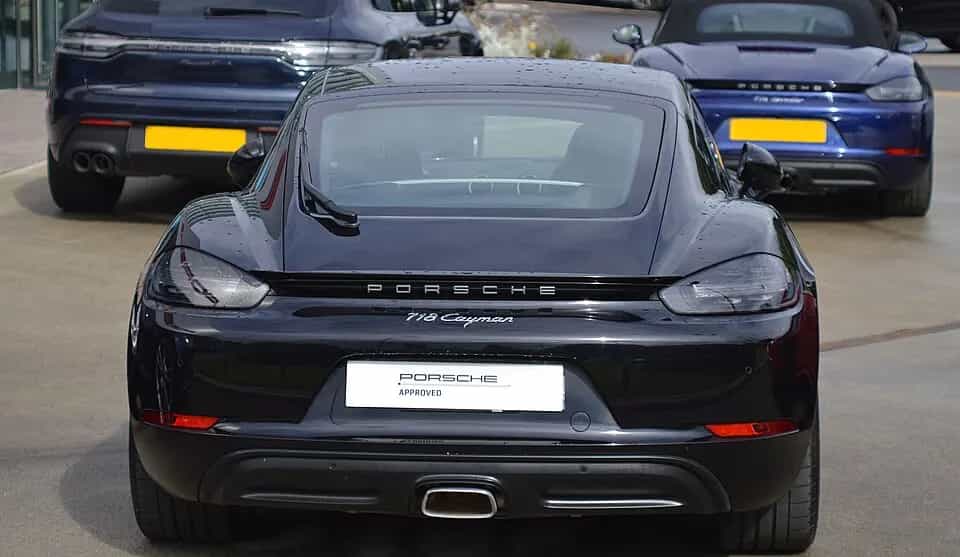
Porsche Cayman

Importing a used Porsche Cayman from the USA

The Porsche Cayman is the mid-engine coupe that many drivers consider the purest-handling car in the modern Porsche range, and the United States has always been one of its biggest markets. That depth is exactly why importing a used Cayman from the USA appeals to European buyers: the American used pool is large and varied, spanning value-priced early cars to sought-after GTS and GT4 models, often in dry-state condition. USCar Trader operates as an independent broker for used vehicles only — we source, verify and coordinate the import without acting as a dealer, without a manufacturer partnership and without adding a margin.

Porsche cayman – used car imported from the USA
Photo: 多多123 · CC BY 4.0 · Wikimedia Commons

From launch to today

Three generations cover the Cayman. The original 987 (2006–2012) introduced the hardtop coupe alongside the Boxster, with the later 987.2 switching to direct fuel injection and the optional PDK dual-clutch gearbox. The 981 (2013–2016) is widely regarded as a high point: sharper styling, a lighter and stiffer chassis, and a lineup that grew to include the 3.4-litre GTS and the celebrated 3.8-litre GT4. The current 718 Cayman (982, 2017 onward) moved the base and S cars to turbocharged flat-four engines, before the flat-six returned in the GTS 4.0 and GT4. Each generation has a distinct character, so deciding which one you want is the first real step.

Engines and drivetrain in detail

Powertrains span naturally aspirated flat-sixes and turbocharged flat-fours, all mounted amidships and driving the rear wheels. The 987 offered 2.7 and 3.4-litre sixes; the 981 ran a 2.7 base (around 275 hp), a 3.4 S (about 325 hp), a 340 hp GTS and the 385 hp GT4. The 718 introduced 2.0-litre (about 300 hp) and 2.5-litre turbo fours (350–365 hp), with the GTS 4.0 and GT4 returning to a naturally aspirated 4.0-litre flat-six making roughly 400–414 hp. Transmissions are a six or seven-speed manual or the quick-shifting PDK dual-clutch. The mid-engine layout gives the Cayman its trademark balance regardless of engine.

Trim levels and variants

The Cayman is a two-seat, two-door coupe throughout. The ladder generally runs from the base car up through S, GTS and the track-focused GT4, with Porsche's extensive options list meaning two nominally identical cars can be very differently equipped. Sought-after options include the Sport Chrono package, PASM adaptive dampers, limited-slip differential (PTV), sports exhaust, and on GT cars the full bucket seats and carbon-ceramic brakes. On an import, a well-optioned S or GTS often represents the strongest blend of value and desirability.

Used availability in the USA

US availability is excellent across all three generations. Early 987 and 981 base cars provide an affordable entry, while GTS and GT4 examples appear regularly, frequently as enthusiast-owned, low-mileage cars with full history. Many come from dry southern and western states, which is a real advantage for corrosion. Typical mileage varies widely — from garage-kept weekend cars to higher-mileage examples used more seriously — so history and specification drive value more than age alone.

When importing makes sense

A used Cayman suits the driver who prioritises handling and engagement over outright straight-line drama, and who wants access to specific US-market cars — a particular GT4, a manual GTS, or a well-specified S — that are scarcer or pricier in Europe. It rewards buyers willing to check history carefully, since Porsche running costs punish neglect. If you need rear seats or a big boot, look elsewhere; the Cayman is a focused two-seat sports car.

Facts and figures

AttributeDetail (typical US Porsche Cayman)
Generations987 (2006–2012), 981 (2013–2016), 718/982 (2017–)
Body style2-door, 2-seat mid-engine coupe
Engine layoutMid-mounted flat-six or turbo flat-four
Base power (981 / 718)~275 hp / ~300 hp
S power~325 hp (981) / ~350 hp (718)
GTS / GT4~340–365 hp / ~385–414 hp
Transmissions6/7-speed manual or PDK dual-clutch
DrivetrainRear-wheel drive
0–100 km/h~4.0–5.6 s by model
FuelPremium unleaded
Length~4,380 mm (981)
Wheelbase~2,475 mm
Kerb weight~1,310–1,430 kg
Key optionsPASM, Sport Chrono, PTV LSD, sports exhaust
Country of buildGermany (neutral origin — verify by VIN)

Reliability and common problems

Cayman reliability depends heavily on generation. On early 987.1 cars with the M96/M97 engine, the intermediate-shaft (IMS) bearing and bore scoring are the well-known concerns; a documented IMS solution or a later 987.2 DFI engine avoids the worst of it. The 981 flat-six is robust but still benefits from evidence of regular oil changes and attention to the water pump and coolant hoses. On 718 turbo-four cars, check for the reported cold-start rattle, confirm oil condition, and verify the PDK has been serviced. Across all versions, tyres, brakes and clutch (on manuals) are wear items that get expensive if ignored. A full Porsche or specialist service history is the single most valuable piece of paperwork.

How US versions differ

US Caymans carry amber side markers, right-hand-traffic headlight aim, mph-first instruments and no rear fog lamp, all addressed at German approval. US cars use US-market PCM navigation and radio bands. Mechanically they match European cars closely, which keeps homologation clean. Optional equipment follows the US price list, so a US car may combine options differently from a comparable German example — worth noting when comparing specifications.

From US purchase to registration

The sequence is: (1) selection — you choose a listing or we source the car; (2) VIN and origin check — history, accident and title records plus the plant of manufacture are confirmed; (3) escrow — funds are held securely so you never pay a seller unprotected; (4) ocean freight — container shipping (recommended for a Porsche) to a German port; (5) customs clearance — duty assessed on true origin and the 19% import VAT calculated; (6) TÜV / individual approval — lighting and any changes certified; (7) registration at your Zulassungsstelle.

Costs, duty and taxes at a glance

Remember: no origin proof, no 0% duty – and 19% German import VAT is due on every import.

The Cayman is built in Germany, which makes this an origin="neutral" case for import purposes: the applicable duty depends on the vehicle's actual proven origin, not on the fact that it is shipping from the USA. The 0% preferential EU rate under Regulations (EU) 2026/1455 and 2026/1461 applies only where genuine US origin can be proven on a directly transported vehicle — which will not be the case for a German-built Cayman, so the standard passenger-car duty normally applies. Interestingly, a German-built car being re-imported may qualify for returned-goods relief in specific documented circumstances, which we assess case by case. In all cases the 19% German import VAT (Einfuhrumsatzsteuer) applies and is shown separately. We never use the word "duty-free" and we add no margin.

TÜV, approval and license plates

Typical approval work includes converting the headlights for right-hand traffic, fitting or activating a rear fog lamp, confirming the speedometer in km/h, and verifying the odometer. Any aftermarket exhaust, suspension or wheels are documented for entry or removed. A largely standard Cayman passes individual approval without complication, and Porsche-specific data is readily obtained.

Pre-purchase checklist

Confirm before buying: the full VIN and build details; a clean Carfax or AutoCheck with no salvage, flood or major accident branding; the title status; a complete Porsche or specialist service history, including IMS on early cars and PDK service on later ones; corrosion-free underbody, ideally a dry-state car; and whether the drivetrain and suspension are stock. A pre-purchase inspection by a Porsche specialist in the US is strongly recommended.

Import FAQ

Which Cayman generation should I import?

The 981 is a popular sweet spot for its naturally aspirated flat-six and sharp chassis, while 718 GTS 4.0 and GT4 cars appeal to buyers wanting the latest flat-six.

Does the 0% EU import duty apply to a Cayman?

Not on origin grounds, since the Cayman is German-built; the standard duty normally applies, though returned-goods relief may be assessed. The 19% import VAT always applies.

Are early Caymans risky to buy?

Early 987.1 cars carry the known IMS bearing and bore-scoring concerns, so favour cars with a documented IMS fix or step up to a 987.2 or later.

PDK or manual?

PDK is faster and easier daily; the manual is prized by enthusiasts and can command a premium, especially in GTS and GT4 specification.

Will a US Cayman pass German TÜV?

Yes, after lighting conversion, a rear fog lamp and a km/h speedometer are addressed during individual approval.

How should a Porsche be shipped?

Container shipping is recommended for a sports car, giving enclosed protection to a German port such as Bremerhaven.

Can I import a Cayman GT4?

Yes. The GT4 is a US-market model and imports the same way; its aero and track options are documented at approval.

To begin, browse Porsche in the Carhub, compare the roadster Porsche Boxster and the Porsche Cayenne Coup, or the rival Audi TT, and view current Cayman listings.