Importing a used Porsche 718 Boxster and Cayman from the USA
USCar Trader is an independent broker. We take no margin on the vehicle, we are not a dealer, and we hold no manufacturer relationship.
 0049 (0)89 2000 791 00
 Mo - Fr 8:00am - 8:00pm
USCar Trader import service
Choose a specific vehicle. Where data is available, its detail page shows the import cost calculation. We assess any possible duty benefit with you before purchase.
Important: A 0% EU import-duty rate may be available for a vehicle covered by Regulation (EU) 2026/1455 that has US origin and is imported directly into the EU. CETA may apply to a vehicle with preferential Canadian origin. Whether the requirements are met is assessed for the individual case. Please contact us before purchase; we review the possible duty benefit and provide non-binding support through the process. Import VAT and other costs are assessed separately.
CarHub · Porsche
The 718 is Porsche's mid-engined two-seater, sold as the Boxster roadster and the Cayman coupé, and it is one of the best-handling sports cars the company has ever made.
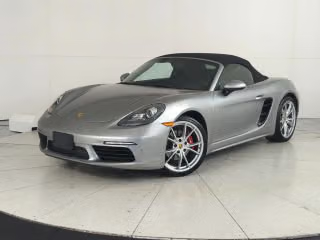
Price:57,984.00 USD

Price:54,599.00 USD

Price:46,250.00 USD

Price:128,500.00 USD

Price:129,500.00 USD
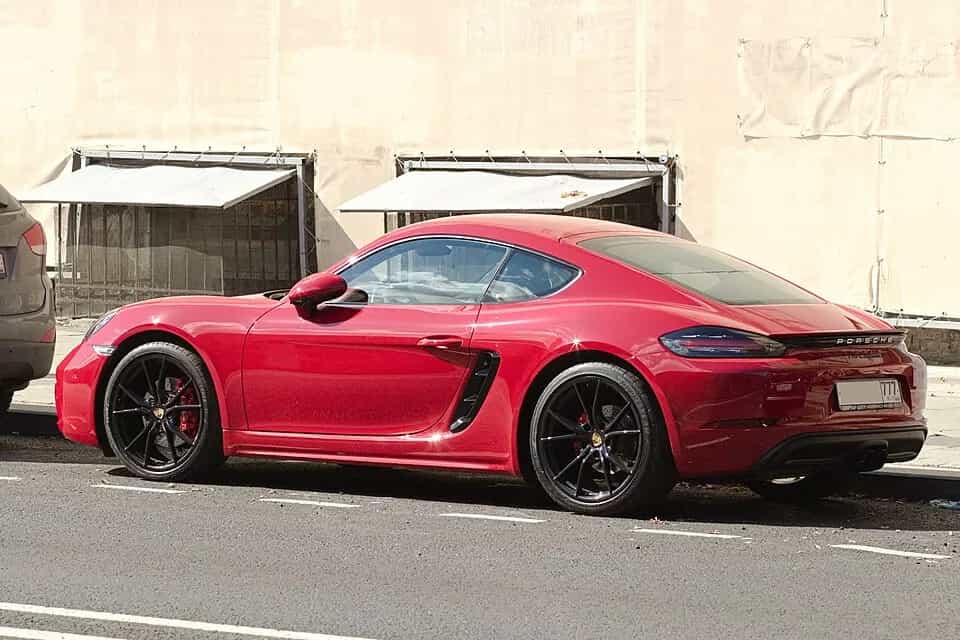
Model profile
USCar Trader is an independent broker. We take no margin on the vehicle, we are not a dealer, and we hold no manufacturer relationship.
The 718 name arrived with the 982-generation update in 2016, replacing the earlier 981 Boxster and Cayman.
Powertrain and equipment
The core turbo range uses a 2.0-litre flat-four in the base 718 (around 300 hp) and a 2.5-litre turbo flat-four in the S and GTS (roughly 350 to 365 hp), both mounted amidships and driving the rear wheels.
Two body styles: the Boxster convertible and the Cayman fixed-roof coupé. Trims run from the base 718, through S and GTS turbo cars, up to the flat-six GTS 4.0, the Boxster Spyder and the Cayman GT4.
Vehicle selection
American 718s are plentiful and often fair-weather cars, which helps preservation. Typical used examples range from low-mileage garaged cars to enthusiast-driven ones with full history.
A 718 import suits the driver who wants a specific engine and specification, especially the flat-six GTS 4.0 or GT4, or a well-optioned Cayman S that is hard to find locally.
Vehicle data
| Body styles | Detail: Boxster convertible, Cayman coupé |
|---|---|
| Seats | Detail: 2 |
| Engine layout | Detail: Mid-mounted, rear-wheel drive |
|---|---|
| Base engine | Detail: 2.0 L turbo flat-four (approx. 300 hp) |
| S / GTS turbo | Detail: 2.5 L turbo flat-four (approx. 350–365 hp) |
| GTS 4.0 / GT4 | Detail: 4.0 L naturally aspirated flat-six (approx. 394–400 hp) |
| Transmissions | Detail: 6-speed manual or 7-speed PDK |
| Fuel | Detail: Petrol (premium) |
| Layout benefit | Detail: Mid-engine balance |
| Generation | Detail: 982 (718), from 2016 |
|---|---|
| 0–100 km/h (S, PDK) | Detail: approx. 4.2 s |
| 0–100 km/h (GT4) | Detail: approx. 4.4 s |
| Top speed (GTS 4.0) | Detail: approx. 293 km/h |
| Redline (flat-six) | Detail: approx. 8,000 rpm |
| Suspension | Detail: PASM adaptive available |
| Brakes | Detail: Steel or optional PCCB |
Values are reproduced verbatim from the existing article table. The documents for the specific vehicle govern.
Pre-purchase review
The 718 is generally dependable, but there are points to check. The 2.0 and 2.5 turbo flat-fours have been broadly reliable, though some early cars experienced issues with the turbocharger and, in a subset, bore or oiling concerns, so a documented service record is important. The flat-four exhaust note is a matter of taste rather than a fault.
Germany and Europe
US 718s have federal lighting with amber side markers, mph-primary instruments and US emissions equipment. Certain options and colours differed between markets.
Typical approval work is lighting: adapting or documenting headlights and fitting a rear fog lamp where needed. The speedometer must display km/h and the odometer is read in kilometres.
USCar Trader services
As a buyer based in Germany, you do not have to inspect the vehicle yourself in the United States or Canada. Within the agreed scope, USCar Trader can coordinate document review, a separately commissioned on-site inspection and purchase processing.
Covered inspection points are agreed in advance. An on-site inspection records condition at the appointment and is not a guarantee.
Next step: Before commissioning, USCar Trader and the customer agree which document, history, inspection and transaction checks suit the vehicle and are included in the service. This records what was actually checked.
Import process
The assessment depends on the specific vehicle and the circumstances of the transaction. Please contact USCar Trader before purchase; we review any possible duty benefit and provide non-binding support. Import VAT and other costs are considered separately.
Questions and answers
Yes. Both are importable as used cars, and we handle the process from US purchase to German registration as your broker without taking a margin on the vehicle.
No, not automatically. A 0% EU import-duty rate may be available for a vehicle covered by Regulation (EU) 2026/1455 that has US origin and is imported directly into the EU. CETA may apply to a vehicle with preferential Canadian origin. Whether the requirements are met is assessed for the individual case. Please contact USCar Trader before purchase; we review the possible duty benefit and provide non-binding support. Import VAT and other costs are assessed separately.
Import VAT and other taxes or costs are assessed separately under the applicable rules and the circumstances of the individual case. A blanket answer for every vehicle would not be reliable.
The turbo flat-four cars are quicker to find and more affordable to run; the flat-six GTS 4.0 and GT4 are more sought after and sound better. Both import the same way.
Broadly yes, with documented servicing. Check turbo history and service records, and include a specialist inspection before buying.
PDK is faster and easier; the manual is more engaging. It is a preference choice and does not affect the import at all.
It depends on sailing schedules, port handling and approval booking. We give you a realistic timeline once the car and route are confirmed.
Identify them before purchase. Non-original exhaust, tunes or suspension may need adjustment for German approval and can affect value.
More vehicles