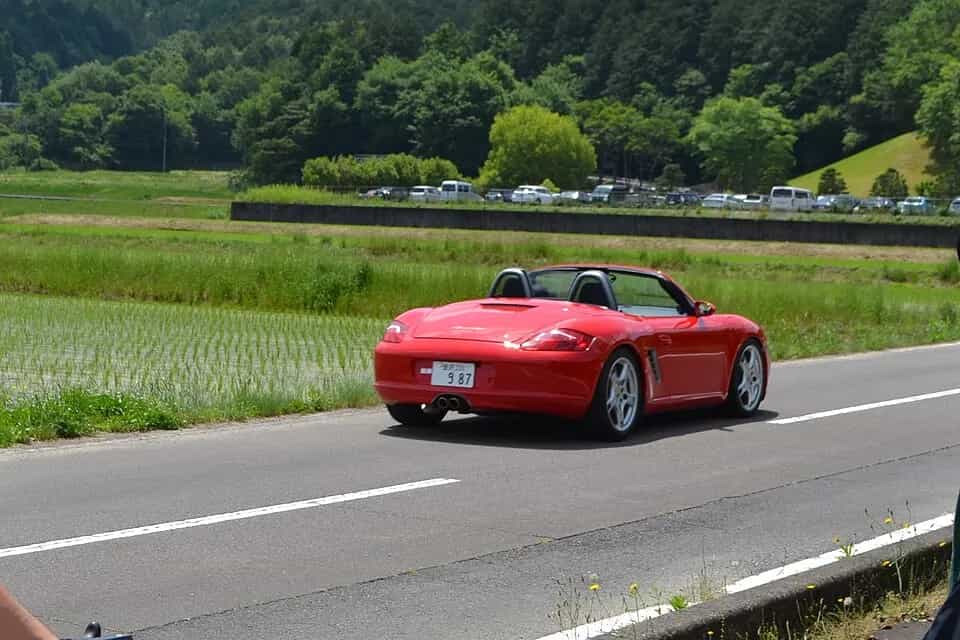
Porsche Boxster

Importing a used Porsche Boxster from the USA

The Porsche Boxster is one of the most rewarding used sports cars you can buy, and the American market holds a deep, well-kept supply of them. The United States bought Boxsters in large numbers as second cars and weekend toys, which means many now come up for sale with modest mileage, comprehensive history and dry-climate bodies. Importing a used Boxster from the USA can widen your choice considerably compared with the tighter European pool, especially for specific colours, gearboxes and options. USCar Trader acts as your independent broker: we find the car, verify the VIN and build plant, and run the import through to German registration without holding stock or taking a vehicle margin.

Porsche boxster – used car imported from the USA
Photo: 先従隠始 · CC0 · Wikimedia Commons

Production years and key changes

The mid-engined Boxster roadster launched in 1996 as the 986, the car that arguably saved Porsche. The 987 followed for 2005 with a stiffer shell and sharper looks, updated in 2009 with direct-injection engines and the PDK dual-clutch option. The 981 arrived for 2012 on a lighter, longer-wheelbase platform with electric steering and a much-praised chassis. From 2016 the 982 generation adopted the 718 branding. Across two decades the Boxster kept the same recipe: engine amidships, folding fabric roof, near-perfect balance.

What is under the hood

Early 986 cars used 2.5, 2.7 and 3.2-litre flat-six engines. The 987 ran 2.7 and 2.9 base units with 3.2 and later 3.4-litre S engines, the post-2009 cars gaining direct injection. The 981 offered a 2.7 flat-six and a 3.4 in the S, with the naturally aspirated flat-six at its peak. The 718 then switched to turbocharged 2.0 and 2.5-litre flat-four engines for the base and S, while the 718 Boxster GTS 4.0 and Spyder revived a 4.0-litre naturally aspirated flat-six. Gearboxes are a five- or six-speed manual, Tiptronic on the oldest cars, or the excellent PDK dual-clutch from 2009 onward. Every Boxster is rear-wheel drive.

Trims and body styles

The Boxster is a two-seat convertible in essence. The hierarchy runs base, S, GTS and the special Spyder, plus the track-focused Boxster Spyder RS at the very top of the 718 range. American cars are frequently loaded with PASM adaptive dampers, the Sport Chrono package, PDK, Bose or Burmester audio and heated leather, because US buyers ticked options generously.

What the US market offers

Supply is strong and varied. Typical import candidates are 987 and 981 cars from 2006 to 2016 with 40,000 to 120,000 km, many of them summer-only cars from California, Arizona, Texas and Florida with clean, rust-free underbodies. Manual-gearbox 981 S models and any 718 GTS 4.0 attract the most attention from enthusiasts. Because these were often garaged weekend cars, condition can be excellent, but service history and engine health matter more than sticker mileage. No European price is quoted here; it depends on the individual car and market.

Who this import is for

The Boxster suits a driver who values balance, steering feel and open-top usability over straight-line drama. It is a genuine sports car that also works as a comfortable daily. If you want the classic flat-six soundtrack, chase a 981 or the 718 GTS 4.0; if you prioritise low running costs and torque, the turbo flat-four 718 makes sense. Buyers wanting rear seats or all-weather traction should look elsewhere.

Technical data and figures

AttributeDetail (generation-dependent)
Body styleTwo-seat mid-engine roadster
Generations986, 987, 981, 982 (718)
986/987/981 enginesFlat-six, 2.5-3.4 L
718 base/S enginesTurbo flat-four, 2.0 / 2.5 L
718 GTS 4.0 / SpyderNaturally aspirated flat-six, 4.0 L
Power rangeapprox. 204 hp (986 2.5) to 400 hp (Spyder RS)
Transmission5/6-speed manual, Tiptronic, or PDK dual-clutch
DrivetrainRear-wheel drive
RoofPowered fabric folding top
Length (981)approx. 4,374 mm
Wheelbase (981)2,475 mm
Curb weightapprox. 1,310-1,450 kg
FuelPetrol
AssemblyGermany (Stuttgart) and Finland (Uusikaupunki) depending on year

Reliability: trouble spots to check

The great caveat with older flat-six Boxsters is the intermediate shaft (IMS) bearing on 986 and early 987 cars up to roughly 2008, which can fail and cause catastrophic engine damage; many cars have had an upgraded bearing fitted, and proof of that work is worth paying for. Rear main seal (RMS) leaks are common on the same era. Bore scoring on the flat-six, particularly larger-displacement engines, is another known issue, so a cold-start listen and ideally a borescope are wise. The 987 and 981 also had coolant pipe and water-pump concerns. The 718 flat-four sidesteps the IMS question entirely but has its own trait of oil dilution and a less charismatic sound. On every Boxster, check the convertible roof mechanism, the front radiators (which trap debris and corrode), and the condition of the clutch or PDK service history.

US vs. Europe differences

American Boxsters run different lighting: expect no rear fog lamp and US-pattern headlights that require ECE adaptation. Side marker lights and the mph speedometer need addressing at inspection. Mechanically the cars are the same globally, and options such as PASM, Sport Chrono and PDK are identical.

How the import works

First a specific car is selected, then the VIN and build plant are checked to establish origin. Funds move through secured escrow rather than a direct transfer. The Boxster is booked onto ocean freight, cleared through customs at the European port, presented for TUV and individual approval (Einzelabnahme), and finally registered. USCar Trader manages every stage as your broker.

Import duty, VAT and fees

Key point: duty depends on the plant of build; only a VIN check secures the 0% rate. Import VAT of 19% applies regardless.

Import duty depends on where the car was actually built. Under EU Regulations 2026/1455 and 2026/1461, in force since 1 July 2026 for directly transported goods until 31 December 2029, a 0% rate applies only with documented US origin. The Boxster is a German-built car (with some years assembled in Finland), so a US-origin claim generally will not apply and the standard duty rate is likely, determined per VIN and plant. The 19% German import VAT (Einfuhrumsatzsteuer) always applies on top, calculated on customs value plus freight. USCar Trader takes no vehicle margin.

From modifications to registration

Typical work includes fitting a rear fog lamp, adapting headlights to ECE beam pattern, correcting side markers and documenting the odometer conversion to kilometres. After individual approval the car is registered locally on its new papers.

Pre-buy inspection points

Confirm the 17-digit VIN across car and documents. Obtain a Carfax or AutoCheck report for accident, title and mileage history. On flat-six cars, establish whether the IMS bearing has been upgraded and look for bore-scoring symptoms. Inspect the underbody for corrosion despite the dry-state reputation. Verify the convertible roof cycles fully. Check clutch or PDK service and the front radiators. Confirm a clean, non-salvage title unless knowingly accepted.

What buyers ask most

Which Boxster generation is the best import?

The 981 is widely regarded as the sweet spot for chassis and flat-six sound; the 718 GTS 4.0 is the enthusiast pick if budget allows.

Is the IMS bearing still a worry?

Only on 986 and early 987 flat-six cars up to about 2008. Cars with a documented IMS upgrade, or the later 981 and 718, avoid the issue.

Will a Boxster qualify for 0% EU import duty?

Generally no, because it is built in Germany or Finland rather than the USA. Duty is set per VIN and plant, and the 19% import VAT always applies.

Manual or PDK for import?

Both are common in the US pool. Manuals suit purists; PDK is faster and easier in traffic.

Are US Boxsters rust-free?

Many southern-state cars are very clean, but always inspect the underbody and radiators regardless of climate claims.

How many kilometres is normal?

Import candidates typically show 40,000 to 120,000 km, often as former weekend cars.

Can I import a 718 flat-four?

Yes. It is the most economical choice and avoids the older flat-six failure modes, though it sounds different.

Does USCar Trader handle everything?

Yes, as an independent broker we cover sourcing, escrow, freight, customs, TUV and registration.

Discover the full range in the Porsche in the Carhub, compare the closely related Porsche Cayman and Porsche Cayenne Coup, or browse the current Boxster listings.