Kia Stinger

Importing a used Kia Stinger from the USA

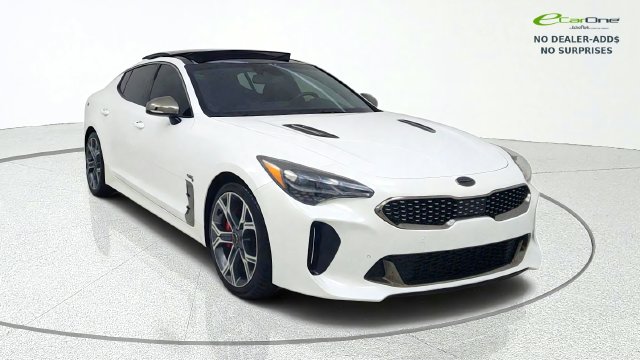
The Kia Stinger was the car that made people look twice at the badge. A rear-drive fastback sport sedan developed under Albert Biermann, the former head of BMW M engineering, it slotted a twin-turbo V6 and a proper grand-touring silhouette into a segment nobody expected Kia to enter. In the United States it sold from the 2018 model year through 2023, and the used market there is now the most sensible place to find one — especially a well-kept GT. As an independent broker, USCar Trader helps German and EU buyers source, inspect and bring one home, whether you want an all-wheel-drive daily or a lightly used GT2 with the full leather cabin.

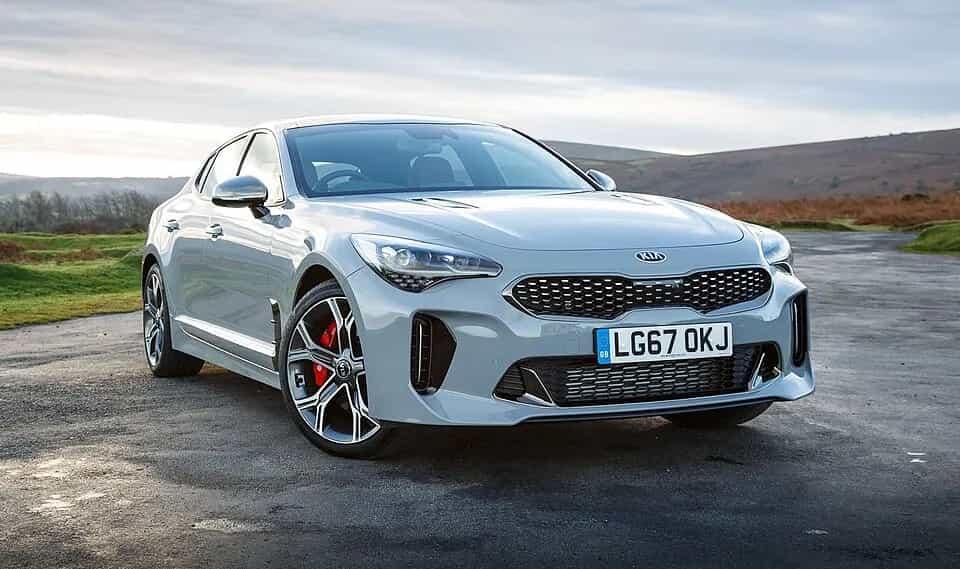
Kia stinger – used car imported from the USA
Photo: Motor Verso · CC BY 2.0 · Wikimedia Commons

Model history: years and generations

The Stinger ran on a single generation, internally CK, unveiled at Detroit in 2017 and reaching US showrooms as a 2018 model. It shared its rear-biased platform philosophy with the Genesis G70 and used a design penned under Gregory Guillaume, with the long dash-to-axle proportions of a classic gran turismo. A mid-cycle refresh arrived for the 2022 model year: the base 2.0-litre four was dropped in the US in favour of a stronger 2.5-litre turbo, the infotainment grew to a 10.25-inch screen, and the GT gained a small power bump. Production ended in 2023, which makes clean late cars genuinely collectible.

Engines, transmissions and drive

Two turbocharged petrol engines defined the US Stinger. The entry unit was the 2.0-litre Theta II turbo four (around 255 hp), replaced from 2022 by a 2.5-litre turbo four rated near 300 hp. The headline engine is the 3.3-litre Lambda II twin-turbo V6, making 365–368 hp and 510 Nm, good for a 0–100 km/h sprint of roughly 4.7–4.9 seconds. Every US car uses a smooth eight-speed automatic; buyers chose between rear-wheel drive and an on-demand all-wheel-drive system with a limited-slip rear differential on GT trims. Brembo brakes and adaptive dampers came on the higher grades.

Equipment lines and body styles

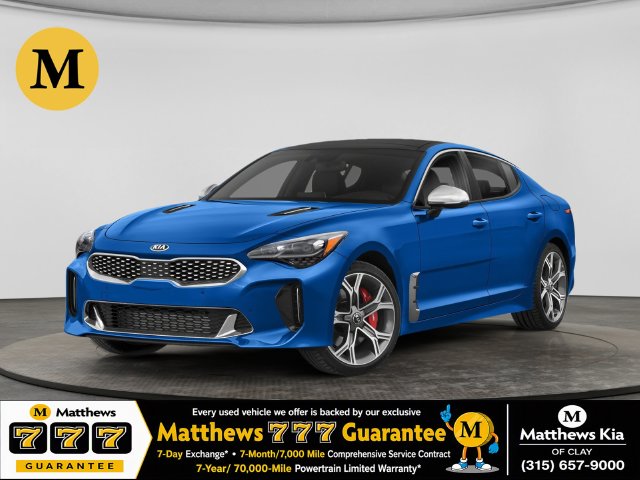
The Stinger is only a five-door liftback — there was never a coupe or wagon. US trim ladders shifted over the years but centred on base/GT-Line four-cylinder cars and the GT, GT1 and GT2 V6 models. GT2 is the one to hunt for: Nappa leather, ventilated seats, a head-up display, a Harman Kardon system and the full Brembo package. Colour choice matters for resale; Ceramic Silver, HiChroma Red and Micro Blue are the enthusiast favourites.

The US used market

Because the Stinger sold in steady numbers across the States, supply is healthy and geographically spread. Typical used examples run from 2018 to 2023 with mileages between roughly 30,000 and 90,000 miles. The four-cylinder cars are the most common and cheapest to run; clean V6 GT cars command a premium and move quickly. Southern and western states offer the rust-free bodies you want for an EU import — a car that has never seen road salt is worth chasing.

Is an import right for you?

Import a used Kia Stinger from the USA if you want rear-drive grand-touring character, a practical hatchback boot and a long standard-equipment list, without the badge premium of the German establishment. It suits the driver who wants something rare on European roads, and who values the strong original warranty reputation of the brand. If you need a compact commuter, look elsewhere in the range; the Stinger is a deliberate, mid-size statement car.

Specs at a glance

Body style5-door fastback sport sedan (liftback)
GenerationsOne (CK, 2018–2023 US market)
Top engine3.3 L Lambda II twin-turbo V6
Power (GT)365–368 hp / approx. 510 Nm
Base engine2.0 L / later 2.5 L turbo four
Transmission8-speed automatic
DrivetrainRWD or AWD (LSD on GT)
0–100 km/h (GT)approx. 4.7–4.9 s
Top speed (GT)approx. 270 km/h
Lengthapprox. 4,830 mm
Wheelbaseapprox. 2,905 mm
Kerb weightapprox. 1,780–1,930 kg
Boot capacityapprox. 406 L (1,114 L folded)
Fuel tankapprox. 60 L
AssemblySohari, South Korea

Common issues buyers should know

Stinger reliability is generally strong, but there are known weak points worth checking. The 2.0-litre Theta II turbo has a history of oil consumption and, in some cases, engine concerns tied to Kia's wider Theta program — verify service records and any completed campaigns. Both engines are direct-injected, so carbon build-up on the intake valves is a long-term maintenance item; a walnut-blast clean around 100,000 km is normal. Owners also report HVAC blend-door actuator noises, occasional infotainment glitches, and heavy front brake and tyre wear on hard-driven GT cars. The eight-speed automatic is robust when serviced. Keeping to the oil-change interval and using the correct spec fluid is the single biggest factor in long-term Stinger reliability.

Differences from the European version

US Stingers run amber rear turn signals in many cases but often lack a rear fog lamp, and headlight aiming follows the US pattern — both are standard TÜV correction points. Instruments read in mph, and speed on the digital display can be switched, but the analogue cluster may need attention. The daytime running lights and side-marker configuration also differ. Mechanically the cars are identical to European-market equivalents, which simplifies parts supply through Kia's global network.

Import step by step

The process is methodical: select the specific car and confirm the price; run a VIN and plant-of-origin check to establish the customs rate; place funds in escrow so payment is released only on agreed terms; arrange inland transport to the export port and container or RoRo ocean freight to a hub such as Bremerhaven; clear EU customs on arrival; present the car for TÜV and individual type approval (Einzelabnahme); then register it with your local authority. USCar Trader coordinates each handover so nothing stalls in transit.

Customs and taxes: what applies

In short: the 0% duty rate applies only with documented US origin (VIN/plant) – German import VAT of 19% is always due.

Two charges apply and they are always shown separately, with no broker margin added. First, import duty: the Kia Stinger is assembled in South Korea, so it does not carry US origin and the standard EU passenger-car duty (currently 10%) normally applies. The 0% US-origin duty introduced by Regulations (EU) 2026/1455 and 2026/1461 (in force since 01 July 2026, direct transport required, running until 31 December 2029) applies only when the VIN and plant prove US manufacture — which a Sohari-built Stinger will not. Second, the 19% German import VAT (Einfuhrumsatzsteuer) always applies, on top of the vehicle value plus duty and freight. We never promise duty-free import.

Modifications and single-vehicle approval

Typical TÜV work covers headlight adjustment or replacement to the EU beam pattern, adding a functioning rear fog lamp, and confirming the odometer and speedometer. The Stinger's LED lighting usually passes with an aiming correction. A COC document may be obtainable to ease registration; where it is not, the car goes through individual approval. Once approved, you register and receive German plates.

What to verify before buying

Match the VIN on the dashboard, door jamb and title. Pull a full Carfax or AutoCheck history for accidents, title brands and odometer consistency. Inspect the underbody and suspension arms for rust, especially on cars from northern states. Confirm the service record, particularly oil changes on the 2.0T. Check the title is clean, not salvage or rebuilt, unless you knowingly accept it. Test the infotainment, all electric seat functions and the adaptive dampers. Verify tyre and brake life on GT cars.

Common questions

Can I import a used Kia Stinger from the USA to Germany?

Yes. The Stinger is a straightforward import; the main work is customs clearance and the TÜV individual approval for lighting and documentation.

Does the Kia Stinger qualify for 0% EU import duty?

Generally no. It is built in South Korea, so it lacks US origin and the standard 10% car duty usually applies. Only a VIN-proven US-built vehicle can qualify for 0%.

Is the 19% import VAT avoidable?

No. German Einfuhrumsatzsteuer of 19% always applies on import and is calculated separately from any duty.

Which Stinger engine should I import?

The 3.3 twin-turbo V6 GT is the enthusiast choice; the four-cylinder cars are cheaper to run and insure.

Are Kia Stinger parts available in Europe?

Yes. Kia's European dealer network supplies most service parts, as the car was also sold in Europe.

What mileage is normal on a used Stinger?

Most US cars fall between 30,000 and 90,000 miles; verify service history rather than mileage alone.

Is the Kia Stinger reliable?

Broadly yes, with the caveats around 2.0T oil use and routine direct-injection carbon maintenance.

How long does the import take?

Typically several weeks door to door, depending on freight scheduling and customs.

Explore the full Kia in the Carhub, compare related models such as the Kia K5, the Kia Optima and the electric Kia EV6, or browse current Stinger listings.