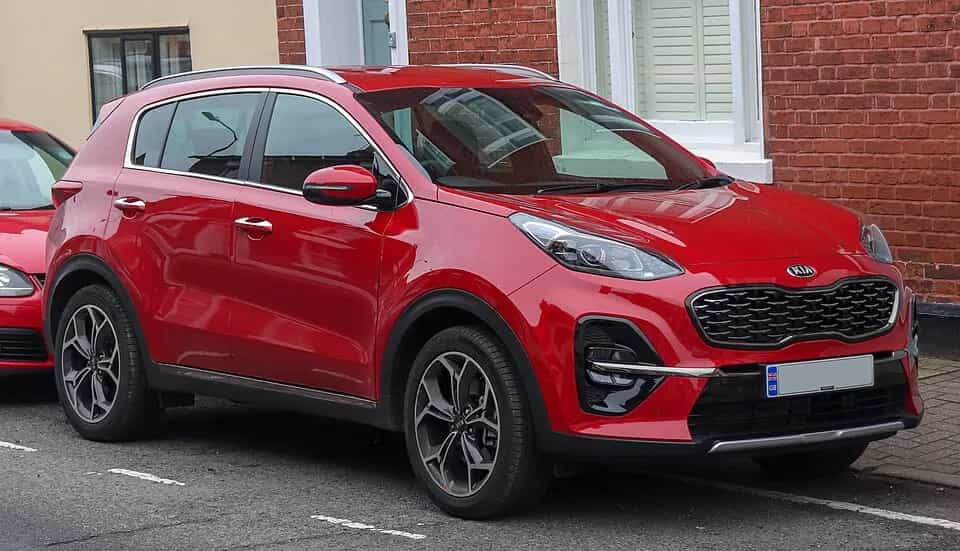
Kia Sportage
Importing a used Kia Sportage from the USA
The Sportage is one of Kia's global best-sellers, and the American market has spent years absorbing them in large numbers. That matters if you want to import a used Kia Sportage from the USA: supply is deep, prices reflect a saturated market, and you can be selective about generation, drivetrain and condition. As an independent broker, USCar Trader does not sell you a car from stock and takes no vehicle margin. We source the specific Sportage you want from US auctions and private sellers, verify its history, and manage the shipment and clearance into Germany. This page gives you the technical grounding to choose well before you commit.

Generations at a glance
The Sportage nameplate goes back to 1993, but the versions worth importing today start with the third generation. The SL (2010–2015) was the Peter Schreyer redesign that turned the Sportage into a genuine design statement. The fourth generation QL (2016–2021 in the US) matured the platform, shared with the Hyundai Tucson, and offered the sought-after 2.0-litre turbo. The current fifth generation NQ5 arrived in US showrooms for the 2023 model year with a longer wheelbase, a far roomier cabin and available hybrid and plug-in hybrid drivetrains. Each step brought better crash structure, more advanced driver assistance and larger screens.
Powertrain lineup
US-market Sportages are almost all four-cylinder. The QL generation paired a naturally aspirated 2.4-litre Theta II GDI (around 181 hp) with a six-speed automatic, while the SX Turbo used the 2.0-litre turbocharged four making roughly 237–240 hp. The NQ5 moved to a 2.5-litre four (about 187 hp) as the base engine, plus a 1.6-litre turbo hybrid producing around 227 hp combined and a plug-in hybrid near 261 hp. Front-wheel drive is standard; the on-demand all-wheel-drive system is a popular option and is the version most European buyers look for.
Trims in the US market
The Sportage is a five-door compact SUV only, so the choice is about equipment. On the QL, the ladder ran LX, EX and the turbocharged SX Turbo. The NQ5 offers LX, EX, the more rugged-styled X-Line and X-Pro, and the loaded SX Prestige. US cars are frequently well equipped: heated and ventilated seats, panoramic roofs, a powered tailgate and large touchscreens appear far down the range compared with base European trims.
The used market stateside
Because the Sportage sold in volume across rental fleets and retail, the used pool is large and varied. Clean three- to six-year-old examples with 40,000 to 90,000 miles are common. Southern and Western states supply cars with little to no structural rust, which is a real advantage for a later TÜV inspection. As with any high-volume model, condition varies widely, so a documented service record and a clean history report separate the good cars from the rest.
Who should import one
A US Sportage import suits a buyer who wants a practical, well-equipped compact SUV and values a specific configuration — a loaded turbo QL or a hybrid NQ5 — that may be scarce or expensive locally. It is less compelling if you simply want the cheapest possible small SUV, since the Sportage is a mainstream car you can also buy domestically. The case gets stronger when you find a low-mileage, rust-free, fully optioned example at the right US price.
Key specifications
| Vehicle class | Compact SUV (five-door) |
| Generations (US) | SL (2010–2015), QL (2016–2021), NQ5 (2023–present) |
| Base engine (NQ5) | 2.5 L inline-4, ~187 hp |
| Popular engine (QL) | 2.0 L turbo I4, ~237–240 hp |
| Hybrid (NQ5) | 1.6 L turbo hybrid, ~227 hp combined |
| Plug-in hybrid | ~261 hp combined |
| Transmission | 6-speed auto (QL), 6-speed auto/DCT (NQ5) |
| Drivetrain | Front-wheel drive or on-demand AWD |
| Length (NQ5) | approx. 4,660 mm |
| Width | approx. 1,865 mm |
| Wheelbase (NQ5) | approx. 2,755 mm |
| Seating | 5 |
| Fuel | Petrol / hybrid / plug-in hybrid |
| Typical import mileage | 40,000–90,000 mi |
| Body styles | SUV only |
How reliable is it?
Sportage reliability is generally solid, but there are known weak points. The 2.4-litre Theta II GDI can show elevated oil consumption on higher-mileage cars, so check oil level and look for consumption complaints in the service history. The 2.0 turbo is robust when serviced on schedule with fresh oil, since carbon build-up and heat make maintenance discipline important. Across generations, expect occasional infotainment and electrical glitches and the usual wear items — suspension bushings, brakes and the AWD coupling. None of these are unusual for the class, but they underline why a documented history matters.
What US models do differently
US Sportages run amber rear turn signals in many trims, daytime running light logic and headlight aiming set for right-hand traffic, and a speedometer in mph. Some safety and lighting features are calibrated to US standards. Radio bands and the navigation map region differ. These are the points a German inspection will focus on, and all are addressable during type approval.
Seven steps to your import
First, we agree on the exact specification and shortlist candidate cars. Next comes a VIN and origin check, followed by a condition and history review. Payment runs through escrow for security. The car is then trucked to a US port, loaded for ocean freight and shipped to a European port such as Bremerhaven. On arrival we handle customs clearance, arrange the TÜV individual approval (Einzelabnahme), complete any required modifications, and support the German registration.
Customs, taxes and costs explained
In short: the 0% duty rate applies only with documented US origin (VIN/plant) – German import VAT of 19% is always due.
Two separate charges apply. The EU import duty is 0% only where US origin is proven via the VIN and build plant, under Regulations (EU) 2026/1455 and 2026/1461, which require direct transport and run until 31 December 2029. The Sportage is a global model built mainly in South Korea, so most examples do not carry US origin — in that case the standard 10% passenger-car duty applies. The 19% German import VAT (Einfuhrumsatzsteuer) always applies on top, regardless of origin. We calculate both transparently and never take a vehicle margin.
German TÜV and registration
Typical changes for approval include converting or adding a rear fog lamp, adjusting or replacing headlights for European beam pattern, and confirming the amber signals meet requirements. The odometer must be presented in kilometres or verified accordingly. Once the individual approval is issued, the car can be registered at your local authority.
The buyer checklist
- Decode the VIN and confirm the build plant and generation.
- Order a Carfax or AutoCheck history for accidents and title branding.
- Inspect for rust on subframe, brake lines and rear arches.
- Confirm oil-change records, especially on 2.4 GDI and 2.0 turbo cars.
- Verify a clean, non-salvage title.
- Check AWD engagement and transmission behaviour on a test drive.
Questions and answers
Can I get 0% customs duty on a Kia Sportage?
Only if the specific car is proven to be US-built via its VIN. Most Sportages are Korean-built, so the standard 10% duty usually applies; the 19% import VAT applies either way.
Which Sportage generation is best to import?
The QL (2016–2021) turbo and the current NQ5 hybrid are the most popular for their equipment and value.
Is the 2.4-litre engine reliable?
It is generally durable but can consume oil at higher mileage, so check the service history and oil level.
Does a US Sportage need modifications for TÜV?
Usually lighting adjustments and a rear fog lamp; these are routine during individual approval.
How long does the import take?
Typically several weeks from purchase to European port, plus clearance and approval time.
Can I import a hybrid Sportage?
Yes, the NQ5 hybrid and plug-in hybrid can be imported like any other used example.
Is rust a concern on US cars?
Cars from southern and western states are usually rust-free, which helps at inspection.
Do you buy the car or just broker it?
We act purely as an independent broker; we take no vehicle margin.
Explore the full range in the Kia in the Carhub, compare it with the larger Kia Sorento, the three-row Kia Telluride or the smaller Kia Seltos, and browse current Sportage listings.