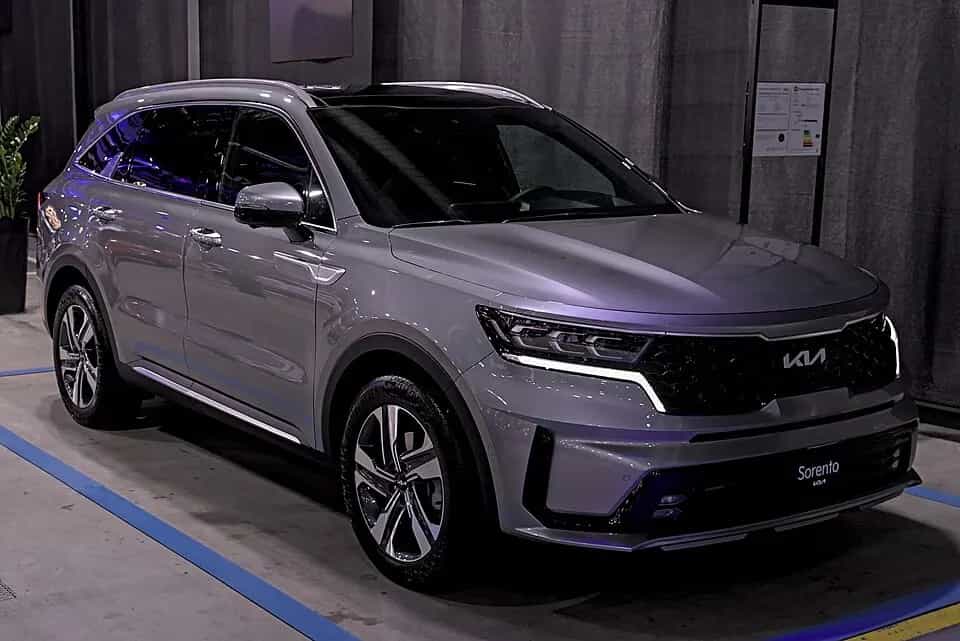
Kia Sorento

Importing a used Kia Sorento from the USA

The Kia Sorento occupies a useful middle ground in the American SUV landscape: bigger and more practical than a compact crossover, yet easier to live with than a full-size body-on-frame truck. Over four generations it has grown into a genuine three-row family vehicle with a broad choice of engines. As an independent broker for used US vehicles, USCar Trader locates well-documented Sorentos across the United States and handles the export, ocean freight, customs and German approval so a car specified for American families can be registered in Germany.

Kia sorento – used car imported from the USA
Photo: Alexander-93 · CC BY-SA 4.0 · Wikimedia Commons

Model history and generations

The first Sorento (2003-2009, BL) was a body-on-frame SUV with a V6 and real off-road hardware. The second generation (2010-2015, XM) reinvented the car as a car-based unibody crossover with an available third row, built partly at Kia's West Point, Georgia plant. The third generation (2016-2020, UM) sharpened the design and offered a strong 3.3-litre V6 alongside four-cylinder options. The current fourth generation (2021-present, MQ4) rides on the N3 platform and introduced a modern turbocharged and electrified line-up, including hybrid and plug-in hybrid variants. Production spans Korea and the Georgia plant depending on model year and market, which is central to the import-duty question.

Engines and drivetrain

US Sorentos have used a wide range of engines. Third-generation cars offered a 2.4-litre GDI four (Theta II), a 2.0-litre turbo four, and the well-regarded 3.3-litre Lambda II V6 with around 290 hp. The fourth generation replaced these with the 2.5-litre naturally aspirated Smartstream four (roughly 191 hp), a 2.5-litre turbo four (around 281 hp) paired with an eight-speed wet dual-clutch transmission, plus 1.6-litre turbo hybrid and plug-in hybrid powertrains. Front-wheel drive is standard on many trims, with all-wheel drive optional. Conventional automatics dominate the older cars, so buyers wary of dual-clutch behaviour can simply target the V6 UM generation.

Which trim makes sense

The Sorento is a five-door SUV, offered in five-, six- and seven-seat configurations depending on generation and trim. US ladders have run from LX and S through EX, SX and SX Prestige, with the rugged X-Line and X-Pro grades on the current car. Loaded American examples typically include leather, ventilated seats, a panoramic roof, a large touchscreen and a full driver-assistance suite, equipment that adds real value on an imported car.

Supply on the US market

Sorento supply is plentiful nationwide because it sold as a mainstream family SUV. Realistic import candidates cluster in the 2016-2021 range, covering both the proven V6 UM cars and the early fourth-generation models. Inspect northern-state examples for corrosion and check service records closely on GDI four-cylinder cars. Because volumes are high, you can hold out for a clean, single-owner car with a full history rather than compromise.

Who benefits from importing

A used Sorento suits a family that needs three-row flexibility without full-size bulk, or a buyer seeking a specific US configuration such as a V6 SX or a well-optioned hybrid. It is a sensible import for anyone who values a long factory-warranty heritage, generous equipment and a manageable footprint in European traffic.

Technical data

ItemDetail (typical US-spec)
Body style5-door mid-size SUV
Seating5, 6 or 7
Engine (UM V6)3.3 L Lambda II V6, approx. 290 hp
Engine (UM four)2.4 L GDI or 2.0 L turbo
Engine (MQ4 base)2.5 L Smartstream, approx. 191 hp
Engine (MQ4 turbo)2.5 L T-GDI, approx. 281 hp
Electrified1.6 L turbo hybrid / plug-in hybrid (MQ4)
Transmission6/8-speed auto; 8-speed wet DCT on 2.5T
DriveFWD standard, AWD optional
Length (MQ4)approx. 4,810 mm
Kerb weightapprox. 1,700-1,950 kg
Towing (US rating)up to approx. 3,500 lb
Fuel tankapprox. 67 L
FuelPetrol / hybrid

Known weak points and maintenance

The 3.3-litre Lambda V6 has an excellent durability record and is the reliability pick among older Sorentos. The four-cylinder Theta II GDI engines are the ones to scrutinise: these families were subject to widely publicised recalls and warranty extensions relating to connecting-rod bearing wear and, in worst cases, engine failure or fire risk, addressed through a Knock Sensor Detection System (KSDS) update. Always confirm any outstanding campaigns have been performed. On the current 2.5T, early eight-speed wet dual-clutch units drew some complaints about low-speed hesitation. Elsewhere, watch for catalytic-converter theft history, occasional infotainment glitches and age-related suspension bushings. A clean history and completed recalls matter more here than on many rivals.

US and EU spec compared

US cars run mph speedometers, US-beam headlights and no factory rear fog lamp, all routine TUEV conversion points. Infotainment may default to US navigation maps and radio bands; software region and map updates are handled during preparation. Equipment levels often exceed comparable European trims, which is part of the appeal.

The import process in detail

Choose the specific car; run a VIN and origin check to confirm the build plant (Korea or West Point, Georgia); pay securely through escrow; arrange inland haulage and ocean freight to a European port; clear customs on arrival; complete the German TUEV individual approval with any required modifications; then register the car locally. USCar Trader manages every step and keeps you updated throughout.

What customs clearance really costs

Key point: duty depends on the plant of build; only a VIN check secures the 0% rate. Import VAT of 19% applies regardless.

Keep the two charges separate. Import duty first: the Sorento carries a neutral origin, so the rate depends on where your particular car was actually built. A US-plant car (West Point, Georgia) with provable US origin by VIN and plant code can qualify for the 0% EU import duty under Regulations (EU) 2026/1455 and 2026/1461, in force since 1 July 2026 for direct transport until 31 December 2029. A Korean-built Sorento does not qualify and is charged the standard third-country passenger-car duty. Nothing is duty-free by default; origin must be proven. Second, the 19% German import VAT (Einfuhrumsatzsteuer) is always due, on every car, regardless of origin. USCar Trader takes no margin on these and passes freight, duty and VAT through as they arise.

TUEV, modifications and registration

Typical work includes retrofitting a rear fog lamp, checking the headlight beam pattern and documenting the mph odometer for the individual approval. After TUEV sign-off the car is registered normally and receives German plates.

Check before you buy

  • Decode the VIN and confirm the build plant for the duty assessment.
  • Obtain a full Carfax or AutoCheck history report.
  • On four-cylinder cars, verify all engine recalls and KSDS updates were completed.
  • Inspect for corrosion on northern-state examples.
  • Check transmission behaviour on 2.5T dual-clutch cars.
  • Confirm a clean title, not salvage or rebuilt.
  • Review service history for regular oil changes.

Common questions

Can I import a used Kia Sorento from the USA?

Yes. USCar Trader brokers used US-market Sorentos and handles freight, customs and the German TUEV process.

Is the Sorento import duty 0%?

Only if your specific car is provably US-built (West Point, Georgia) under the current EU regulations. Korean-built cars pay the standard duty; origin is verified by VIN and plant code.

Does the 19% import VAT always apply?

Yes. The German Einfuhrumsatzsteuer of 19% applies to every import regardless of origin.

Which Sorento is the most reliable?

The 3.3-litre V6 (2016-2020 UM) has the strongest durability record and avoids the four-cylinder Theta engine concerns.

What should I check on four-cylinder cars?

Confirm that the Theta II engine recalls and the KSDS software update have been carried out.

Does the Sorento seat seven?

Many trims offer a third row for six or seven occupants; some are configured as five-seaters.

Do I need lighting changes for TUEV?

Usually a rear fog lamp retrofit and a headlight check, which are standard import items.

How long does import take?

Expect several weeks from purchase to German registration, largely set by shipping schedules.

Explore the full Kia in the Carhub, compare the related Kia Sportage and Kia Telluride, or view current Sorento listings to begin.