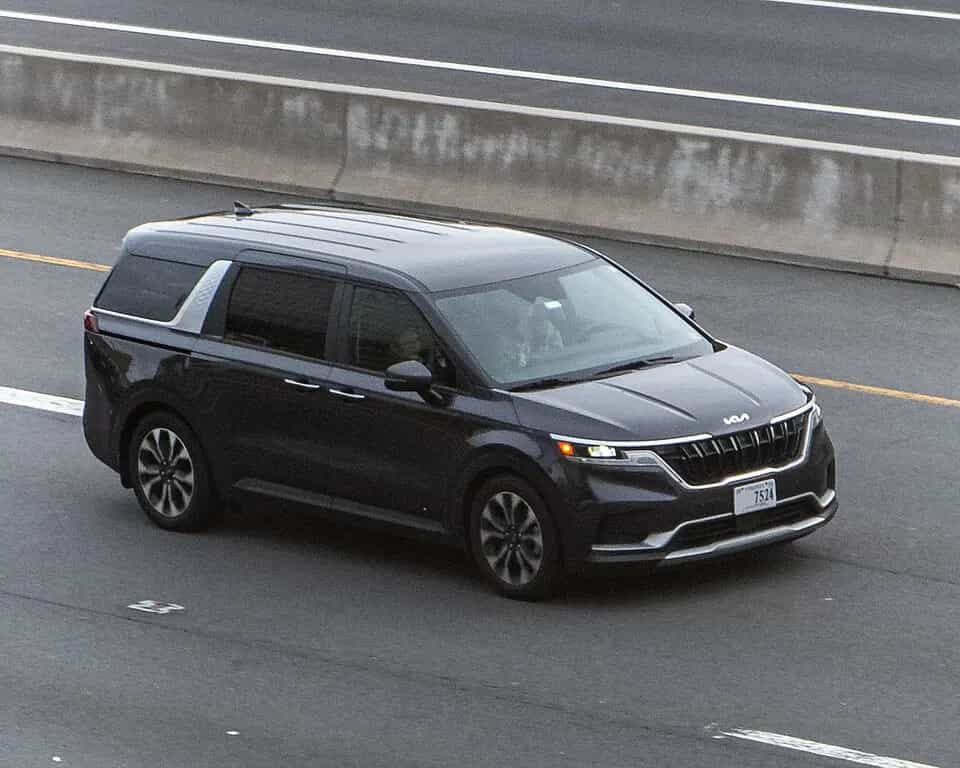
Kia Sedona

USCar Trader import service

Import this model from the USA or Canada

Choose a specific vehicle. Where data is available, its detail page shows the import cost calculation. We assess any possible duty benefit with you before purchase.

Important: A 0% EU import-duty rate may be available for a vehicle covered by Regulation (EU) 2026/1455 that has US origin and is imported directly into the EU. CETA may apply to a vehicle with preferential Canadian origin. Whether the requirements are met is assessed for the individual case. Please contact us before purchase; we review the possible duty benefit and provide non-binding support through the process. Import VAT and other costs are assessed separately.

CarHub · Kia

Kia Sedona

The Sedona is Kia's full-size minivan — the same vehicle sold as the Carnival in most of the world — and the American market is one of the best places to find a well-equipped, high-mileage-friendly family hauler.

Body style
Detail (typical 3rd-gen US Sedona): Full-size minivan (MPV)
Generation
Detail (typical 3rd-gen US Sedona): YP (2015-2021)
Assembly plant
Detail (typical 3rd-gen US Sedona): Sohari/Gwangmyeong, South Korea
Engine
Detail (typical 3rd-gen US Sedona): 3.3 L Lambda II V6
Kia Sedona

Model profile

Model history and generations

From launch to today

Two generations are relevant to importers. The second-generation Sedona (VQ, 2006-2014) introduced the more modern shape and the 3.8-litre Lambda V6. The third generation (YP, 2015-2021) is the sweet spot for most buyers: a stiffer body, a genuinely upscale cabin on higher trims, and a design that still looks current.

Powertrain and equipment

Engines, drivetrain and trims

Engines and drivetrain in detail

Third-generation US Sedonas use the 3.3-litre Lambda II V6 producing 276 hp and around 248 lb-ft, driving the front wheels. Early cars paired it with a six-speed automatic; later cars moved to a smooth eight-speed automatic.

Trim levels and variants

The Sedona is a minivan only. US trims run L, LX, EX, SX and the top SX-L (SXL). Higher grades add power-sliding doors, a power liftgate, leather, a large touchscreen, ventilated front seats and, on SXL, second-row lounge-style reclining seats with leg rests.

Vehicle selection

North American market and suitability

Used availability in the USA

Third-gen Sedonas are plentiful, generally between 50,000 and 120,000 miles, and many were family cars with consistent dealer servicing.

When importing makes sense

A used Sedona from the USA suits large families and anyone who wants maximum interior space and sliding-door access without paying for a premium European MPV.

Vehicle data

Technical data by generation and specification

Body and dimensions

Body styleDetail (typical 3rd-gen US Sedona): Full-size minivan (MPV)
SeatingDetail (typical 3rd-gen US Sedona): 7 or 8 passengers
LengthDetail (typical 3rd-gen US Sedona): approx. 5,115 mm
WheelbaseDetail (typical 3rd-gen US Sedona): 3,060 mm
Curb weightDetail (typical 3rd-gen US Sedona): approx. 2,000 kg
DoorsDetail (typical 3rd-gen US Sedona): Dual sliding side doors

Engine and drivetrain

EngineDetail (typical 3rd-gen US Sedona): 3.3 L Lambda II V6
OutputDetail (typical 3rd-gen US Sedona): 276 hp / approx. 248 lb-ft
TransmissionDetail (typical 3rd-gen US Sedona): 6-speed (early) / 8-speed (later) automatic
DriveDetail (typical 3rd-gen US Sedona): Front-wheel drive
FuelDetail (typical 3rd-gen US Sedona): Petrol
Fuel tankDetail (typical 3rd-gen US Sedona): approx. 80 L

Model and other data

GenerationDetail (typical 3rd-gen US Sedona): YP (2015-2021)
Assembly plantDetail (typical 3rd-gen US Sedona): Sohari/Gwangmyeong, South Korea
Predecessor/successorDetail (typical 3rd-gen US Sedona): VQ (2006-14) / Carnival KA4 (2022+)

Values are reproduced verbatim from the existing article table. The documents for the specific vehicle govern.

Pre-purchase review

Model-specific inspection points

Reliability and common problems

The 3.3 V6 is one of the Sedona's strengths — it is a robust, well-understood engine when serviced on schedule. Known issues to check are the power-sliding door motors and cables, which can wear or misalign; the rear tailgate struts; and occasional electrical niggles in the infotainment on early cars.

Germany and Europe

Differences, adaptation and registration

How US versions differ

US Sedonas carry amber side markers, mph-primary clusters and no rear fog lamp.

From US purchase to registration

The assessment depends on the specific vehicle and the circumstances of the transaction. Please contact USCar Trader before purchase; we review any possible duty benefit and provide non-binding support. Import VAT and other costs are considered separately.

TÜV, approval and license plates

Typical work includes fitting a rear fog lamp, adapting the lighting, and documenting the odometer.

USCar Trader services

Inspection, purchase processing and escrow

As a buyer based in Germany, you do not have to inspect the vehicle yourself in the United States or Canada. Within the agreed scope, USCar Trader can coordinate document review, a separately commissioned on-site inspection and purchase processing.

  • Vehicle profile and history: The profile can show the VIN, US title status and available history records. No data source guarantees that every earlier event was reported.
  • Optional CARFAX report: Additional reported maintenance or service entries can be included. The report is not a complete service book or proof of every interval.
  • On-site inspection / USCT AutoCheck: USCar Trader can arrange a separately booked vehicle inspection. Agreed visible and accessible areas are documented. Road or functional tests require suitable access and seller approval; the visual review is not a lift inspection or workshop diagnosis.
  • Purchase processing and escrow: After approval, USCar Trader can coordinate seller contact, negotiation, contract and the escrow and import service. Fees, payment route and responsibilities are recorded in advance.
  • Recalls: Open safety recalls can be checked by VIN through the NHTSA recall search; they do not describe overall condition.

Covered inspection points are agreed in advance. An on-site inspection records condition at the appointment and is not a guarantee.

Next step: Before commissioning, USCar Trader and the customer agree which document, history, inspection and transaction checks suit the vehicle and are included in the service. This records what was actually checked.

Import process

Import, customs, costs and delivery

Process for the specific listing

The import process for a Kia Sedona is planned around the specific listing, location, documents and commissioned service scope.

Questions and answers

Common questions about importing this model

Can I import a used Kia Sedona from the USA?

Yes. The Sedona can be imported and registered in Germany after a TUEV individual approval and customs clearance.

Is the Sedona the same as the Kia Carnival?

Yes — Sedona was the US name for the vehicle sold elsewhere as the Carnival; the third generation shares its mechanicals globally.

Does this vehicle automatically qualify for a 0% import-duty rate?

No, not automatically. A 0% EU import-duty rate may be available for a vehicle covered by Regulation (EU) 2026/1455 that has US origin and is imported directly into the EU. CETA may apply to a vehicle with preferential Canadian origin. Whether the requirements are met is assessed for the individual case. Please contact USCar Trader before purchase; we review the possible duty benefit and provide non-binding support. Import VAT and other costs are assessed separately.

How is import VAT treated when importing a Kia Sedona?

Import VAT and other taxes or costs are assessed separately under the applicable rules and the circumstances of the individual case. A blanket answer for every vehicle would not be reliable.

How reliable is the 3.3 V6?

Very durable when serviced on schedule; it is one of the main reasons the Sedona is a sensible high-mileage buy.

How many seats does it have?

Depending on trim, seven or eight, with sliding doors on both sides for easy access.

What mileage is normal?

Most available cars run 50,000 to 120,000 miles; documented servicing matters more than the odometer alone.

What needs changing for the TUEV?

Usually a rear fog lamp and minor lighting adaptations, plus odometer documentation.

More vehicles