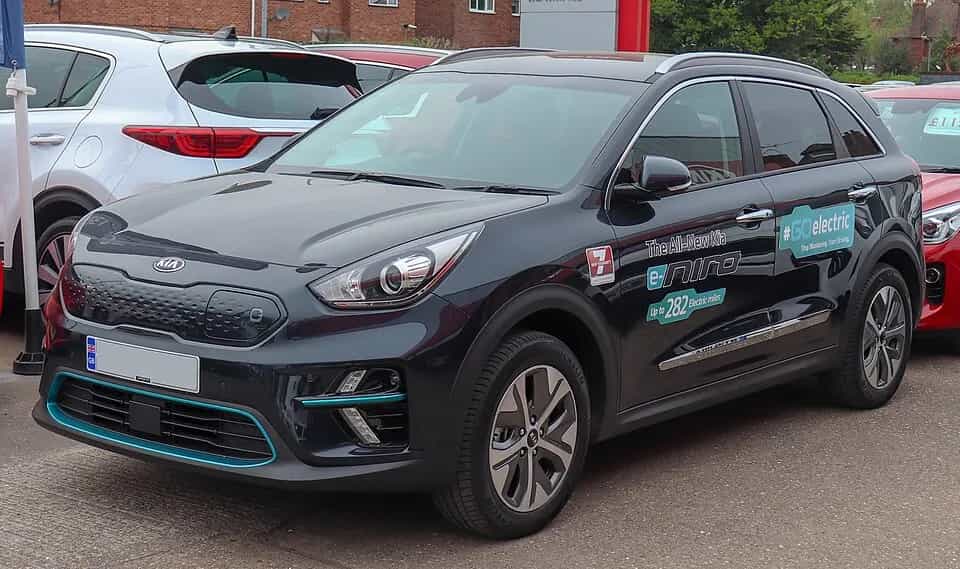
Kia Niro

Importing a used Kia Niro from the USA

The Kia Niro is a compact, efficiency-focused crossover offered in three electrified flavours — hybrid, plug-in hybrid and full battery-electric — which makes it an unusually versatile import candidate. American buyers took to the Niro as a sensible, low-running-cost alternative to a small SUV, and the US used market now holds a healthy spread of all three drivetrains. USCar Trader works purely as your import broker here; we are an independent intermediary rather than a Kia dealer, and we source each Niro to your specification. If you want to import a used Kia Niro from the USA, the key decisions are the powertrain, the generation, and confirming the build origin, since the Niro is a Korean-built car and that shapes the customs picture.

Kia niro – used car imported from the USA
Photo: Vauxford · CC BY-SA 4.0 · Wikimedia Commons

From launch to today

The first-generation Niro (chassis code DE) launched for 2017 and ran through 2022. It was sold from the start as a dedicated eco crossover on Kia's shared hybrid platform, offered as a conventional hybrid (HEV), a plug-in hybrid (PHEV) added shortly after, and a battery-electric version marketed as the Niro EV (badged e-Niro in some markets). The second generation (SG2), on sale from 2023, brought sharper styling with its distinctive contrasting C-pillar, a more modern cabin and improved efficiency across all three variants. Both generations keep the same clever three-in-one drivetrain strategy, so buyers can match the car to how they actually drive.

Engines and drivetrain in detail

The hybrid and plug-in hybrid pair a 1.6-litre GDI Atkinson-cycle four-cylinder with an electric motor, driving the front wheels through a six-speed dual-clutch transmission (DCT) rather than the CVT most rivals use — a setup that gives the Niro a more conventional, connected feel. Combined output is roughly 139–146 hp depending on variant and year. The plug-in hybrid carries a larger battery for a useful electric-only range before the petrol engine assists. The Niro EV drops the engine entirely for a single front motor and a battery of around 39 kWh (first-gen short-range) or 64 kWh (first-gen long-range), with the second generation using a battery near 64.8 kWh. All versions are front-wheel drive; there is no all-wheel-drive option.

Trim levels and variants

The Niro is a five-door crossover hatchback only. US trims broadly followed an LX / EX / EX Premium / Touring structure on the first generation, with the second generation moving to LX / EX / SX / SX Touring-style grades. Higher trims add features such as a sunroof, heated and ventilated seats, a larger touchscreen with wireless smartphone integration on newer cars, a Harman Kardon sound system, and driver-assistance items including adaptive cruise, lane-keeping and blind-spot monitoring. The PHEV and EV generally sit toward the upper end of the equipment ladder.

Used availability in the USA

Supply is steady rather than enormous, and it skews toward the hybrid, which was the volume seller. Plug-in hybrids and EVs are available but rarer, so a specific variant may take a little patience to source. Typical US cars are family-owned commuter vehicles with moderate mileage; sun-belt examples avoid road-salt corrosion and are worth prioritising, and for the EV a documented battery-health history is valuable. We do not quote European prices — condition, battery state on electrified cars, and service history determine value more than the odometer alone.

When importing makes sense

The Niro suits a buyer who wants low running costs, everyday practicality and the ability to choose exactly how electrified they go. Someone after a specific configuration that is scarce here — a particular EV battery size, a well-equipped PHEV, or simply a colour and trim combination Kia never widely offered in Germany — is the natural import candidate. If you need towing capacity or serious off-road ability, look elsewhere; the Niro is about efficiency and easy urban and highway use.

Facts and figures

ItemDetail (US-market, variant-dependent)
Body style5-door compact crossover
Generations1st (DE, 2017–2022), 2nd (SG2, 2023+)
LayoutFront-wheel drive
Hybrid / PHEV engine1.6 L GDI Atkinson I4 + electric motor
Hybrid system outputapprox. 139–146 hp combined
Transmission (HEV/PHEV)6-speed dual-clutch (DCT)
EV motorSingle front motor
EV battery (1st gen)~39 kWh or ~64 kWh
EV battery (2nd gen)~64.8 kWh
FuelRegular unleaded (HEV/PHEV) / electricity (EV)
Lengthapprox. 4,375–4,420 mm
Wheelbaseapprox. 2,700–2,720 mm
Kerb weightapprox. 1,470–1,760 kg
Seating5

Reliability and common problems

Kia Niro reliability is one of the model's strong points, helped by the mechanically simple hybrid layout, but there are Kia Niro common problems worth checking. The dual-clutch transmission can feel hesitant at low speed and, on hard-worked cars, the clutch pack is the main wear item, so a smooth test drive matters. The 12V auxiliary battery can drain if the car sits unused, occasionally triggering warning messages. Some owners report minor infotainment glitches and the usual electrified-car sensitivity to software updates. On the EV, verify the high-voltage battery's state of health and confirm charging works on both AC and DC. The 1.6 GDI engine itself is durable when serviced on schedule; carbon build-up is the typical long-term direct-injection consideration.

How US versions differ

US Niros use red rear turn signals (or amber, year-dependent) rather than the separate amber indicators required in Germany and lack a rear fog lamp. Instruments read in mph, headlights follow the US beam pattern, and infotainment carries US maps and radio bands. On the EV and PHEV, the charging port follows the North American standard — J1772 for AC and, on first-generation cars, CCS1 for DC fast charging — which is not directly compatible with European CCS2, so charging-interface conversion or adapters are an important practical point to plan for. None of this blocks registration but each item forms part of the approval and usability picture.

From US purchase to registration

The order of events is: select the car and agree terms; verify the VIN and build origin; place funds in escrow for security; book roll-on/roll-off or container ocean freight from a US port; clear EU customs on arrival with duty and import VAT; complete TÜV individual approval (Einzelabnahme) with the required modifications; and register locally. For the EV, plan the charging-interface question early. USCar Trader coordinates each stage as your broker.

Costs, duty and taxes at a glance

Bottom line: what matters is the factory shown by the VIN – proven US origin unlocks 0% duty. The 19% import VAT always applies.

The Niro is treated here as a neutral-origin model, and in practice it is built in Korea rather than the United States. That means the 0% US-origin preference under Regulations (EU) 2026/1455 and 2026/1461 will generally not apply, because that rate requires provable US build and direct US transport. The applicable EU import duty must be confirmed from the VIN and plant code; a Korean-built Niro is assessed at the rate applicable to its actual origin, which is not the US preferential rate. Separately and in every case, the 19% German import VAT (Einfuhrumsatzsteuer) is charged on the customs value. We never promise duty-free import and add no margin to these state charges.

TÜV, approval and license plates

Typical approval work includes fitting a rear fog lamp, converting the rear turn signals to amber, adjusting or replacing the headlights for the European beam, and verifying the speedometer in km/h. US cars rarely come with a COC, so a full expert assessment (Vollgutachten) is the normal route. For the EV, the charging port and, where needed, the on-board charger compatibility are practical items to resolve so the car can be charged conveniently in Europe.

Pre-purchase checklist

Before committing, confirm: the VIN and build origin; a Carfax or AutoCheck report for accidents, title brands and mileage consistency; the underbody for salt corrosion on northern cars; a documented service history including hybrid-system checks; on the EV, a battery state-of-health readout; the title status (clean vs. salvage/rebuilt); and that all charging modes function. A local pre-purchase inspection, and a battery diagnostic for electrified variants, is money well spent.

Import FAQ

Can I import and register a Kia Niro in Germany?

Yes. All three variants — hybrid, plug-in hybrid and EV — can be imported and registered after individual approval and the standard modifications.

Will my Niro qualify for 0% EU import duty?

Generally no, because the Niro is Korean-built and the 0% preference requires provable US origin. The duty follows the car's actual origin, confirmed by VIN.

Does the 19% import VAT still apply?

Yes. The 19% German import VAT applies to every import regardless of origin and is separate from any customs duty.

Can I charge an imported Niro EV in Europe?

US EVs use J1772/CCS1 connectors, which differ from European CCS2. Adapters or a charging-interface solution are needed; plan this before import.

Is the dual-clutch transmission reliable?

The DCT is generally durable but can feel hesitant at low speed; check for smooth engagement on the test drive.

Which variant is easiest to find in the USA?

The conventional hybrid is the most common. PHEV and EV versions are available but rarer and may take longer to source.

How long does the import take?

Plan for roughly two to three months from purchase to German plates, driven mainly by shipping and the TÜV appointment.

What should I check on a used Niro EV?

The high-voltage battery's state of health, DC and AC charging function, and a clean service and accident history.

To begin, browse the Kia in the Carhub, compare related models such as the Soul, the Sportage and the Hyundai Kona, or view the current Niro listings.