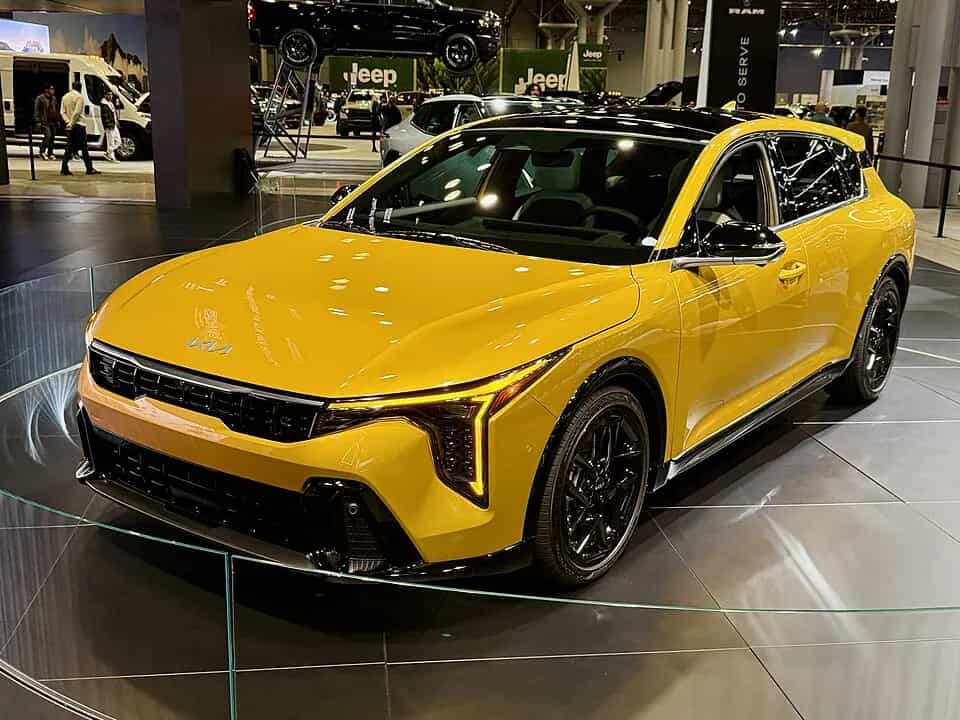
Kia K4

Importing a used Kia K4 from the USA

The Kia K4 is the compact sedan that took over from the long-running Forte for the 2025 model year, and it arrived on the US market as a genuinely fresh design rather than a facelift. For German and EU buyers looking to import a used Kia K4 from the USA, the appeal is straightforward: a modern, well-equipped four-door with sharp styling and a turbo option that Kia never brought to Europe in this exact form. Because the K4 is still young, the American used market consists almost entirely of low-mileage, late-model cars — which changes how you should approach sourcing, inspection and the customs paperwork. As an independent broker for used US vehicles, USCar Trader handles the K4 as a straightforward North American car, but the origin question deserves attention from the very first VIN check.

Kia k4 – used car imported from the USA
Photo: Oleg Yunakov · CC BY-SA 4.0 · Wikimedia Commons

Production years and key changes

Kia revealed the K4 in 2024 and launched it as a 2025 model, positioning it above the outgoing Forte in size, refinement and cabin technology. It is the first Kia compact sedan to wear the global "K" naming logic (slotting below the K5 mid-size sedan) in the United States. Unlike the Forte, the K4 is offered as both a four-door sedan and, later in the cycle, a five-door hatchback body. The car rides on an updated version of the Hyundai-Kia K3 compact architecture, with a longer wheelbase than the Forte and a noticeably more aggressive front and rear treatment featuring the brand's vertical "Star Map" lighting signature.

What is under the hood

Two petrol engines carry the US K4 range. The volume choice is a naturally aspirated 2.0-litre inline-four (the Nu/Smartstream family) making roughly 147 hp, paired with Kia's continuously variable transmission (marketed as IVT). Front-wheel drive is standard across the board. The performance option, fitted to the GT-Line Turbo, is a 1.6-litre turbocharged direct-injection four producing around 190 hp and 265 Nm, mated to an eight-speed torque-converter automatic rather than the CVT. That turbo-plus-8AT combination is the drivetrain most European enthusiasts will actively seek out, since it delivers meaningfully stronger real-world response than the base 2.0. There is no all-wheel-drive K4, and no diesel — every US car you import will be a front-driven petrol.

Trims and body styles

US K4 trims run from LX and LXS through EX up to the sportier GT-Line and range-topping GT-Line Turbo. Lower trims focus on value: a large central touchscreen, wireless Apple CarPlay and Android Auto, and a full suite of Kia's driver-assist features. Move up and you gain a panoramic display setup, upgraded upholstery, a Harman Kardon audio option, heated and ventilated front seats, and the turbo powertrain. The sedan is the mainstream body; the hatchback (badged K4 Hatchback in the US) adds practicality for buyers who want more load flexibility.

What the US market offers

Because the K4 only reached dealers recently, the American used pool is dominated by 2025 cars with low mileage, many of them former rental or lease returns. That is good news for condition — most examples have their factory warranty history intact and minimal wear — but it also means you rarely find heavily discounted, high-mileage bargains yet. Expect clean interiors, current software and full electronic equipment. As always, the used market rewards patience: a well-optioned GT-Line Turbo in the right colour appears less often than a base LX, so it pays to define your target trim before searching.

Who this import is for

A used Kia K4 import suits a buyer who wants a nearly-new compact sedan with a longer, better-equipped body than European compacts, and who values the turbo variant that isn't sold here in identical trim. It is a sensible choice for someone comfortable with a young US car — modern safety tech, familiar mechanicals, easy parts supply through the global Hyundai-Kia network — rather than a classic or a collector piece. If you specifically want the GT-Line Turbo character or the American infotainment layout, importing is the most direct route.

Technical data and figures

AttributeDetail (US-market Kia K4)
Body styles4-door sedan; 5-door hatchback
Base engine2.0 L naturally aspirated inline-4 (Smartstream)
Base outputapprox. 147 hp
Turbo engine1.6 L turbocharged direct-injection inline-4
Turbo outputapprox. 190 hp / 265 Nm
Transmission (base)CVT (IVT)
Transmission (turbo)8-speed automatic
DrivetrainFront-wheel drive
FuelPetrol
TrimsLX, LXS, EX, GT-Line, GT-Line Turbo
AssemblyMexico (Kia North America plant)
GenerationFirst generation (from 2025 MY)
PredecessorKia Forte
Seating5

Reliability: trouble spots to check

The K4 is too new for a long field record, but its mechanical building blocks are well understood. The 2.0 Smartstream engine and the 1.6 turbo are established Hyundai-Kia units with known behaviour. On the turbo, watch for the usual direct-injection housekeeping: keep to the correct oil grade and change intervals, and be aware that GDI engines can develop intake-valve deposits over long lives. The IVT/CVT in base cars is smooth but should be serviced with the correct fluid — avoid cars that have been chip-tuned or run on the wrong oil. Early-production software niggles (infotainment reboots, occasional driver-assist over-sensitivity) are typically resolved by a dealer update, so confirm the car has the latest system version. For a car this young, most "Kia K4 common problems" you will find online are software or trim rattles rather than serious mechanical faults.

US vs. Europe differences

US K4s run amber rear turn signals or combined red units depending on trim, imperial instrument markings (mph primary), and a daytime-running-light and headlight configuration set to US federal standards. There is no rear fog lamp, which is mandatory in Germany, and the auto-dimming and speed-display units may need adaptation. American infotainment ships with US navigation map data and US radio bands. None of this is unusual for a modern import, but each item is something the TÜV inspector will expect to be addressed.

How the import works

The process runs in a clear sequence: select the specific car and trim; run a VIN and origin check to confirm the assembly plant; place funds in escrow for security; arrange ocean freight (container or RoRo) from a US port to Bremerhaven or Rotterdam; complete EU customs clearance on arrival; pass a TÜV individual approval (Einzelabnahme, §21 StVZO) with any required modifications; and finally register the car in Germany. USCar Trader coordinates these stages as an intermediary; you remain the importer of record.

Import duty, VAT and fees

In short: the 0% duty rate applies only with documented US origin (VIN/plant) – German import VAT of 19% is always due.

Two charges must always be considered separately. First, the EU import duty on the customs value: the K4 is assembled in Mexico, so it does not automatically qualify as a US-origin good. Whether the reduced 0% rate under Regulations (EU) 2026/1455 and 2026/1461 applies depends entirely on provable origin from the VIN and plant code, and that relief covers US-built cars on direct transport between 1 July 2026 and 31 December 2029. If the K4's origin is not established as US, the standard passenger-car duty applies. Second, the 19% German import VAT (Einfuhrumsatzsteuer) is charged on the customs value plus duty and always applies — there is no exemption. We never quote a margin or a guaranteed "duty-free" figure; the rate follows the documented origin.

From modifications to registration

Typical work for a US K4 includes retrofitting a rear fog lamp, adapting the lighting to ECE requirements, converting the speedometer display to km/h where needed, and confirming the odometer reads in kilometres or is correctly documented. The individual approval verifies emissions and safety compliance; once passed, you receive the paperwork to register the car and obtain German plates.

Pre-buy inspection points

  • Decode the VIN and confirm the assembly plant for a correct customs origin call.
  • Pull a full Carfax or AutoCheck history — accidents, title brand, service records.
  • Verify the title is clean (not salvage, rebuilt or flood).
  • Confirm the powertrain: base 2.0/CVT versus 1.6 turbo/8AT.
  • Check the software version and that all driver-assist systems function.
  • Inspect for undisclosed rental wear and mismatched panels.
  • Confirm mileage against service and inspection records.

What buyers ask most

Can I import a used Kia K4 from the USA to Germany?

Yes. As a used vehicle it can be imported and registered after customs clearance and a TÜV individual approval; USCar Trader acts as your independent broker.

Does the Kia K4 qualify for 0% EU import duty?

Only if the VIN proves US assembly. The K4 is built in Mexico, so 0% is not automatic — the rate depends on documented origin.

Do I always pay German import VAT?

Yes. The 19% Einfuhrumsatzsteuer applies to every import regardless of origin and is calculated on customs value plus any duty.

Which K4 engine should I look for?

The 1.6 turbo with the eight-speed automatic offers the strongest performance; the 2.0 with the CVT is the efficient volume choice.

Is the K4 available with all-wheel drive?

No. All US K4 models are front-wheel drive.

What modifications does the TÜV require?

Usually a rear fog lamp, ECE-compliant lighting and a km/h speed display; specifics are confirmed at inspection.

How is the K4 different from the old Forte?

It is larger, more modern inside, and offers updated styling and technology; it replaced the Forte for 2025.

How long does importing take?

Ocean freight plus clearance and approval typically runs several weeks; exact timing depends on shipping schedules.

Ready to start? Browse Kia in the Carhub, compare related sedans such as the Kia K5, the Kia Forte and the Hyundai Elantra, or view current Kia K4 listings.