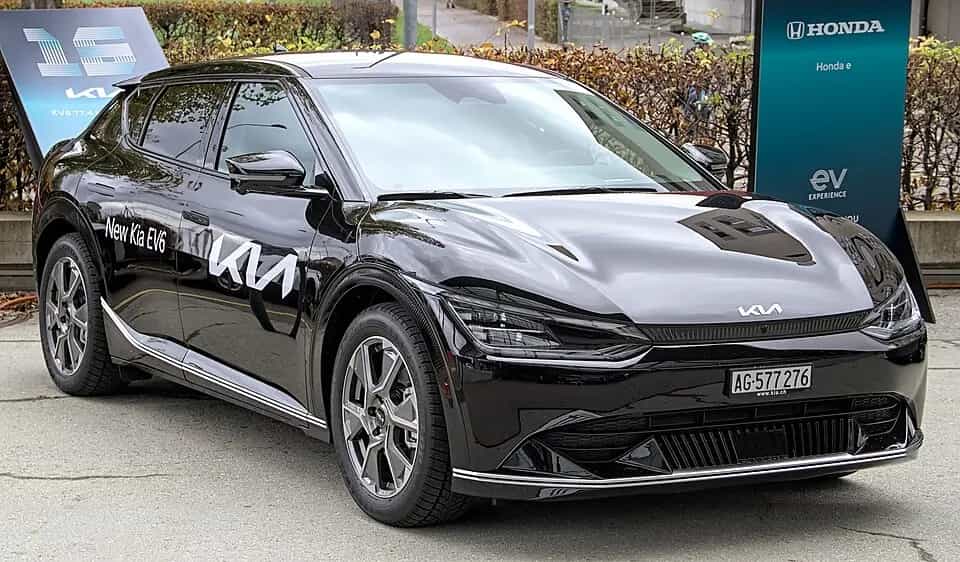
Kia EV6

Importing a used Kia EV6 from the USA

The Kia EV6 is one of the standout electric cars of its generation, and the American used market now holds a healthy supply, including the fierce EV6 GT. USCar Trader is an independent broker for used vehicles only: we hold no stock, add no margin to the car and have no manufacturer partnership. We help you find, verify and ship the EV6 you want from the USA to Germany or the EU. Here is what the car is, where its weak points sit, and how the import works in practice.

Kia ev6 – used car imported from the USA
Photo: Alexander Migl · CC BY-SA 4.0 · Wikimedia Commons

Model history and generations

The EV6 launched for the 2022 model year as Kia's first vehicle on the dedicated E-GMP electric platform, sharing its bones with the Hyundai IONIQ 5 and Genesis GV60. It is a low-slung crossover-liftback with a distinctive fastback tail. A performance flagship, the EV6 GT, arrived for 2023. Kia gave the EV6 a mid-cycle refresh for the 2025 model year with a larger battery, updated styling and interior tweaks, so US used stock spans early 2022 cars through the newer facelifted examples.

Engines and drivetrain

The EV6's headline feature is its 800-volt E-GMP architecture, which enables very fast DC charging. US cars came with a standard-range battery (around 58 kWh, early cars) and a long-range pack of about 77.4 kWh, enlarged to roughly 84 kWh with the 2025 update. Long-range rear-wheel-drive versions make around 225 hp; dual-motor all-wheel-drive versions produce about 320 hp. The EV6 GT is the extreme version, with roughly 577 hp and a 0-100 km/h time near 3.5 seconds, plus an electronic drift mode. On a 350 kW charger the EV6 can go from 10 to 80 percent in under 20 minutes under ideal conditions.

Which trim makes sense

US trims run Light, Wind, GT-Line and the standalone GT. Wind and GT-Line cars are the volume sellers, offering the long-range battery, heat pump on many builds, a dual 12.3-inch curved display, and available features such as a head-up display, ventilated seats and the vehicle-to-load power outlet. All are five-door, five-seat crossovers; there is no other body style.

Supply on the US market

Because the EV6 sold well in the States and many went on lease, used availability is good and cars are often nicely equipped. You will see plenty of 2022-2023 Wind and GT-Line long-range examples with low to moderate mileage, plus a smaller pool of GT cars. Battery health is the key variable on any used EV: look for cars with modest mileage, gentle charging habits and, ideally, remaining factory battery warranty. Southern and western cars avoid road salt.

Who benefits from importing

Import a used EV6 if you want a fast-charging, sharply styled electric crossover with genuine driving appeal, or if the ballistic EV6 GT is on your wish list. It suits buyers who value charging speed and technology over maximum interior space. If you need a three-row family EV, look at the larger EV9 instead.

Technical data

ItemDetail (long range, typical)
Body styleFive-door electric crossover-liftback
PlatformE-GMP, 800-volt
Battery (long range)approx. 77.4 kWh (approx. 84 kWh from 2025)
Output (RWD)approx. 225 hp
Output (AWD)approx. 320 hp
EV6 GTapprox. 577 hp
DriveRWD or dual-motor AWD
DC fast chargingup to ~240 kW, 10-80% under 20 min
Range (WLTP, long range RWD)up to approx. 500-528 km
Lengthapprox. 4,695 mm
Wheelbaseapprox. 2,900 mm
Boot capacityapprox. 480 L + front trunk
Seating5
Launch2022 (GT 2023, refresh 2025)
AssemblySouth Korea

Known weak points and maintenance

Kia EV6 reliability is strong overall, with the usual EV advantage of few wear parts, but there is one issue every buyer must know about. The Integrated Charging Control Unit (ICCU), shared across E-GMP cars, can fail and cause a loss of 12-volt charging, warning lights and, in some cases, the car losing drive power. Kia issued recalls and updated hardware and software, so confirm any recall work has been completed on the car you buy. Beyond that, early cars had occasional software and 12-volt battery quirks resolved by updates, and some owners note slow onboard AC charging speed. Check tyre wear on GT cars. With recalls done and healthy battery state of health, the EV6 is a dependable used EV.

US and EU spec compared

The biggest practical difference is the charging port: US EV6s use the North American ports and connectors, and while CCS1 hardware is standard on these cars, you should plan for a suitable adapter or setup for European CCS2 charging. Instrumentation is in miles, lighting lacks a standard rear fog lamp, and telematics are US-configured. These are handled during conversion and approval.

The import process in detail

Selection: we shortlist the battery, drivetrain and trim you want and review battery health. VIN and origin check: we decode the VIN to confirm the plant, which sets the customs rate. Escrow: funds stay protected until verification. Ocean freight: the EV6 ships by container or RoRo to a German port. Customs clearance: duty and VAT are declared on arrival. TUEV and individual approval: the car is inspected and documented, including charging compatibility. Registration: German plates follow once paperwork is complete.

What customs clearance really costs

Bottom line: what matters is the factory shown by the VIN – proven US origin unlocks 0% duty. The 19% import VAT always applies.

Two separate charges apply. Import duty: the 0% rate under Regulations (EU) 2026/1455 and 2026/1461 (in force from 1 July 2026 to 31 December 2029, direct transport) applies only to vehicles of provable US origin. The EV6 is built in South Korea, so a US-market car is typically not of US origin, and the standard duty rate normally applies rather than 0%. We confirm the plant from the VIN and never promise duty-free status. Import VAT: the 19% German Einfuhrumsatzsteuer is always due. Every charge is an official pass-through with no margin.

TUEV, modifications and registration

Typical work covers a rear fog lamp, ECE-compliant lighting, odometer documented in kilometres, and confirmation of European charging compatibility. The individual approval (Einzelabnahme per §21 StVZO) records the specification for registration.

Check before you buy

Match the VIN to the title and build. Order a Carfax or AutoCheck report for accident, title and odometer history. Confirm a clean, non-salvage title, especially important on EVs where flood or battery damage matters. Verify the ICCU recall and any software updates are complete. Ask for a battery state-of-health readout. Check tyre wear, particularly on GT cars. Confirm the car's charging port and plan the CCS2 solution.

Common questions

Does a US Kia EV6 qualify for 0% import duty?

Usually not, because it is built in South Korea. We check the plant from the VIN; the standard rate normally applies, and the 19% import VAT always does.

Can I charge a US EV6 in Europe?

Yes, with the right setup. The car uses CCS1 hardware, so plan an adapter or conversion for European CCS2 charging. We address this during approval.

What is the ICCU issue?

The Integrated Charging Control Unit can fail on E-GMP cars. Kia issued recalls; confirm the fix is done on your car before buying.

How is battery health checked?

We look for a state-of-health readout and favour low-mileage cars with gentle charging history and remaining warranty.

Is the EV6 GT worth importing?

For performance buyers, yes. It is exceptionally quick, but check tyres, brakes and battery health given how it may have been driven.

How long does the import take?

Usually a few weeks from purchase to registration, depending on shipping and the approval appointment.

Start here: browse Kia in the Carhub, compare the Kia EV9, the Hyundai IONIQ 5 and the Genesis GV60, or view current Kia EV6 listings.