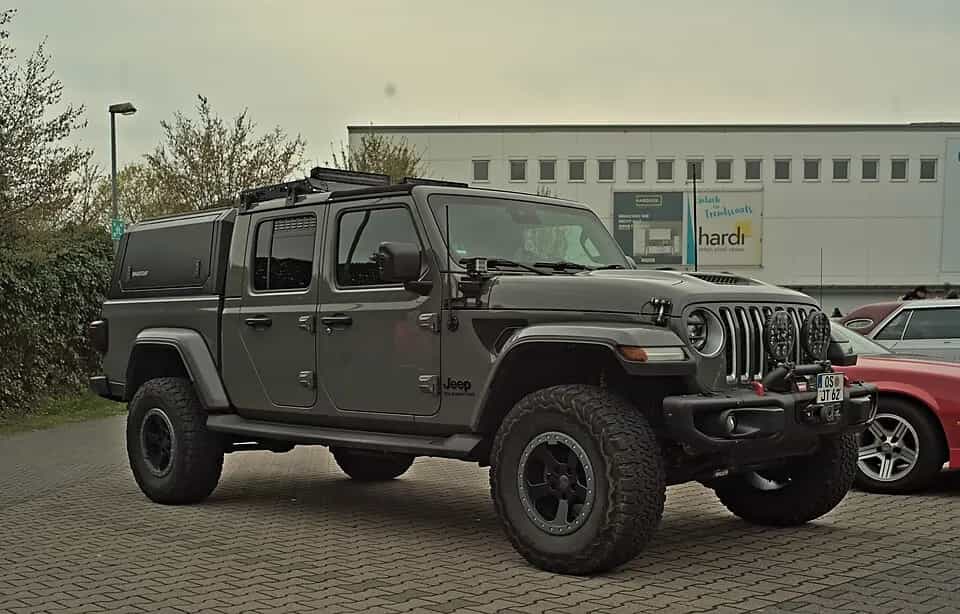
Jeep Gladiator

Importing a used Jeep Gladiator from the USA

The Gladiator is the pickup that Wrangler fans waited decades for, and it is a fundamentally American vehicle. It was built in Toledo, sold in real volume across the States and barely registered on German roads, which makes the US used market the obvious place to find one. As an independent broker, USCar Trader locates the exact Gladiator you want in the States and moves it through freight, customs and TÜV approval, without acting as a dealer or holding stock.

Jeep Gladiator – used car imported from the USA
Photo: Thomas Vogt · CC BY 2.0 · Wikimedia Commons

Model history and generations

The Gladiator (factory code JT) launched for the 2020 model year, its first year of production. It shares its front structure and doors with the JL Wrangler but rides on a longer, purpose-built ladder frame with a five-foot steel cargo bed and a solid-axle setup front and rear. A refresh arrived for the 2024 model year with a new grille, a bigger 12.3-inch Uconnect 5 screen and standard side airbags. The short-lived 3.0-litre EcoDiesel V6 was offered on US cars from 2021 to 2023 before being discontinued, making diesel Gladiators a distinct and sought-after subset.

Engines and drivetrain

The mainstay engine is the 3.6-litre Pentastar V6, producing 285 hp and 260 lb-ft, available with a six-speed manual or the eight-speed automatic. The optional 3.0-litre EcoDiesel V6 delivered 260 hp but a stout 442 lb-ft of torque, automatic only, prized for towing and low-end grunt. All Gladiators are four-wheel drive with a two-speed transfer case; Rubicon models get the Rock-Trac case with a 4:1 low range, front and rear lockers and a disconnecting sway bar, while other trims use Command-Trac.

Which trim makes sense

Every Gladiator is a four-door crew cab with the five-foot bed and the signature removable roof, doors and fold-down windscreen. US trims include Sport, Sport S, Willys, Overland, the desert-runner Mojave and the rock-crawling Rubicon. The Mojave and Rubicon are the enthusiast picks: Mojave for high-speed desert use with Fox shocks, Rubicon for technical trails.

Supply on the US market

Availability is strong, with plenty of 2020 to 2023 examples between 20,000 and 70,000 miles. Rubicon is the most common desirable trim, and the EcoDiesel is the one to snap up if you can find a clean one, since production ended in 2023. Dry southern and western states offer the cleanest, corrosion-free trucks.

Who benefits from importing

A used Gladiator from the USA is for the buyer who wants a genuine open-air pickup with Wrangler DNA, real off-road hardware and a usable bed, in a configuration that was scarce or expensive in Europe. It particularly suits anyone chasing a diesel Rubicon or a Mojave that German dealers rarely stocked.

Technical data

GenerationJT (2020–present), 2024 refresh
Body style4-door crew-cab pickup, 5-ft bed
Petrol engine3.6 L Pentastar V6, 285 hp / 260 lb-ft
Diesel engine3.0 L EcoDiesel V6, 260 hp / 442 lb-ft (2021–2023)
Transmission6-speed manual or 8-speed automatic
DrivetrainPart-time 4WD, low range
AxlesSolid front and rear
Max towingup to 7,650 lb (approx. 3,470 kg)
Max payloadup to approx. 1,700 lb (approx. 771 kg)
Fuel typePetrol / Diesel
Lengthapprox. 5,591 mm
Curb weightapprox. 2,200–2,400 kg
Ground clearance (Rubicon)approx. 287 mm
Seating5

Known weak points and maintenance

The Gladiator's mechanicals are largely shared with the well-understood Wrangler, so parts and knowledge are plentiful. The 3.6 Pentastar is a durable engine, though early examples of the wider family had rocker-arm and cooling niggles worth checking. The EcoDiesel is strong but, like most modern diesels, has an emissions system (EGR, DPF) that demands proper long-run use and can be costly if neglected. The classic Wrangler-derived complaint is the death wobble, a steering shimmy at speed traceable to worn front-end components; check the track bar, ball joints and steering damper. Also inspect the removable roof and door seals for leaks and the tailgate and bed for corrosion on northern trucks.

US and EU spec compared

US Gladiators use mph instruments, US lighting without a standard rear fog lamp, and combined red rear turn signals on many trims. Bed tie-downs, tyre-pressure systems and infotainment follow US norms. Diesel emissions equipment is US-spec. All of this is adaptable for German type approval.

The import process in detail

We start by agreeing on the exact truck and confirming its build. The VIN and origin check establishes plant and history; secure escrow then protects payment. The Gladiator is booked onto ocean freight to a European port such as Bremerhaven, cleared through German customs, prepared and taken through TÜV single-vehicle approval (Einzelabnahme) where required, and finally registered for German plates.

What customs clearance really costs

Remember: no origin proof, no 0% duty – and 19% German import VAT is due on every import.

The Gladiator is built in Toledo, Ohio, so a VIN confirming US assembly can qualify for the 0% EU import duty under Regulations (EU) 2026/1455 and 2026/1461, which apply to vehicles of provable US origin shipped directly, in force from 1 July 2026 to 31 December 2029. This is never automatic; it depends on documented origin from the VIN and plant data. Note that pickups can fall under a different tariff heading than passenger cars, so origin documentation matters even more here. Separately, the 19% German import VAT (Einfuhrumsatzsteuer) always applies. USCar Trader adds no margin to these government charges.

TÜV, modifications and registration

Typical approval work includes adapting the headlights to the European beam pattern, fitting or activating a rear fog lamp, and switching the speedometer to km/h. Larger off-road tyres may need documentation, and the odometer is recorded and converted to kilometres. After the inspection passes, the truck is registered at the Zulassungsstelle. Note that as a pickup it may be classed and taxed differently from a passenger car in Germany.

Check before you buy

1. Decode the VIN to confirm Toledo build, engine and trim. 2. Pull a Carfax or AutoCheck history for accidents, title and odometer. 3. Inspect the front end for death-wobble wear (track bar, ball joints, damper). 4. On EcoDiesel trucks, verify the emissions system and service history. 5. Check the roof, door seals and bed for leaks and corrosion. 6. Confirm the title is clean, not salvage or rebuilt. 7. Prefer dry southern or western state trucks.

Common questions

Is the Jeep Gladiator reliable enough to import?

Yes, its Wrangler-based mechanicals are well understood; just check the front end and, on diesels, the emissions system.

Petrol or EcoDiesel Gladiator?

The 3.6 petrol is simpler and cheaper to run; the EcoDiesel offers far more torque for towing but needs regular long-distance use.

Can a used Gladiator qualify for 0% EU import duty?

It can, because it is US-built, but only with VIN-proven US origin and compliant transport, and pickups may sit under a different tariff heading, so documentation is key.

Does the 19% import VAT always apply?

Yes, the German Einfuhrumsatzsteuer of 19% is charged on every import in addition to any duty.

What is death wobble?

A steering shimmy at speed caused by worn front suspension parts; it is repairable and worth checking before purchase.

How much can a Gladiator tow?

Up to about 7,650 lb (roughly 3,470 kg) when properly equipped.

Is the Gladiator taxed as a truck in Germany?

As a pickup it can be classified and taxed differently from a car; we clarify the registration category during import.

How long does the import take?

Typically several weeks after purchase, mostly driven by shipping and customs.

Get started: browse Jeep in the Carhub, compare related models such as the Wrangler Unlimited, the Wrangler 4-Door or the Grand Wagoneer L, and see current Gladiator listings.