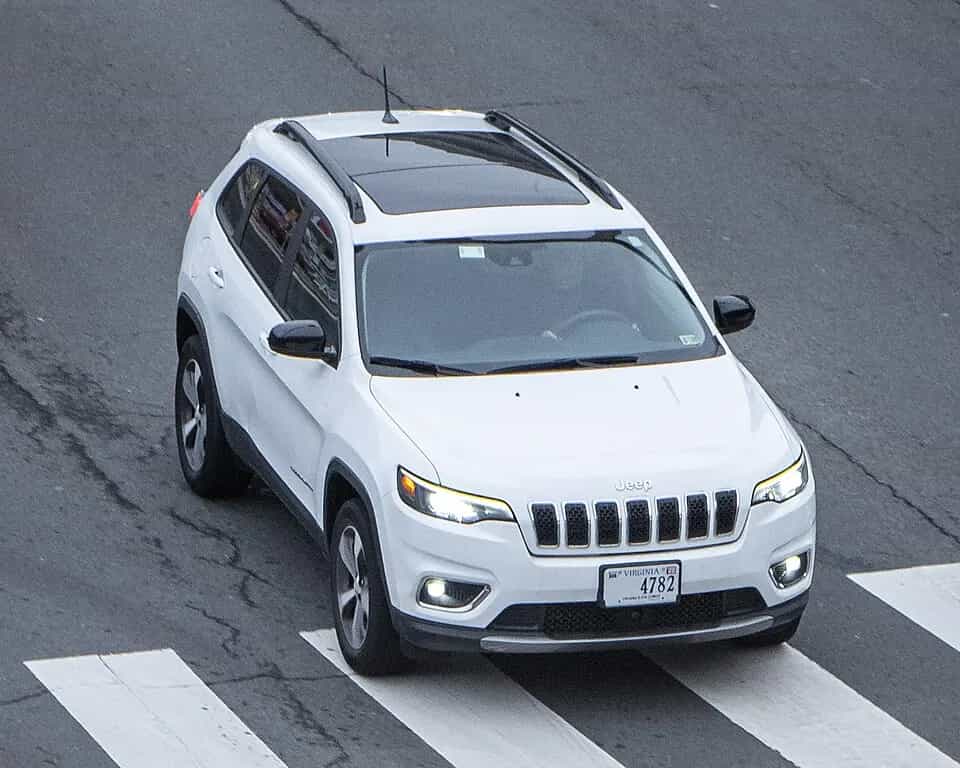
Jeep Cherokee

Importing a used Jeep Cherokee from the USA

The Cherokee name carries weight, and the American market is where these SUVs were built, sold and used in the greatest numbers. For a European buyer, that means the deepest pool of used cars, the widest trim spread and, crucially, the go-anywhere Trailhawk versions that were thin on the ground in Germany. USCar Trader works as an independent broker, finding the specific Cherokee you want in the States and steering it through freight, customs and approval without ever being the seller or dealer.

Jeep Cherokee – used car imported from the USA
Photo: OWS Photography · CC BY 4.0 · Wikimedia Commons

From launch to today

Most Cherokees now moving on the US used market are the KL generation, sold from the 2014 model year until production ended in 2023. That car replaced the boxy Liberty and introduced a car-like unibody platform shared with the Fiat-Chrysler Compact US Wide architecture. A notable facelift for 2019 replaced the polarising split-headlamp front end with a more conventional face and added the 2.0-litre turbo engine. Enthusiasts still hunt the earlier XJ Cherokee (1984–2001), a genuine off-road classic, though those are older imports needing more scrutiny. This page focuses mainly on the modern KL.

Engines and drivetrain in detail

The KL Cherokee offered three main engines in the US: a 2.4-litre Tigershark four-cylinder with around 180 hp, the 3.2-litre Pentastar V6 with roughly 271 hp, and from 2019 a 2.0-litre turbocharged four (270 hp, 295 lb-ft). All KL Cherokees used the nine-speed ZF-based 948TE automatic. Four-wheel drive came in three flavours: Active Drive I, the more capable Active Drive II with a low range, and Active Drive Lock on the Trailhawk, which adds a locking rear differential. Front-wheel-drive versions exist too, so confirm the drivetrain before buying.

Trim levels and variants

The Cherokee is a five-seat, five-door mid-size SUV. US trims ran through Latitude, Latitude Plus, Limited, Trailhawk and the top Overland and High Altitude. The Trailhawk is the one to know: raised ride height, skid plates, red tow hooks, all-terrain tyres and the locking diff make it a proper trail SUV rather than a soft crossover.

Used availability in the USA

Cherokees are everywhere in the States, so availability is excellent across model years and trims. Expect plenty of 2017 to 2022 cars with 30,000 to 80,000 miles. Southern and western states supply the cleanest, rust-free examples. V6 and turbo Trailhawks are the sweet spot for buyers who want capability, while Limited and Overland cars appeal to those after leather and equipment.

When importing makes sense

A used Cherokee from the USA suits a buyer who wants a mid-size Jeep with real trail ability and specific options that were rare or costly in Europe. It is also a sensible route if you want a well-kept, low-mileage V6 or Trailhawk that simply is not on offer at your local dealer.

Facts and figures

GenerationKL (2014–2023), facelift 2019
Body style5-door mid-size SUV, 5 seats
Base engine2.4 L Tigershark I4, approx. 180 hp
V6 engine3.2 L Pentastar, approx. 271 hp
Turbo engine2.0 L turbo I4, 270 hp / 295 lb-ft
Transmission9-speed automatic (948TE)
DrivetrainFWD or 4WD (Active Drive I/II/Lock)
Low rangeActive Drive II / Trailhawk only
Towing (V6, equipped)up to 4,500 lb (approx. 2,041 kg)
Fuel typePetrol
Lengthapprox. 4,624 mm
Curb weightapprox. 1,700–1,950 kg
Fuel tankapprox. 60 L
Seating5
Ground clearance (Trailhawk)approx. 221 mm

Reliability and common problems

The Cherokee's reputation is mixed, and the biggest talking point is the nine-speed automatic. Early KL cars (2014–2016) were notorious for rough, hesitant shifts and needed several software updates; later cars are much improved but still not the smoothest. The 2.4-litre Tigershark engine can consume oil and has been linked to occasional failures, so check consumption and history carefully. The 3.2 Pentastar V6 is the more durable choice. Watch for power transfer unit (PTU) leaks on four-wheel-drive cars, electrical gremlins in the Uconnect system, and the usual checks on cooling and the rear axle disconnect mechanism. A well-maintained V6 Cherokee is a solid used buy; a neglected four-cylinder is riskier.

How US versions differ

US Cherokees run miles-per-hour clusters, US lighting with combined red rear indicators on some trims, and no standard rear fog lamp. Infotainment is set up for the US market. Some safety-assist calibrations and tyre-pressure systems follow US norms. All of this is adaptable for German registration.

From US purchase to registration

First we agree on the exact car and confirm its build and specification. The VIN and origin check establishes the plant and history, then secure escrow protects the payment. The Cherokee is loaded onto ocean freight to a European port such as Bremerhaven or Zeebrugge, cleared through German customs, prepared and taken through TÜV single-vehicle approval where required, and finally registered for road use.

Costs, duty and taxes at a glance

Bottom line: what matters is the factory shown by the VIN – proven US origin unlocks 0% duty. The 19% import VAT always applies.

The KL Cherokee was built in Belvidere, Illinois, so a VIN confirming US assembly can open the door to 0% EU import duty under Regulations (EU) 2026/1455 and 2026/1461, applicable to vehicles of provable US origin shipped directly, effective 1 July 2026 through 31 December 2029. This is not guaranteed and depends entirely on documented origin from the VIN and plant data. On top of any duty, the 19% German import VAT (Einfuhrumsatzsteuer) always applies. USCar Trader passes these government charges through without any markup.

TÜV, approval and license plates

Approval typically means adapting the headlights to the European beam pattern, adding or activating a rear fog lamp, and ensuring the speedometer reads in km/h. The odometer is documented and converted to kilometres where needed. Once the technical inspection passes, the car is registered at the Zulassungsstelle.

Pre-purchase checklist

1. Decode the VIN to confirm US build, engine and drivetrain. 2. Pull a Carfax or AutoCheck report for accidents, title status and odometer. 3. On four-cylinder cars, check for oil consumption and any engine history. 4. Test the nine-speed transmission for harsh or hesitant shifts. 5. Inspect the PTU and rear axle for leaks on 4WD models. 6. Confirm the title is clean, not salvage or flood. 7. Prefer southern-state cars to avoid road-salt corrosion.

Import FAQ

Which Jeep Cherokee engine is most reliable?

The 3.2-litre Pentastar V6 has the strongest reputation; the 2.4 four-cylinder is the one to scrutinise for oil use.

Is the nine-speed automatic a problem?

Early KL cars shifted poorly, but software updates improved things; test drive and check that updates were applied.

Can a used Cherokee qualify for 0% EU import duty?

Often yes, since it is US-built, but only with VIN-proven US origin and compliant direct transport. It is never promised in advance.

Does the 19% import VAT always apply?

Yes, the German Einfuhrumsatzsteuer of 19% is due on every import in addition to any duty.

What is a Cherokee Trailhawk?

The most off-road-capable trim, with raised suspension, a low range, skid plates and a locking rear differential.

How much can a Cherokee tow?

A properly equipped V6 can tow up to about 4,500 lb (roughly 2,041 kg).

Are older XJ Cherokees worth importing?

Yes for enthusiasts, but they need much closer inspection for rust and age-related wear.

How long does the import take?

Usually several weeks after purchase, mostly determined by shipping and customs.

Start here: explore Jeep in the Carhub, look at related models like the Compass, the Liberty or the Grand Cherokee L, and view current Cherokee listings.