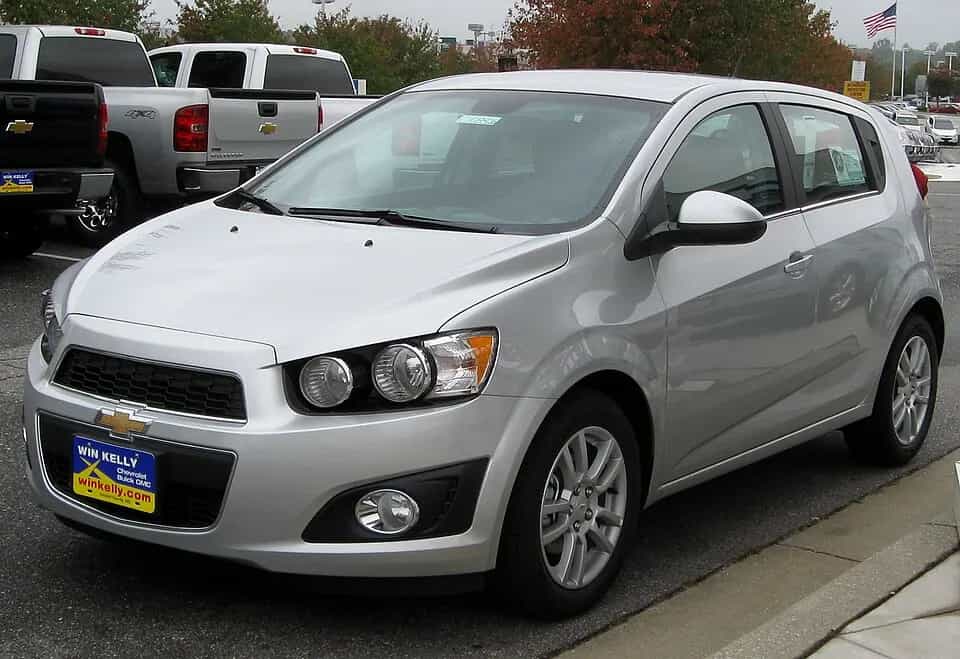
Chevrolet Sonic

Importing a used Chevrolet Sonic from the USA

The Chevrolet Sonic is a genuinely interesting small-car import because it is one of the few subcompacts actually built in the United States. Assembled at GM's Orion Assembly plant in Michigan, the Sonic replaced the Aveo and gave American buyers a peppy, well-handling little car with an available turbo engine. For a German buyer that US build matters — it directly affects the customs origin question. USCar Trader works as an independent broker for used US vehicles, handling sourcing, shipping and German approval. Here is what the Sonic offers and what importing one involves.

Chevrolet Sonic – used car imported from the USA
Photo: IFCAR · Public domain · Wikimedia Commons

Model history and generations

The Sonic (T300 platform) was sold in the US from the 2012 model year through 2020 as both a four-door sedan and a five-door hatchback. It arrived as GM's serious attempt at a fun, European-flavoured subcompact, with a firmer chassis and sharper steering than the Aveo it replaced. A styling refresh for 2017 updated the front end and interior tech, adding a modern touchscreen with Apple CarPlay and Android Auto. GM discontinued the Sonic after 2020 as the US market shifted toward crossovers, so the used pool is a defined 2012–2020 window.

Engines and drivetrain

Two Ecotec four-cylinders powered the Sonic, both front-wheel drive. The naturally aspirated 1.8-litre made around 138 hp and was the value engine. The more entertaining choice is the 1.4-litre turbocharged Ecotec, also rated near 138 hp but with a much fatter torque curve that suits the car's light weight. Transmissions were a five- or six-speed manual and a six-speed automatic. The turbo-plus-manual combination is the enthusiast's pick and gives the Sonic a genuinely willing character that belies its budget positioning.

Which trim makes sense

US trims ran LS, LT, LTZ, Premier and the sporty RS. The RS added a body kit, sport suspension tuning, unique wheels and interior trim, and paired well with the turbo engine to create a warm-hatch feel. Sedans emphasise value and boot space; hatchbacks add versatility and are the more sought-after body. Equipment climbs from basic cloth-and-steel-wheel LS cars to leatherette, heated seats, a sunroof and the MyLink touchscreen on higher trims.

Supply on the US market

Sonics are plentiful and inexpensive in the American market, having served as economy and first-owner cars. Mileage varies widely, with many examples between 60,000 and 150,000 km. Because the Sonic ceased production in 2020, even the newest cars are now several years old, so condition and maintenance history are everything. Southern-state cars avoid the rust that afflicts salt-belt examples and are the safer starting point for an import.

Who benefits from importing

The Sonic suits a buyer who wants an affordable, fun-to-drive small car that is genuinely uncommon on German roads — and who appreciates the customs advantage of a US-built vehicle. The turbo RS hatchback in particular rewards enthusiasts on a budget. Because the Sonic is assembled in Michigan, it is one of the stronger candidates in this class for a 0% duty claim, subject to VIN verification.

Technical data

AttributeTypical figure (Chevrolet Sonic)
Body styleSubcompact sedan or 5-door hatchback
Length (sedan)approx. 4,399 mm
Widthapprox. 1,735 mm
Wheelbaseapprox. 2,525 mm
Kerb weight1,150–1,270 kg
Engine (base)1.8 L Ecotec I4, ~138 hp
Engine (turbo)1.4 L turbo Ecotec I4, ~138 hp
Transmission5-/6-speed manual or 6-speed automatic
DrivetrainFront-wheel drive
FuelPetrol
Seats5
Model years (US)2012–2020
AssemblyOrion Assembly, Michigan, USA
Fuel tankapprox. 46 L

Known weak points and maintenance

The Sonic is generally durable, but the 1.4-litre turbo has known weak points worth checking. Coolant leaks are common — the plastic thermostat housing, water pump and intake components can seep or fail over time — and a low-coolant warning should be investigated seriously. The PCV system integrated into the valve cover can fail and cause rough running or oil consumption. The timing chain and tensioner deserve attention on higher-mileage turbo cars. On manuals, inspect the clutch. The naturally aspirated 1.8 is simpler and has fewer cooling-related headaches. As with any budget car, Chevrolet Sonic common problems are almost always tied to deferred maintenance, so a documented service history is the best safeguard.

US and EU spec compared

US Sonics run amber side-marker lights, mph-dominant instruments and headlamp aim set for right-hand traffic. Standard-equipment bundling differs from European small cars, and the MyLink system uses US mapping. Because the Ecotec engine family was used globally, service knowledge and many parts are available in Germany, though some Sonic-specific trim pieces may need to be sourced from the US.

The import process in detail

The route is straightforward: select and inspect the car; run a VIN and origin check to confirm the Michigan build; pay through escrow rather than a direct wire; ship by container or RoRo to a German port such as Bremerhaven; clear customs on arrival; obtain the TÜV individual approval (§21 StVZO) with the necessary modifications; and register locally. USCar Trader coordinates each stage so the car keeps moving.

What customs clearance really costs

Remember: no origin proof, no 0% duty – and 19% German import VAT is due on every import.

Two separate charges apply and must not be merged. The EU import duty under Regulations (EU) 2026/1455 and 2026/1461 can be 0% for vehicles of proven US origin imported by direct transport between 1 July 2026 and 31 December 2029. The Sonic carries a "neutral" origin flag, but because it is built at Orion Assembly in Michigan, a US-origin claim is realistic — a VIN and plant match can support the 0% rate, though it is never guaranteed without documentary proof. Separately and always, the 19% German import VAT (Einfuhrumsatzsteuer) is charged on the customs value plus duty and freight. USCar Trader works on a transparent fee and adds no margin to the vehicle.

TÜV, modifications and registration

Expect to convert the lighting to European specification, retrofit a rear fog lamp (required in Germany, absent on US cars), and document the odometer if it reads in miles. Without a European CoC, the TÜV inspector assesses the car by VIN and technical inspection. Registration follows at your Zulassungsstelle once the approval is issued.

Check before you buy

  • Decode the VIN and confirm the Michigan build for the origin claim.
  • Order a Carfax or AutoCheck report for accident, title and mileage history.
  • On turbo cars, check for coolant leaks and a healthy cooling system.
  • Confirm the PCV/valve cover is not causing rough idle or oil use.
  • Inspect the timing chain area for rattle on higher-mileage cars.
  • Favour rust-free southern-state examples with a clean title.
  • Review the service history for regular oil and coolant changes.

Common questions

Is the Chevrolet Sonic reliable?

Broadly yes, especially the 1.8 engine. The 1.4 turbo needs attention to its cooling system and PCV, so buy on a documented service record.

Can a US Chevrolet Sonic qualify for 0% import duty?

It has a strong chance, because the Sonic is built in Michigan. A VIN and plant match can support a US-origin 0% claim, but it requires documentary proof and is never automatic.

Does the 19% import VAT still apply?

Yes, always. The German Einfuhrumsatzsteuer of 19% is due on every import regardless of origin, on customs value plus duty and freight.

Which Sonic should I look for?

The 1.4 turbo, ideally in RS hatchback form with a manual, is the fun choice; the 1.8 is the simpler, lower-maintenance option.

Are parts available in Germany?

Mechanical Ecotec parts are widely available; some Sonic-specific trim may need to be sourced from the US.

Do I need a rear fog lamp?

Yes. US Sonics lack one and it must be retrofitted for German approval.

Is USCar Trader a Chevrolet dealer?

No. USCar Trader is an independent broker for used US vehicles, with no manufacturer partnership and no margin on the car.

Why import a Sonic rather than buy locally?

It is rare in Germany, often cheaper to source in the US, and its Michigan build gives it a realistic path to the 0% duty rate with proper documentation.

To begin, browse Chevrolet in the Carhub, compare related models such as the Chevrolet Cruze, the Chevrolet Spark and the Chevrolet Malibu, or view current Sonic listings.