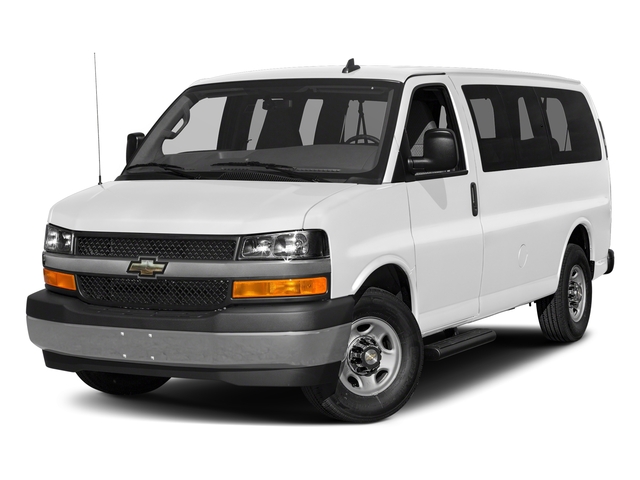
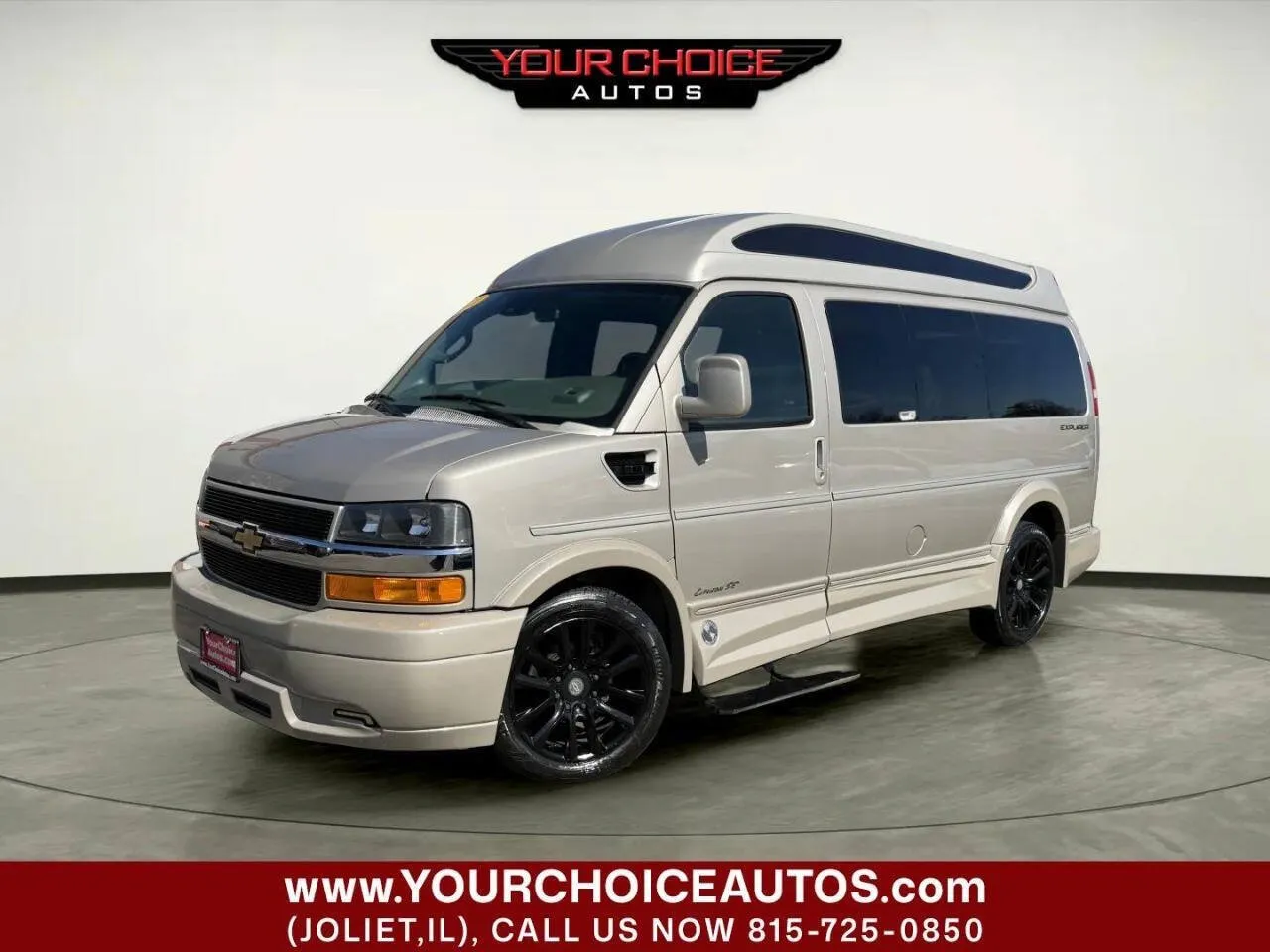
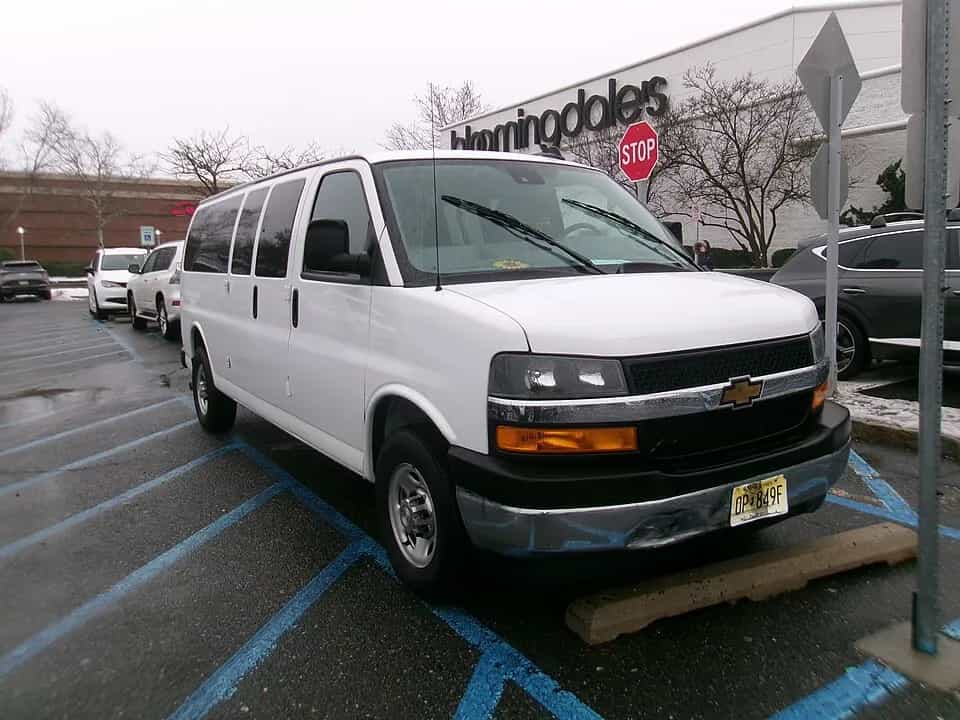
Chevrolet Express Passenger
Importing a used Chevrolet Express Passenger from the USA
The Chevrolet Express Passenger is a full-size American van built for one job: moving a lot of people or a lot of gear in a body-on-frame package that shrugs off hard use. It has almost no European equivalent, which is exactly why shuttle operators, large families, church groups and camper-conversion builders import them. Because the Express is assembled in the United States, its customs position can be more favourable than an imported car built elsewhere, provided origin is documented from the VIN. USCar Trader arranges the whole import as an independent broker, sourcing the specific van, checking it and managing freight and clearance without a dealer margin.

Model history and generations
The current GMT610 Express arrived for 1996 and, remarkably, is still in production with only evolutionary updates. That longevity is a buying advantage: parts, mechanicals and service knowledge are deeply established, and a used Express from almost any recent year is fundamentally the same rugged design. Major changes over the years were mainly under the hood and in electronics rather than structure. The Express Passenger is the window-van, multi-row version sold as 2500 (up to 12 seats) and 3500 (up to 15 seats), the extended twin of the GMC Savana Passenger.
Engines and drivetrain
Powertrains evolved across the run. Recent vans use the 4.3-litre EcoTec3 V6 (around 276 hp) as the base engine and the 6.6-litre L8T V8 gasoline unit (roughly 401 hp) as the strong option, both paired with GM's modern six- or eight-speed automatics driving the rear wheels. Earlier examples ran 4.8, 5.3 and 6.0-litre Vortec V8s. For a period Chevrolet also offered a 2.8-litre Duramax turbo-diesel four (about 181 hp) prized for economy. All are longitudinal, rear-drive layouts; there is no all-wheel-drive on the passenger van in the modern era.
Which trim makes sense
The Express Passenger keeps things simple: LS and LT-style trim levels, a choice of 2500 or 3500 GVWR, and seating configurations from around eight up to fifteen occupants. Equipment ranges from basic fleet-shuttle spec to more comfortable versions with cloth or vinyl seating, rear air conditioning, power accessories and modern infotainment on later years. The single long wheelbase and tall roofline give a huge, flat cargo floor when seats are removed, which is why so many become camper and overland conversions.
Supply on the US market
Supply is strong because the Express is a fleet staple: hotel shuttles, airport transfers, church vans and rental fleets cycle through them constantly. That means many high-mileage but mechanically sound examples, plus lower-mileage former private or specialist vans. Condition varies with duty cycle, so a shuttle van with detailed service history can be a smarter buy than a neglected low-mileage one. The drivetrains are famously long-lived, so history and maintenance matter more than the odometer reading alone.
Who benefits from importing
An imported Express Passenger suits a shuttle or transfer business wanting a rugged people-mover, a large family, an events or crew operation, or a builder seeking a proven base for a camper. Buyers should plan for its size and appetite for fuel, and understand the European rules around vehicles with nine or more seats, which we cover below. If you need genuine full-size van capacity that European makers rarely match, the Express delivers it.
Technical data
| Item | Detail (US-market Express Passenger) |
|---|---|
| Body style | Full-size passenger van |
| Platform | GMT610 (since 1996) |
| Base engine | 4.3L EcoTec3 V6 |
| Base output | approx. 276 hp |
| Top gasoline engine | 6.6L L8T V8 |
| Top output | approx. 401 hp |
| Diesel (earlier) | 2.8L Duramax turbodiesel I4, approx. 181 hp |
| Transmission | 6- or 8-speed automatic |
| Drive | Rear-wheel drive |
| Ratings | 2500 and 3500 (GVWR) |
| Seating | up to 12 (2500) / up to 15 (3500) |
| Wheelbase | approx. 3,429 mm |
| Fuel | Petrol (or diesel on some years) |
| Assembly | Wentzville, Missouri, USA |
Known weak points and maintenance
The Express earns its reputation through simple, proven mechanicals: the small-block-derived V8s and the 4.3 V6 are durable when serviced, and the transmissions are heavy-duty. That does not make it faultless. Fuel economy is poor by any European measure. High-seat 15-passenger 3500 vans need respect: a fully loaded, tall RWD van handles very differently from a car, and tyre condition and loading matter for stability. On older examples check for rust in the rockers, wheel arches and frame, brake wear from heavy shuttle duty, and worn suspension bushings. Duramax diesel vans add DEF and emissions hardware to inspect. Interiors are hard-wearing but plain, and electronics on well-worn fleet vans can show their miles.
US and EU spec compared
Beyond US-federal lighting (red rear indicators, no rear fog lamp, US headlight aim) and mph instrumentation, the Express raises a classification point unique to large vans. In the EU, a vehicle designed to carry more than eight passengers plus the driver is category M2/M3, not an ordinary car (M1), which affects approval and, for commercial passenger transport, potentially periodic testing and tachograph rules. Many importers therefore re-seat a 15-passenger van to eight-plus-driver to keep it in the M1 car category. Discuss the intended use early, because it shapes the whole approval path.
The import process in detail
Select the specific van and agree terms; verify the VIN, decode the US build plant and pull the full history; place funds in escrow; arrange US inland transport and ocean freight (a van this size is usually shipped RoRo or in a dedicated container) to a European port; clear German customs with the correct code and origin evidence; present for TÜV inspection and individual approval under §21 StVZO; then register. USCar Trader runs the chain end to end.
What customs clearance really costs
Key point: duty depends on the plant of build; only a VIN check secures the 0% rate. Import VAT of 19% applies regardless.
The Express is assembled in Wentzville, Missouri, so US origin is usually provable from the VIN and documentation. Where that origin is established, the 0% preferential EU import duty for US-origin vehicles under Regulations (EU) 2026/1455 and 2026/1461 can apply for direct transport in the current window — this is never automatic and depends on the paperwork, so we never promise a duty-free result in advance. Without accepted origin proof, the standard third-country rate applies. Separately, the 19% German import VAT (Einfuhrumsatzsteuer) always applies to the customs value. Our brokerage fee is transparent and we add no margin to the van.
TUEV, modifications and registration
Typical conformity work includes fitting a rear fog lamp, sorting the headlights for European beam patterns, confirming km/h instrumentation and a kilometre odometer, documenting emissions and noise, and, where relevant, adjusting the seating configuration for the intended vehicle category. Side markers and lighting details are checked before the inspector releases the paperwork.
Check before you buy
Before committing: 1) VIN matches title, plates and dash, and decodes as US-built; 2) clean Carfax or AutoCheck with no salvage, rebuilt or flood title; 3) frame, rockers and arches free of structural rust; 4) service history for the drivetrain, brakes and (if diesel) emissions system; 5) transmission and engine run cleanly under load; 6) seating and interior match the configuration you need; 7) tyres and suspension sound, especially on a 3500.
Common questions
Can a 15-passenger Express be registered in Germany?
Yes, but a vehicle for more than eight passengers plus driver is an M2/M3 category vehicle with a different approval path. Many owners re-seat to eight-plus-driver to keep it in the M1 car category.
Does the Express qualify for 0% import duty?
It is US-built, so US origin is usually provable and the 0% preferential rate can apply with accepted documentation and direct transport. It is never guaranteed in advance.
Is the 19% import VAT always charged?
Yes. German import VAT of 19% always applies and is separate from any customs duty.
Petrol or diesel Express?
Petrol V8 and V6 vans are simpler and more common; the 2.8 Duramax diesel offers better economy but adds emissions hardware to maintain.
How is such a large van shipped?
Typically by RoRo or dedicated container from a US port to a European port such as Bremerhaven, then inland to inspection.
Is it expensive to run?
Fuel consumption is high by European standards. It is chosen for capacity and durability rather than efficiency.
Are parts available in Europe?
The Express uses widely shared GM mechanicals, so servicing is straightforward; body and trim parts may need ordering from the US.
Can USCar Trader find a specific seating layout?
Yes. As a broker we search for the exact 2500 or 3500 van, engine and seating configuration you require.
See more with Chevrolet in the Carhub, compare the mechanically identical GMC Savana Passenger, the Ford Transit Passenger Van and the cargo Chevrolet Express Cargo, or browse current Express Passenger listings.